
Paper: GS Paper III | Subject: Environment, Ecology and Disaster Management | Topic: Global Agreements and Efforts (B12) | Issue: Kigali Amendment and HFC Phase-down
Context
The Kigali Amendment (2016) to the Montreal Protocol completes 10 years in October 2026. It aims to reduce hydrofluorocarbons (HFCs), powerful greenhouse gases used in refrigeration and air-conditioning. For India, this transition is particularly challenging because rising temperatures, urbanisation and increasing incomes are driving demand for cooling.
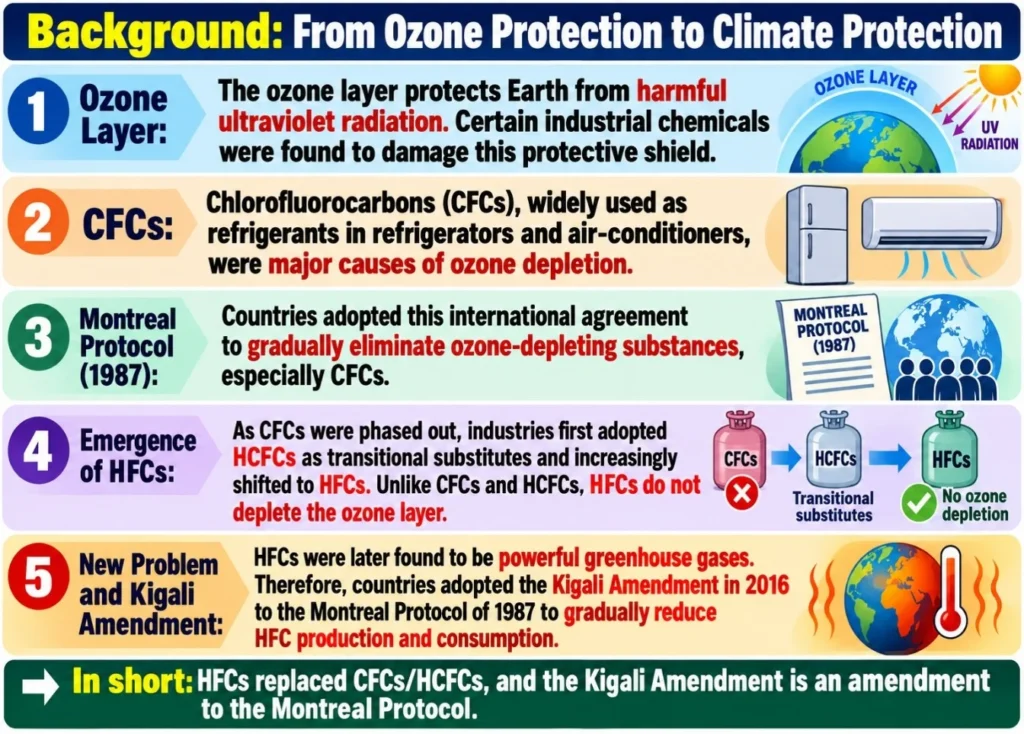
Explanation
What Does the Kigali Amendment Provide?
Adopted in Kigali, Rwanda, in October 2016, it entered into force in January 2019.
- Objective: Gradually reduce the production and consumption of HFCs worldwide.
- Climate Benefit: Full implementation could prevent approximately 0.3°C–0.5°C of global warming by 2100.
- Differentiated Responsibilities: Developing countries receive longer transition periods.
- Financial Support: The Montreal Protocol’s Multilateral Fund supports eligible developing countries through technology transfer and financial assistance.
4. India’s Commitments
India ratified the amendment in 2021 and follows a phased HFC reduction schedule.
- 2028: Freeze HFC production and consumption at the agreed baseline.
- 2032: Reduce by 10%.
- 2037: Reduce by 20%.
- 2042: Reduce by 30%.
- 2047: Achieve an 85% reduction.
5. Why Is India’s Cooling Transition Challenging?
Cooling contributes to global warming through two mechanisms.
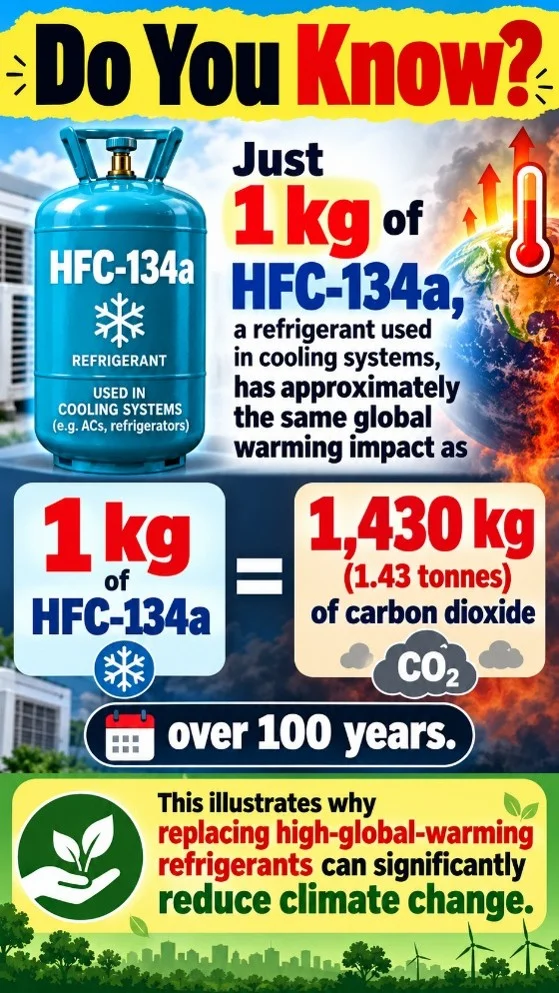
- Direct Emissions: HFC refrigerants escaping from cooling equipment trap heat in the atmosphere.
- Indirect Emissions: Air-conditioners consume electricity, often generated using fossil fuels, releasing carbon dioxide.
India’s cooling demand is projected to more than double by 2035. Replacing existing refrigerants requires technological investment, equipment redesign and workforce training.
6. Way Forward
- Promote refrigerants with low global warming potential.
- Improve energy efficiency of air-conditioners and refrigerators.
- Encourage passive cooling and climate-responsive building designs.
- Strengthen technology transfer, financial assistance and technician training.
Conclusion
India must balance affordable cooling with climate protection, ensuring that rising cooling demand does not translate into proportionately higher greenhouse gas emissions.
Source: (The Indian Express)
La Excellence IAS Academy, the best IAS coaching in Hyderabad, known for delivering quality content and conceptual clarity for UPSC 2026 preparation.
FOLLOW US ON:
◉ YouTube: https://www.youtube.com/@CivilsPrepTeam
◉ Facebook: https://www.facebook.com/LaExcellenceIAS
◉ Instagram: https://www.instagram.com/laexcellenceiasacademy/
GET IN TOUCH:
Contact us at info@laex.in, https://laex.in/contact-us/
or Call us @ +91 9052 29 2929, +91 9052 99 2929, +91 9154 24 2140
OUR BRANCHES:
Head Office: H No: 1-10-225A, Beside AEVA Fertility Center, Ashok Nagar Extension, VV Giri Nagar, Ashok Nagar, Hyderabad, 500020
Madhapur: Flat no: 301, survey no 58-60, Guttala begumpet Madhapur metro pillar: 1524, Rangareddy Hyderabad, Telangana 500081
Bangalore: Plot No: 99, 2nd floor, 80 Feet Road, Beside Poorvika Mobiles, Chandra Layout, Attiguppe, Near Vijaya Nagara, Bengaluru, 560040