
Paper: GS – II, Subject: International Relations, Topic: India and Its Neighbourhood, Issue: The New Nepal and India’s Diplomatic Balancing Act.
Context:
India and Nepal share a historically close relationship based on geography, culture, economy, religion and people-to-people ties. However, the rise of new political actors and youth-driven politics in Nepal has created a need for India to recalibrate its diplomatic approach. India must ensure that its engagement is seen as respectful partnership rather than dominance, especially in the backdrop of increasing Chinese influence.
Key Takeaways:
Background:
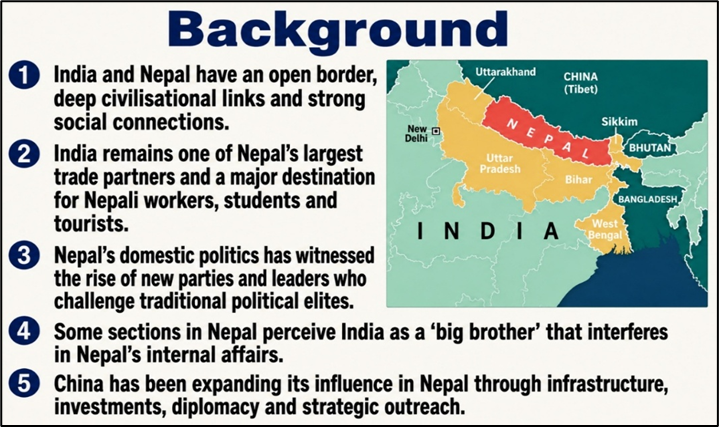
Explanation:
- Changing political landscape: Nepal’s politics is no longer controlled only by traditional parties and old political networks. New leaders and parties represent younger voters, urban aspirations and anti-establishment sentiment. India must engage this new political class seriously.
- Limits of old diplomacy: India has traditionally dealt with long-term political actors in Nepal. However, relying only on established elites may reduce India’s ability to understand new political moods, public opinion and youth nationalism.
- Perception challenge: A major diplomatic problem is that India’s role is sometimes viewed in Nepal as overbearing. Past disputes related to constitutional issues, border concerns and economic disruptions have strengthened this perception among some sections.
- Need for respectful engagement: India should project itself not as a dominant power but as an equal and reliable partner. Smaller neighbours value sovereignty, dignity and non-interference, especially when dealing with a much larger country.
- Development diplomacy: India’s approach should focus on visible benefits such as digital connectivity, UPI linkages, road and rail connectivity, energy cooperation, hydropower, trade facilitation, tourism and employment.
- Strategic importance: Nepal is vital for India’s Himalayan security, border management, river systems, cultural diplomacy and regional stability. Instability or anti-India sentiment in Nepal directly affects India’s security and neighbourhood policy.
- China factor: China can exploit anti-India sentiment by projecting itself as an alternative development and strategic partner. Therefore, India must avoid arrogance and prevent diplomatic space from being ceded to Beijing.
Conclusion:
India–Nepal relations are old and deeply rooted, but they cannot be taken for granted. A changing Nepal requires India to combine strategic sensitivity, economic cooperation and respectful diplomacy. India’s goal should be to make Nepal view India as a trusted partner, not as a bullying neighbour.
Source: (The Indian Express, The Hindu, Live Mint)
La Excellence IAS Academy, the best IAS coaching in Hyderabad, known for delivering quality content and conceptual clarity for UPSC 2026 preparation.
FOLLOW US ON:
◉ YouTube : https://www.youtube.com/@CivilsPrepTeam
◉ Facebook: https://www.facebook.com/LaExcellenceIAS
◉ Instagram: https://www.instagram.com/laexcellenceiasacademy/
GET IN TOUCH:
Contact us at info@laex.in, https://laex.in/contact-us/
or Call us @ +91 9052 29 2929, +91 9052 99 2929, +91 9154 24 2140
OUR BRANCHES:
Head Office: H No: 1-10-225A, Beside AEVA Fertility Center, Ashok Nagar Extension, VV Giri Nagar, Ashok Nagar, Hyderabad, 500020
Madhapur: Flat no: 301, survey no 58-60, Guttala begumpet Madhapur metro pillar: 1524, Rangareddy Hyderabad, Telangana 500081
Bangalore: Plot No: 99, 2nd floor, 80 Feet Road, Beside Poorvika Mobiles, Chandra Layout, Attiguppe, Near Vijaya Nagara, Bengaluru, 560040
India Nepal Relations in a Changing Political Landscape