
Paper: GS – II, Subject: Governance, Topic: Government Policies, Issue: Global Crises Need Strong Institutions, Not Just Citizen Sacrifice.
Context:
Prime Minister Narendra Modi recently appealed to citizens to embrace restraint, self-reliance and responsible consumption amid global uncertainty caused by conflict, energy insecurity and supply-chain disruptions. While such appeals encourage civic discipline, long-term national resilience also requires strong institutions, transparent governance and structural preparedness.
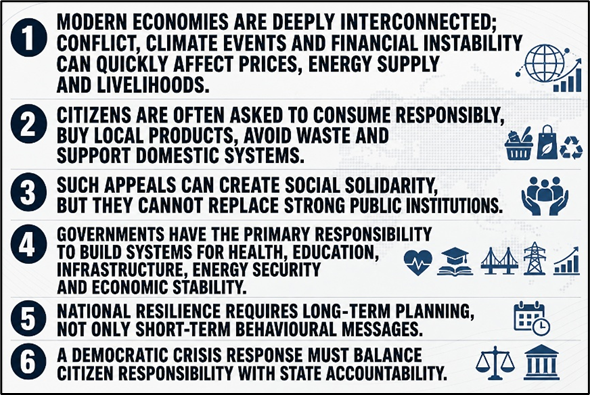
Key Takeaways:
Explanation:
The Problem:
- Shifting burden to citizens: During crises, responsibility is often placed mainly on individuals to sacrifice, adjust and remain resilient.
- Weak institutional preparedness: Health systems, emergency response, public transport, urban planning and social protection remain inadequate in many areas.
- Consumption nationalism is limited: Buying local or reducing consumption can help, but it cannot solve deeper problems like unemployment, inflation or supply-chain dependence.
- Rising inequality: Poor and informal workers cannot bear crisis costs in the same way as wealthier citizens because they lack savings and social security.
- Climate and urban stress: Heat, pollution, water scarcity, poor housing and shrinking green spaces need structural solutions, not only lifestyle advice.
- Low public trust: When governments do not communicate transparently, citizens become uncertain and misinformation increases.
- Weak democratic dialogue: Criticism is sometimes treated as anti-national, reducing public debate and course correction.
Way Forward:
- Strengthen public systems: Invest more in health care, disease surveillance, nutrition, education, emergency preparedness and social security.
- Build economic resilience: Reduce excessive dependence on external supply chains through domestic manufacturing, innovation and skill development.
- Promote inclusive protection: Support vulnerable groups through employment security, affordable essentials and targeted welfare during crises.
- Improve urban governance: Invest in public transport, green spaces, water bodies, heat action plans and climate-resilient infrastructure.
- Support research and innovation: Strengthen Indian universities, scientific institutions and technology ecosystems to build true self-reliance.
- Ensure transparent governance: Governments must communicate honestly, share data, allow expert advice and build public trust.
- Protect democratic debate: Open criticism, media freedom and institutional independence help democracies correct mistakes during crises.
Conclusion:
Citizen discipline and responsible consumption are important, but they cannot become substitutes for governance. A strong nation is built when citizens cooperate and governments deliver transparent, capable and accountable institutions. Real resilience comes from shared responsibility, with the state carrying the larger duty of structural preparedness.
Source: (The Hindu)
La Excellence IAS Academy, the best IAS coaching in Hyderabad, known for delivering quality content and conceptual clarity for UPSC 2026 preparation.
FOLLOW US ON:
◉ YouTube : https://www.youtube.com/@CivilsPrepTeam
◉ Facebook: https://www.facebook.com/LaExcellenceIAS
◉ Instagram: https://www.instagram.com/laexcellenceiasacademy/
GET IN TOUCH:
Contact us at info@laex.in, https://laex.in/contact-us/
or Call us @ +91 9052 29 2929, +91 9052 99 2929, +91 9154 24 2140
OUR BRANCHES:
Head Office: H No: 1-10-225A, Beside AEVA Fertility Center, Ashok Nagar Extension, VV Giri Nagar, Ashok Nagar, Hyderabad, 500020
Madhapur: Flat no: 301, survey no 58-60, Guttala begumpet Madhapur metro pillar: 1524, Rangareddy Hyderabad, Telangana 500081
Bangalore: Plot No: 99, 2nd floor, 80 Feet Road, Beside Poorvika Mobiles, Chandra Layout, Attiguppe, Near Vijaya Nagara, Bengaluru, 560040
Institutional Resilience Beyond Citizen Sacrifice