
Paper: GS – II, Subject: International Relations, Topic: International institutions, agencies, Issue: Challenges to the Enforcement of International Law.
Context:
International law is meant to regulate the conduct of states and protect global peace, sovereignty, human rights and common resources. However, recent conflicts and crises show that powerful states often violate international norms with limited consequences, weakening trust in the rules-based international order.
Background:
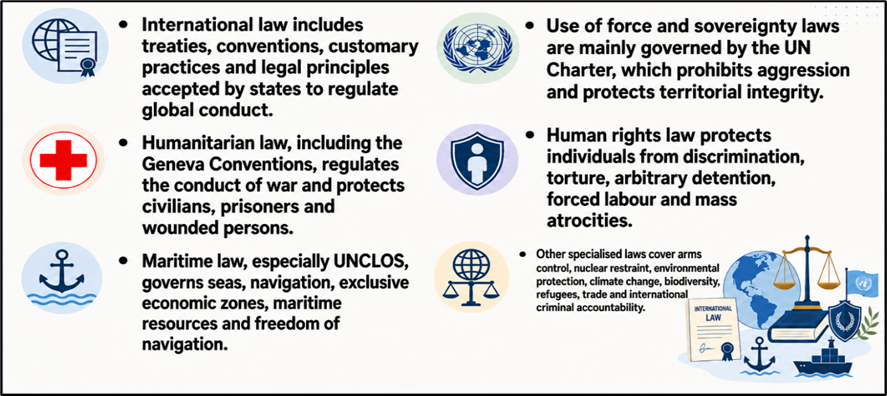
Key Takeaways:
Explanation:
1. Erosion of Legal Norms:
- The international order was built to prevent war, aggression and unchecked state power.
- However, conflicts in different regions show repeated violations of sovereignty, territorial integrity and humanitarian principles.
- When powerful states act without accountability, international law appears selective and weak.
2. Violations across Regions:
- Military interventions, territorial aggression, cross-border attacks and blockades have weakened the prohibition on the use of force.
- Civilian bombings, sieges, starvation, chemical weapon use and forced displacement have challenged humanitarian law.
- Human rights violations such as mass detention, torture, cultural erasure, suppression of protests and ethnic violence continue in many countries.
3. Weakening of Maritime, Arms-Control and Environmental Norms:
- Disputes in the South China Sea, Strait of Hormuz and other maritime zones show pressure on UNCLOS and freedom of navigation.
- Arms-control regimes have weakened due to the collapse or uncertainty of treaties related to nuclear and missile systems.
- Environmental law is also under stress due to climate inaction, illegal deforestation, biodiversity loss and weak regulation of deep-sea mining.
4. Vacuum in Enforcement and Way Forward:
- International law depends on consent, reciprocity and collective enforcement, but these mechanisms weaken when powerful states refuse compliance.
- Institutions such as the UN Security Council often remain paralysed due to great-power rivalry and veto politics.
- International courts face limits of jurisdiction, selective cooperation and weak enforcement capacity.
- The way forward lies in strengthening multilateral institutions, improving accountability mechanisms, reducing selective application of law, and building a global political culture that values restraint over unilateral power.
Conclusion:
International law is imperfect, but it remains the strongest defence against global disorder. The need is to rebuild respect for legal norms so that power does not become the only basis of international conduct.
Source: (The Hindu)
La Excellence IAS Academy, the best IAS coaching in Hyderabad, known for delivering quality content and conceptual clarity for UPSC 2026 preparation.
FOLLOW US ON:
◉ YouTube : https://www.youtube.com/@CivilsPrepTeam
◉ Facebook: https://www.facebook.com/LaExcellenceIAS
◉ Instagram: https://www.instagram.com/laexcellenceiasacademy/
GET IN TOUCH:
Contact us at info@laex.in, https://laex.in/contact-us/
or Call us @ +91 9052 29 2929, +91 9052 99 2929, +91 9154 24 2140
OUR BRANCHES:
Head Office: H No: 1-10-225A, Beside AEVA Fertility Center, Ashok Nagar Extension, VV Giri Nagar, Ashok Nagar, Hyderabad, 500020
Madhapur: Flat no: 301, survey no 58-60, Guttala begumpet Madhapur metro pillar: 1524, Rangareddy Hyderabad, Telangana 500081
Bangalore: Plot No: 99, 2nd floor, 80 Feet Road, Beside Poorvika Mobiles, Chandra Layout, Attiguppe, Near Vijaya Nagara, Bengaluru, 560040