
Paper: GS – III, Subject: Environment, Ecology and Disaster Management, Topic: Indian initiatives, efforts and Commitments, Issue: Delhi EV Policy 2.0.
Context:
Delhi has approved Electric Vehicle Policy 2.0 to accelerate the transition from petrol and CNG vehicles to electric mobility. It combines financial incentives, registration restrictions and charging infrastructure to reduce vehicular pollution. Its success will depend on whether the transition remains affordable, reliable and socially equitable.
Key Takeaways:
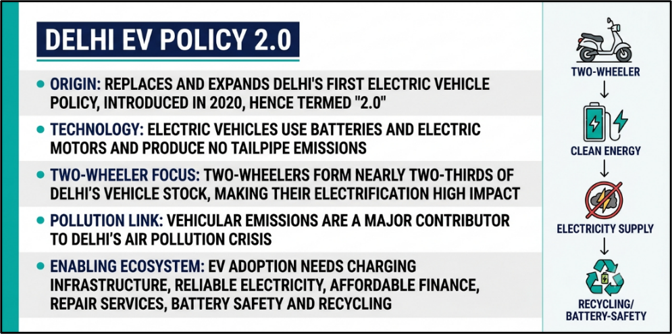
Explanation:
Major Policy Measures:
- From January 1, 2027, only electric passenger and goods three-wheelers and electric N1 goods carriers weighing up to 3.5 tonnes are proposed to receive new registrations.
- From April 1, 2028, only electric two-wheelers will be registered. Existing petrol vehicles are not immediately prohibited and may continue under prevailing rules.
- Purchase incentives are proposed for electric two-wheelers, autorickshaws and light goods vehicles. The incentives decline over time to encourage early adoption.
- Electric cars priced up to ₹30 lakh are proposed to receive complete road-tax and registration-fee waivers. Scrappage incentives support the replacement of older polluting vehicles.
- Schools must gradually increase the electric share of their bus fleets to 10%, 20% and 30% at different stages up to 2030. Government vehicle procurement will also favour electric vehicles.
- More than 30,000 additional charging points, battery-swapping facilities and charging-ready buildings are proposed. Strong hybrid vehicles are excluded from the main incentive framework.
Expected Benefits:
- Electric mobility can reduce nitrogen oxides, carbon monoxide and exhaust particulate matter, thereby improving public health.
- It can lower petroleum consumption, reduce dependence on imported crude oil and protect users from fluctuating fuel prices.
- High-use vehicles such as autorickshaws, buses, delivery vehicles and goods carriers can achieve substantial operating-cost savings.
- The transition can generate employment in batteries, charging equipment, software, maintenance and recycling.
- Scrappage-linked incentives can remove older and disproportionately polluting vehicles from the roads.
Major Challenges:
- Charging facilities may remain inadequate or unevenly distributed, particularly in rented housing, unauthorised colonies and areas without private parking.
- Simultaneous charging can overload local transformers unless distribution networks, smart charging and time-based tariffs are developed.
- High purchase prices and limited access to credit may burden autorickshaw drivers, gig workers and small traders.
- Battery fires and informal recycling require strict safety standards, traceability and producer responsibility.
- Delhi-specific restrictions may encourage vehicle registration in neighbouring National Capital Region cities unless regional coordination is ensured.
- EVs reduce exhaust pollution but cannot by themselves solve congestion, accidents, parking shortages, tyre dust or excessive dependence on private vehicles.
Way Forward:
- Delhi must expand buses and last-mile transport, provide affordable loans and battery-leasing options, protect gig workers and ensure prompt subsidy payments.
- Charging performance must be measured through location, uptime, speed and affordability, rather than merely the number of chargers.
- Readiness reviews, public dashboards, trained technicians, battery recycling and coordination with neighbouring states are essential.
Conclusion:
Delhi EV Policy 2.0 marks a shift from voluntary incentives towards a mandate-supported transition. However, deadlines must be matched by affordable vehicles, reliable charging, grid readiness and worker protection. The objective should be cleaner and less congested mobility, rather than merely replacing petrol vehicles with electric ones.
Source: (The Indian Express)
La Excellence IAS Academy, the best IAS coaching in Hyderabad, known for delivering quality content and conceptual clarity for UPSC 2026 preparation.
FOLLOW US ON:
◉ YouTube : https://www.youtube.com/@CivilsPrepTeam
◉ Facebook: https://www.facebook.com/LaExcellenceIAS
◉ Instagram: https://www.instagram.com/laexcellenceiasacademy/
GET IN TOUCH:
Contact us at info@laex.in, https://laex.in/contact-us/
or Call us @ +91 9052 29 2929, +91 9052 99 2929, +91 9154 24 2140
OUR BRANCHES:
Head Office: H No: 1-10-225A, Beside AEVA Fertility Center, Ashok Nagar Extension, VV Giri Nagar, Ashok Nagar, Hyderabad, 500020
Madhapur: Flat no: 301, survey no 58-60, Guttala begumpet Madhapur metro pillar: 1524, Rangareddy Hyderabad, Telangana 500081
Bangalore: Plot No: 99, 2nd floor, 80 Feet Road, Beside Poorvika Mobiles, Chandra Layout, Attiguppe, Near Vijaya Nagara, Bengaluru, 560040