
Paper: GS – I, Subject: Geography, Topic: Geo-physical Phenomenon, Issue: Europe Heatwave and the Emerging El Niño Threat.
Context:
Large parts of western and central Europe are experiencing an unusual early-season heatwave, with temperatures significantly above normal levels. The immediate trigger is a persistent high-pressure system known as a heat dome. Simultaneously, the emergence of a potentially strong El Niño in the Pacific Ocean has raised concerns about future global weather disruptions, including impacts on India’s monsoon and heatwave patterns.
Key Takeaways:
Explanation:
Heat Dome: The Immediate Cause of Europe’s Heatwave
- A heatwave is a prolonged period of unusually high temperatures compared to the normal climatic conditions of a region.
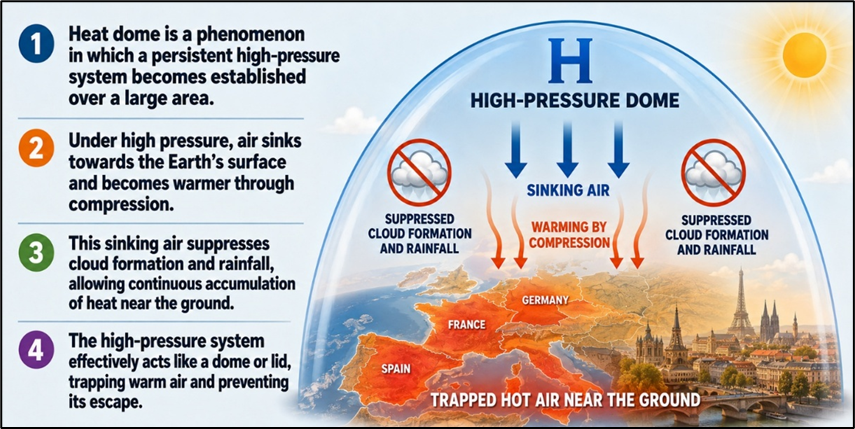
- The current European heatwave is being driven by a heat dome, a phenomenon in which a persistent high-pressure system becomes established over a large area.
- As a result, several European countries have recorded temperatures 10–15°C above seasonal averages.
Why the Current Heatwave is Significant:
- The heatwave has occurred unusually early, during a period when temperatures in Europe are normally much lower.
- It follows the unprecedented heatwaves and droughts of 2022 and 2023, which caused widespread environmental damage and thousands of heat-related deaths.
- The recurrence of such extreme events suggests that intense heatwaves are becoming more frequent and severe.
- Scientists increasingly associate this trend with long-term global warming and rising baseline temperatures.
Climate Whiplash and Increasing Weather Extremes:
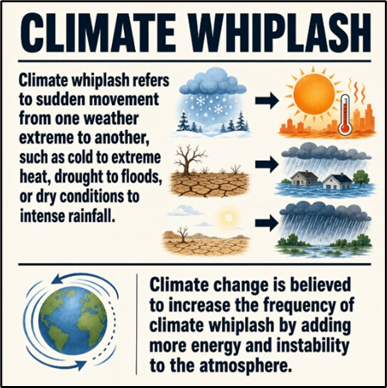
- Weather patterns do not always change gradually; they can shift abruptly between extremes. Such rapid transitions are described as climate whiplash.
- Europe has recently witnessed such fluctuations between cooler, wetter conditions and intense heat.
Emergence of El Niño: A Parallel Global Concern:
- Alongside Europe’s heatwave, attention is focused on the emergence of El Niño, one of the most important global climate phenomena.
- El Niño is the abnormal warming of surface waters in the central and eastern equatorial Pacific Ocean.
- It forms part of the broader El Niño–Southern Oscillation (ENSO) system that influences weather patterns across the globe.
- Scientists expect the current El Niño to be among the stronger events in recent years.
- Strong El Niño events often alter global rainfall patterns, increase temperatures and contribute to weather extremes in many regions.
The Transition from La Niña to El Niño:
- The world has recently emerged from a prolonged La Niña phase, which is characterised by cooler-than-normal sea surface temperatures in the equatorial Pacific Ocean.
- La Niña generally exerts a cooling influence on global temperatures and often supports stronger monsoon conditions in India.
- The current transition from La Niña to El Niño represents a major shift in the global ocean-atmosphere system.
- Historically, global temperatures tend to rise further during El Niño years because the warmer Pacific releases additional heat into the atmosphere.
- This transition is therefore being closely monitored by climate scientists worldwide.
Relationship Between the European Heatwave and El Niño:
- The article emphasises that the present European heatwave is primarily caused by the regional heat dome rather than directly by El Niño.
- However, the simultaneous emergence of El Niño increases concern because both phenomena can contribute to warmer global conditions.
- El Niño may not have caused the current heatwave, but it can amplify the broader background of rising temperatures.
- The coincidence of an extreme European heatwave and a strengthening El Niño highlights the growing interconnectedness of climate risks across regions.
Implications for India:
- El Niño is particularly important for India because it can influence the southwest monsoon, which provides most of the country’s annual rainfall.
- Historically, many El Niño years have been associated with below-normal monsoon rainfall.
- Reduced rainfall can affect agriculture, reservoir storage, groundwater recharge and rural livelihoods.
- El Niño is also associated with a higher probability of severe and prolonged heatwaves across the Indian subcontinent.
- However, monsoon performance depends on several interacting factors, including the Indian Ocean Dipole, monsoon depressions and regional atmospheric conditions; therefore, El Niño increases risk but does not guarantee monsoon failure.
Conclusion:
The ongoing European heatwave demonstrates how regional atmospheric conditions such as heat domes can produce extreme weather events. At the same time, the emergence of a strong El Niño raises concerns about broader global climatic disruptions, including impacts on India’s monsoon and heatwave patterns. Together, these developments highlight the growing influence of climate change and the increasing interconnectedness of weather systems across the world.
Source: (The Indian Express)
La Excellence IAS Academy, the best IAS coaching in Hyderabad, known for delivering quality content and conceptual clarity for UPSC 2026 preparation.
FOLLOW US ON:
◉ YouTube : https://www.youtube.com/@CivilsPrepTeam
◉ Facebook: https://www.facebook.com/LaExcellenceIAS
◉ Instagram: https://www.instagram.com/laexcellenceiasacademy/
GET IN TOUCH:
Contact us at info@laex.in, https://laex.in/contact-us/
or Call us @ +91 9052 29 2929, +91 9052 99 2929, +91 9154 24 2140
OUR BRANCHES:
Head Office: H No: 1-10-225A, Beside AEVA Fertility Center, Ashok Nagar Extension, VV Giri Nagar, Ashok Nagar, Hyderabad, 500020
Madhapur: Flat no: 301, survey no 58-60, Guttala begumpet Madhapur metro pillar: 1524, Rangareddy Hyderabad, Telangana 500081
Bangalore: Plot No: 99, 2nd floor, 80 Feet Road, Beside Poorvika Mobiles, Chandra Layout, Attiguppe, Near Vijaya Nagara, Bengaluru, 560040