
Paper: GS – II, Subject: International Relations, Topic: Agreements involving India and/or affecting India’s interests, Issue: Protecting Indian Seafarers through Maritime Foreign Policy.
Context:
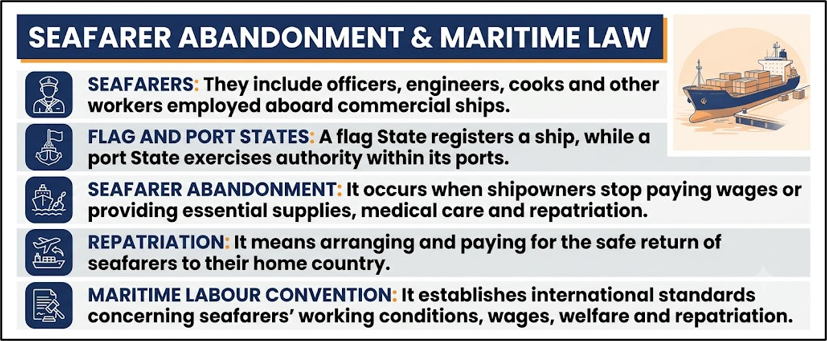
Recently, attacks on commercial ships in West Asia killed several Indian seafarers. India’s “Seafarer First” initiative highlighted the need for permanent protection across flags and jurisdictions.
Key Takeaways:
Explanation:
Why Existing Protection Is Inadequate:
- Divided responsibility: An Indian may work for a foreign company aboard a ship registered elsewhere. Responsibility is divided among owners, insurers, States and Indian missions.
- Territorial limitation: Embassies serve fixed territories, while ships continually cross jurisdictions. Missions may discover stranded Indians only after an emergency.
- Large-scale abandonment: About 1,125 Indian seafarers were abandoned in 2025, reportedly the highest number recorded for any nationality.
- Growing insecurity: Seafarers face missiles, drones and mines in conflict zones. Piracy, detention and hostage-taking create additional dangers.
Government Response and Limitations:
- Seafarer First: It is a dashboard launched by the Ministry of Ports, Shipping and Waterways. It will track vessels, threats and crew welfare. Liaison officers will provide verified information to affected families.
- Limited enforcement: Technology can locate ships but cannot compel owners or flag States to rescue or repatriate crews.
- Recruitment restrictions: The Directorate General of Shipping restricted recruitment on 366 vessels linked to abandonment unless they fulfilled compliance requirements.
- Weak implementation: Some flag States register ships easily but poorly enforce Maritime Labour Convention obligations on wages, abandonment and repatriation.
Way Forward:
- Standing protocol: India needs procedures fixing official responsibility immediately after a maritime distress signal is received.
- Specialised officers: Indian missions in shipping centres should maintain contacts with ports, hospitals, insurers and maritime lawyers.
- Stronger agreements: Bilateral agreements should guarantee legal assistance, consular access, repatriation and protection in conflict zones.
- Right to know: Seafarers must know the vessel’s ownership, route, sanctions, insurance and abandonment record before signing contracts.
- Civilian protection: Seafarers remain civilians even when their vessel, owner or cargo becomes linked with conflict. India should oppose attacks on commercial shipping.
Conclusion:
India’s maritime power cannot be measured only through ports, warships and shipping tonnage. A people-centred foreign policy must protect seafarers through clear responsibility, enforceable rights and international cooperation.
Source: (The Hindu)
La Excellence IAS Academy, the best IAS coaching in Hyderabad, known for delivering quality content and conceptual clarity for UPSC 2026 preparation.
FOLLOW US ON:
◉ YouTube : https://www.youtube.com/@CivilsPrepTeam
◉ Facebook: https://www.facebook.com/LaExcellenceIAS
◉ Instagram: https://www.instagram.com/laexcellenceiasacademy/
GET IN TOUCH:
Contact us at info@laex.in, https://laex.in/contact-us/
or Call us @ +91 9052 29 2929, +91 9052 99 2929, +91 9154 24 2140
OUR BRANCHES:
Head Office: H No: 1-10-225A, Beside AEVA Fertility Center, Ashok Nagar Extension, VV Giri Nagar, Ashok Nagar, Hyderabad, 500020
Madhapur: Flat no: 301, survey no 58-60, Guttala begumpet Madhapur metro pillar: 1524, Rangareddy Hyderabad, Telangana 500081
Bangalore: Plot No: 99, 2nd floor, 80 Feet Road, Beside Poorvika Mobiles, Chandra Layout, Attiguppe, Near Vijaya Nagara, Bengaluru, 560040