
Paper: GS – III, Subject: Economy, Topic: Agriculture – inputs, Issue: Accelerating Adoption of Next-Generation Fertilisers.
Context:
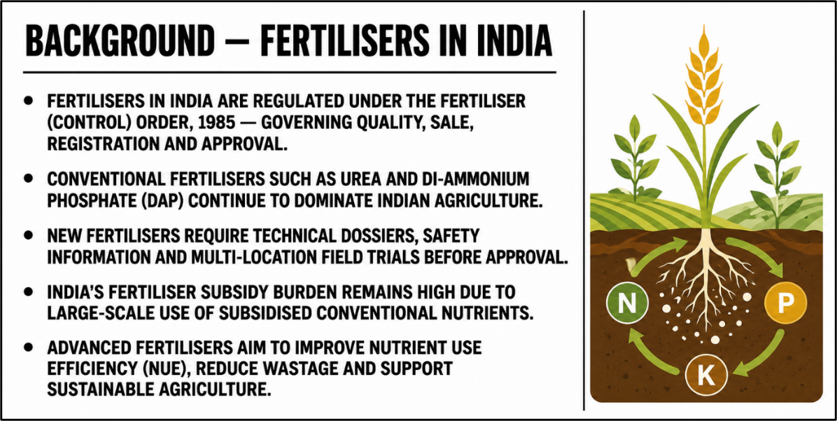
India is seeking to modernise its fertiliser approval system to promote innovative and efficient crop nutrient products. The reform is linked to rising fertiliser subsidy costs, low nutrient-use efficiency of conventional fertilisers and growing dependence on imported inputs. The larger goal is to improve farm productivity while ensuring sustainable nutrient management.
Key Takeaways:
Explanation:
Need for Faster Approvals:
- The existing approval process for new fertilisers is considered lengthy and procedural.
- Delayed approvals restrict the timely entry of innovative nutrient products into the market.
- A faster system can help farmers access modern fertilisers suited to specific crops, soils and growth stages.
- It can also encourage private sector research, investment and product innovation.
Proposed Regulatory Shift:
- Fertilisers meeting prescribed quality, safety and contaminant standards may be exempted from mandatory field trials.
- This approach follows the model used for water-soluble fertilisers, where notified specifications enabled easier market entry.
- Such liberalisation is mainly aimed at non-subsidised fertilisers, reducing pressure on the subsidy regime.
Types of New-Generation Fertilisers:
- Water-Soluble Fertilisers: Dissolve easily in water and support precise nutrient delivery through irrigation systems.
- Micronutrients: Supply essential trace elements such as zinc, boron, iron and manganese.
- Liquid Fertilisers: Allow uniform application and faster nutrient absorption.
- Slow-Release and Controlled-Release Fertilisers: Release nutrients gradually according to crop needs.
- Nano Fertilisers: Use nanotechnology to improve delivery and reduce nutrient losses.
- Bio-stimulants: Enhance plant growth, nutrient uptake, stress tolerance and physiological efficiency.
Importance for Agriculture:
- Conventional fertilisers suffer from low nutrient-use efficiency, leading to wastage and environmental losses.
- Advanced fertilisers can increase crop output from each unit of nutrient applied.
- They can reduce input costs, improve soil health and lower nutrient runoff.
- They are relevant for high-value crops such as fruits, vegetables and horticulture.
- They can reduce vulnerability to global fertiliser price shocks and geopolitical supply disruptions.
Conclusion:
New-generation fertilisers can help shift Indian agriculture from excessive fertiliser use to efficient nutrient management. Faster approvals, if combined with strict safety and quality checks, can promote innovation without compromising farmer interests. Such reforms are important for fiscal prudence, food security and sustainable agriculture.
Source: (The Indian Express)
La Excellence IAS Academy, the best IAS coaching in Hyderabad, known for delivering quality content and conceptual clarity for UPSC 2026 preparation.
FOLLOW US ON:
◉ YouTube : https://www.youtube.com/@CivilsPrepTeam
◉ Facebook: https://www.facebook.com/LaExcellenceIAS
◉ Instagram: https://www.instagram.com/laexcellenceiasacademy/
GET IN TOUCH:
Contact us at info@laex.in, https://laex.in/contact-us/
or Call us @ +91 9052 29 2929, +91 9052 99 2929, +91 9154 24 2140
OUR BRANCHES:
Head Office: H No: 1-10-225A, Beside AEVA Fertility Center, Ashok Nagar Extension, VV Giri Nagar, Ashok Nagar, Hyderabad, 500020
Madhapur: Flat no: 301, survey no 58-60, Guttala begumpet Madhapur metro pillar: 1524, Rangareddy Hyderabad, Telangana 500081
Bangalore: Plot No: 99, 2nd floor, 80 Feet Road, Beside Poorvika Mobiles, Chandra Layout, Attiguppe, Near Vijaya Nagara, Bengaluru, 560040