
Paper: GS – I, Subject: Society and Social Justice, Topic: Social sector – Health, Issue: Gender inequality in contraceptive responsibility.
Context:
India launched the world’s first official family planning programme in 1952, yet contraceptive responsibility continues to fall disproportionately on women. NFHS-6 (2023–24) data reveals persistent structural inequities, where female sterilisation dominates and male participation remains negligible, raising serious questions about reproductive agency and gender equity.
Key Takeaways:
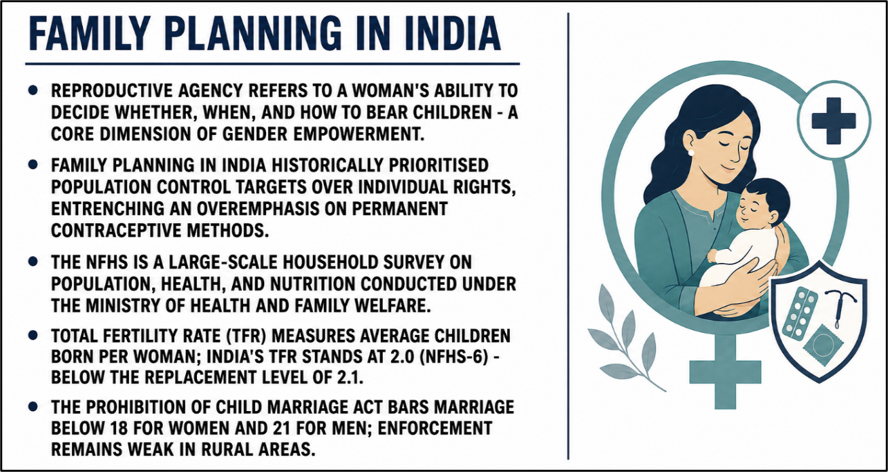
Explanation:
1. Early Marriage and Reproductive Health:
- 20.1% of women aged 20–24 was married before 18; the rural figure rises to 23.3%.
- 6.7% of women aged 15–19 were already mothers or pregnant — directly linking early marriage to restricted reproductive agency.
- Early marriage functions as a reproductive health crisis, simultaneously curtailing education, employment prospects, health outcomes, and decision-making power of women within households and society.
2. Rural-Urban Divide:
- Urban women marry later, complete more schooling, and access wider contraceptive options.
- Rural women face earlier marriage, lower agency, and weaker healthcare infrastructure.
- The divide reflects deeper structural inequities in education, healthcare access, and social norms.
3. Sterilisation Trends and Gender Imbalance:
- Contraception in India must be understood as a matter of reproductive agency, not merely population control — yet the data reflects the opposite in practice.
- Female sterilisation accounts for 36.5% of all contraceptive use nationally (38.1% rurally).
- Male sterilisation (vasectomy) has declined sharply from 3.3% in the early 1990s to just 0.3% today — reflecting near-total absence of male contraceptive responsibility.
- Modern reversible methods declined from 56.4% to 52.7% between NFHS-5 and NFHS-6 — indicating regression in scientific contraceptive adoption.
- Women frequently undergo sterilisation without fully informed consent, in overcrowded public facilities.
4. Vasectomy — Medical Reality vs. Misconceptions:
- A vasectomy is a minor procedure under local anaesthesia sealing the vas deferens; patients are discharged within hours and resume normal activity within days.
- It does not affect testosterone, sexual desire, erectile function, or physical health — contrary to widespread social stigma.
- Vasectomy reversal (recanalisation) within three years carries success rates exceeding 90%, countering the misconception of permanent irreversibility.
- Low uptake is driven by fear of loss of libido, social stigma, poor awareness, and social media misinformation falsely linking vasectomy to obesity, cancer, and chronic infections.
5. Risks and Challenges:
- Public health systems continue to rely on permanent methods over reversible contraception, limiting reproductive choice.
- The Prohibition of Child Marriage Act remains weakly enforced, perpetuating early marriage and its cascading consequences on education, employment, and agency.
- Women frequently lack decision-making power within family structures, making contraceptive choice a reflection of social hierarchy rather than individual agency.
6. Policy Way Forward:
- Treat early marriage as a reproductive health crisis requiring urgent legislative enforcement and community-level intervention.
- Shift policy focus from permanent sterilisation to reversible, modern contraceptive methods delivered through strengthened public healthcare infrastructure.
- Mandate informed consent as a non-negotiable standard in all sterilisation procedures conducted in public health facilities.
- Invest in rural secondary education for girls as the most effective long-term intervention for improving reproductive agency and employment outcomes.
- Promote male participation through targeted awareness campaigns dismantling vasectomy-related stigma and normalising shared contraceptive responsibility.
Conclusion:
India’s family planning inequity demands a shift from population-control-driven sterilisation toward rights-based, reversible contraception with active male participation. Genuine reproductive agency for women is both a health imperative and a gender justice requirement.
Source: (The Hindu)
La Excellence IAS Academy, the best IAS coaching in Hyderabad, known for delivering quality content and conceptual clarity for UPSC 2026 preparation.
FOLLOW US ON:
◉ YouTube : https://www.youtube.com/@CivilsPrepTeam
◉ Facebook: https://www.facebook.com/LaExcellenceIAS
◉ Instagram: https://www.instagram.com/laexcellenceiasacademy/
GET IN TOUCH:
Contact us at info@laex.in, https://laex.in/contact-us/
or Call us @ +91 9052 29 2929, +91 9052 99 2929, +91 9154 24 2140
OUR BRANCHES:
Head Office: H No: 1-10-225A, Beside AEVA Fertility Center, Ashok Nagar Extension, VV Giri Nagar, Ashok Nagar, Hyderabad, 500020
Madhapur: Flat no: 301, survey no 58-60, Guttala begumpet Madhapur metro pillar: 1524, Rangareddy Hyderabad, Telangana 500081
Bangalore: Plot No: 99, 2nd floor, 80 Feet Road, Beside Poorvika Mobiles, Chandra Layout, Attiguppe, Near Vijaya Nagara, Bengaluru, 560040