
Paper: GS – I, Subject: Society and Social Justice, Topic: Issues of women, Issue: Economic Value of Unpaid Domestic Work.
Context:
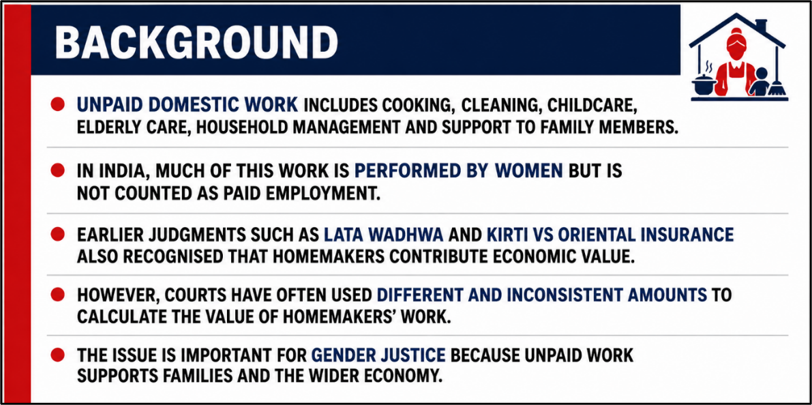
Recently, the Supreme Court said that the unpaid work done by a homemaker has economic value. The case was related to compensation after a road accident. This is important because household work, mostly done by women, is often treated as “non-work” simply because it is unpaid.
Key Takeaways:
Explanation:
What the Court Did:
- The Supreme Court revised compensation in a motor accident case involving the death of a homemaker.
- It fixed ₹30,000 per month as the notional economic value of her domestic work.
- The Court said this amount should be increased by 10% every three years.
- If a woman also earns a salary, that salary can be added separately while calculating compensation.
Why This Matters:
- The judgment recognises that homemakers perform real and valuable work even if they do not receive wages.
- It challenges the belief that unpaid household work has no economic worth.
- It gives dignity and legal recognition to domestic labour, especially women’s work.
- It may help reduce the long-standing invisibility of women’s contribution within families and society.
Limits of the Judgment:
- The ruling does not create a salary, pension or employment right for homemakers.
- It applies mainly to compensation calculations in motor accident claims.
- It does not automatically convert household work into formal paid employment.
- Still, it creates strong legal reasoning for valuing unpaid care work.
Wider Impact:
- Homemakers seeking maintenance in family law cases may use this reasoning to show the value of domestic work.
- Rural women who assist in farming, cattle care, harvesting and household duties may argue for higher recognition of their labour.
- The decision may also influence future debates on work-from-home, caregiving and shared domestic responsibilities.
- Male homemakers may also claim similar recognition in future cases.
- Insurance companies may reassess compensation risks and may prefer quicker settlements in some cases.
Conclusion:
The judgment is a major step towards correcting the economic invisibility of unpaid domestic work. It recognises that household labour has real value, even when it is not paid. The larger challenge is to build social, legal and economic systems that respect care work as essential work.
Source: (The Hindu)
La Excellence IAS Academy, the best IAS coaching in Hyderabad, known for delivering quality content and conceptual clarity for UPSC 2026 preparation.
FOLLOW US ON:
◉ YouTube : https://www.youtube.com/@CivilsPrepTeam
◉ Facebook: https://www.facebook.com/LaExcellenceIAS
◉ Instagram: https://www.instagram.com/laexcellenceiasacademy/
GET IN TOUCH:
Contact us at info@laex.in, https://laex.in/contact-us/
or Call us @ +91 9052 29 2929, +91 9052 99 2929, +91 9154 24 2140
OUR BRANCHES:
Head Office: H No: 1-10-225A, Beside AEVA Fertility Center, Ashok Nagar Extension, VV Giri Nagar, Ashok Nagar, Hyderabad, 500020
Madhapur: Flat no: 301, survey no 58-60, Guttala begumpet Madhapur metro pillar: 1524, Rangareddy Hyderabad, Telangana 500081
Bangalore: Plot No: 99, 2nd floor, 80 Feet Road, Beside Poorvika Mobiles, Chandra Layout, Attiguppe, Near Vijaya Nagara, Bengaluru, 560040