
Paper: GS – II, Subject: International Relations, Topic: India’s Relations with Major Powers, Issue: India–U.S. strategic partnership.
Context:
The India–U.S. relationship in 2025, highlighting a “dual-track dynamic” where institutional cooperation thrives despite political tensions.
Key Highlights:
Political Challenges:
- Delayed Quad Summit: The Quad Leaders’ Summit, scheduled to be hosted by India, was postponed due to communication issues and underlying bilateral tensions.
- Trade Disputes: Worsening trade relations, including U.S. tariffs on Indian goods and India’s response, have created friction.
- U.S.-China Rapprochement: Perceptions of a “G-2” style relationship between the U.S. and China have led India to recalibrate its diplomatic posture.
- Economic Frictions: U.S. tariffs on India’s purchase of Russian crude oil, while China and Pakistan enjoy lower tariffs, have added to the tensions.
Continuing Institutional Cooperation:
- Quad Foreign Ministers’ Meeting: The July 2025 Quad Foreign Ministers’ meeting in Washington showcased new initiatives in maritime security, transnational threats, economic cooperation, critical technologies, and humanitarian efforts.
- Quad Counterterrorism Working Group: The third meeting of the Quad’s Counterterrorism Working Group in December 2025 demonstrated the Quad’s continued operational relevance.
Quad Ports of the Future Conference:
- Inaugural Conference: Held in Mumbai in November 2025, bringing together delegates from 24 Indo-Pacific partners.
- Focus: Developing resilient and secure ports through shared expertise and investments.
- Emphasis: Quality infrastructure development as a crucial dimension of Quad cooperation.
Defence Cooperation:
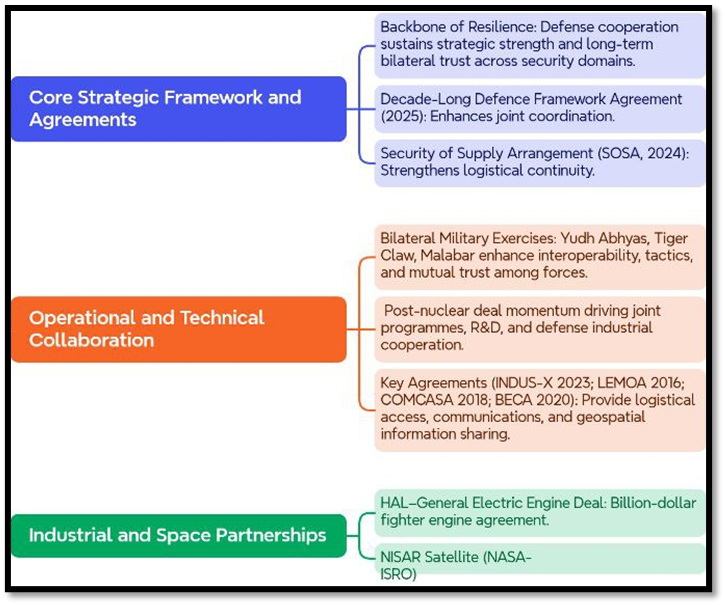
Dual-Track Dynamic:
- Institutional Engagement: Despite political challenges, institutional engagement reveals a dual-track dynamic in the India-U.S. relationship.
- Bureaucratic and Institutional Frameworks: These frameworks sustain and evolve core collaborations, even as political leaders manage strategic diplomacy and national interests.
- Mutual Regional Interests: Drive continuity despite institutional challenges like domestic regulatory frameworks and technology interoperability concerns.
Future Outlook:
- Deeper Institutional Understanding
- Expanding Cooperation
- The resilience of the India-U.S. partnership
- Maintaining Robustness
- Long-Term Partnerships
The U.S.–India relationship endures because it is institution-driven rather than leader-driven. This “parallel track” of defence, technology, and institutional cooperation ensures resilience against political shocks—making the partnership future-ready and geopolitically indispensable.
La Excellence IAS Academy, the best IAS coaching in Hyderabad, known for delivering quality content and conceptual clarity for UPSC 2026 preparation.
FOLLOW US ON:
◉ YouTube : https://www.youtube.com/@CivilsPrepTeam
◉ Facebook: https://www.facebook.com/LaExcellenceIAS
◉ Instagram: https://www.instagram.com/laexcellenceiasacademy/
GET IN TOUCH:
Contact us at info@laex.in, https://laex.in/contact-us/
or Call us @ +91 9052 29 2929, +91 9052 99 2929, +91 9154 24 2140
OUR BRANCHES:
Head Office: H No: 1-10-225A, Beside AEVA Fertility Center, Ashok Nagar Extension, VV Giri Nagar, Ashok Nagar, Hyderabad, 500020
Madhapur: Flat no: 301, survey no 58-60, Guttala begumpet Madhapur metro pillar: 1524, Rangareddy Hyderabad, Telangana 500081
Bangalore: Plot No: 99, 2nd floor, 80 Feet Road, Beside Poorvika Mobiles, Chandra Layout, Attiguppe, Near Vijaya Nagara, Bengaluru, 560040