
Paper: GS – III, Subject: Disaster Management, Topic: Disaster and Disaster Management, Issue: Hanging Glaciers and Transboundary Himalayan Disaster Risk (Himalayan Glacier).
Context:
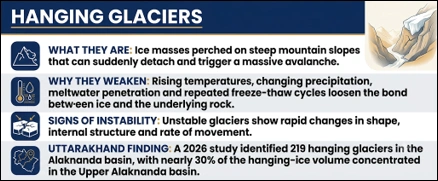
The devastating flood in Nepal’s Rasuwa district, reportedly triggered by a glacial and rock collapse near Langtang Lirung, destroyed settlements, roads, bridges and hydropower projects. It has renewed concern about unstable hanging glaciers across the warming Himalayas.
Key Takeaways:
Explanation:
Cascading hazards:
- A glacier collapse does not remain an isolated avalanche.
- The falling ice collects rock, soil, snow and water, increasing its destructive force. It may block a river, displace water from a glacial lake or damage a moraine dam.
- The resulting dam failure can produce a Glacial Lake Outburst Flood (GLOF) and destructive downstream debris flows.
- Simulations indicate that avalanche flows in the Badrinath–Mana sector could exceed 50 metres in height, threatening settlements, pilgrimage routes, roads and hydropower projects.
Increasing exposure:
- Unplanned construction, tourism, hydropower development and ribbon settlements along river valleys are placing more people and infrastructure inside hazard zones.
- Therefore, climate change is increasing the physical hazard while unsafe development is increasing human exposure.
Lessons for Himalayan Countries:
- Natural hazards are transboundary because glaciers, avalanches and river systems do not recognise political borders.
- India, Nepal and China presently require stronger cooperation in glacier monitoring, hazard mapping, scientific research and cross-border early warning.
- Damage to multiple hydropower projects demonstrates that glacial disasters can disrupt electricity generation, cross-border power trade and regional energy security.
- Local governments and communities are usually the first responders, but they frequently lack trained personnel, equipment, financial resources and warning authority.
- Scientific expertise and disaster-management capacity must therefore be decentralised to vulnerable districts, valleys and villages.
Way Forward:
- Establish an integrated Himalayan multi-hazard monitoring and early-warning network using satellites, weather stations, river gauges and seismic sensors.
- Enforce hazard zonation and carrying-capacity assessments before approving settlements, roads, tourism facilities and hydropower projects.
- Strengthen local institutions through trained response teams, last-mile warning systems, evacuation plans, communication equipment and community participation.
- Create a permanent transboundary coordination mechanism for real-time data sharing, joint research, climate-resilient hydropower planning and coordinated disaster response.
Conclusion:
The Himalayas must shift from reactive relief to anticipatory disaster-risk management. Scientific monitoring, risk-sensitive development, empowered local institutions and regional cooperation can reduce losses and prevent foreseeable glacial hazards from turning into avoidable human catastrophes.
Source: (The Indian Express)
La Excellence IAS Academy, the best IAS coaching in Hyderabad, known for delivering quality content and conceptual clarity for UPSC 2026 preparation.
FOLLOW US ON:
◉ YouTube : https://www.youtube.com/@CivilsPrepTeam
◉ Facebook: https://www.facebook.com/LaExcellenceIAS
◉ Instagram: https://www.instagram.com/laexcellenceiasacademy/
GET IN TOUCH:
Contact us at info@laex.in, https://laex.in/contact-us/
or Call us @ +91 9052 29 2929, +91 9052 99 2929, +91 9154 24 2140
OUR BRANCHES:
Head Office: H No: 1-10-225A, Beside AEVA Fertility Center, Ashok Nagar Extension, VV Giri Nagar, Ashok Nagar, Hyderabad, 500020
Madhapur: Flat no: 301, survey no 58-60, Guttala begumpet Madhapur metro pillar: 1524, Rangareddy Hyderabad, Telangana 500081
Bangalore: Plot No: 99, 2nd floor, 80 Feet Road, Beside Poorvika Mobiles, Chandra Layout, Attiguppe, Near Vijaya Nagara, Bengaluru, 560040