
Paper: GS – III, Subject: Science and Technology, Topic: Computer and ICT, Issue: Uniform Indian Standard Time Framework.
Context:
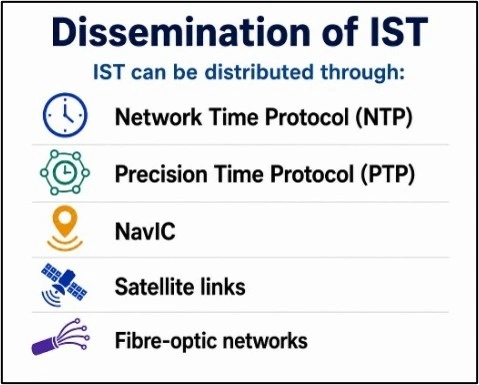
The Union government has notified the Legal Metrology (Indian Standard Time) Rules, 2026, making IST the legally enforceable reference for official and commercial use. Critical systems will be required to use a traceable and authorised IST source rather than relying on independent or foreign time references. The move aims to improve synchronisation, cybersecurity and strategic resilience.
Key Takeaways:

Background:
- India already follows Indian Standard Time (IST), which is UTC + 5 hours 30 minutes.
- However, different organisations may obtain time from different sources such as GPS, foreign internet servers, telecom networks or internal clocks.
- These systems may display the same time but can still differ by milliseconds, microseconds or more.
- Such small differences matter significantly in high-speed digital systems such as banking, stock exchanges, telecom networks and power grids.
- CSIR–National Physical Laboratory (CSIR-NPL) maintains India’s official scientific time using highly precise atomic clocks.
- India is also seeking to reduce excessive dependence on foreign-controlled timing systems and strengthen indigenous infrastructure.
Explanation:
A. What do the new rules seek to achieve?
Uniformity:
- Government and critical commercial systems will have to synchronise with an authorised IST reference.
- The objective is not to change India’s time zone, but to ensure that important systems use the same precise reference time.
Traceability:
- Traceability means that the time used by an organisation can ultimately be linked back to the official IST maintained by CSIR-NPL.
- This creates a verifiable national chain of time measurement similar to traceability used for weights and other physical standards.
B. How is precise time maintained?
Atomic clocks:
- Ordinary quartz clocks gradually drift because their oscillations are not perfectly stable.
- Atomic clocks use highly stable atomic frequencies, generally involving caesium, to measure time with extraordinary precision.
- CSIR-NPL maintains India’s national time scale and keeps it closely aligned with Coordinated Universal Time (UTC).
C. Why is precise synchronisation necessary?
Financial systems:
- Banks and stock exchanges execute transactions within fractions of a second.
- Accurate timestamps help determine the precise sequence of trades, payments and suspicious transactions.
- They are therefore important for regulation, audit and fraud investigation.
Cybersecurity:
- Cyberattacks are reconstructed through digital logs from multiple systems.
- If different servers use different clocks, investigators may be unable to establish which event occurred first.
- Common timestamps therefore strengthen cyber-forensics, digital evidence and incident response.
Telecom and power grids:
- Telecom networks require precise coordination between geographically dispersed equipment.
- Power grids depend on accurate timing for synchronisation, fault identification and reconstruction of failures.
- Uniform time can therefore improve the reliability of critical national infrastructure.
D. Strategic significance:
- India currently relies partly on foreign-controlled systems such as GPS for timing information.
- Such dependence can become a vulnerability during geopolitical conflict, cyber disruption or satellite denial.
- Strengthening domestic timing infrastructure supports technological sovereignty and strategic autonomy.
- A distributed national system can also improve resilience by reducing dependence on a single external source.
Conclusion:
The new IST framework transforms precise time from a simple technical requirement into an element of digital governance and national security. A common and traceable time standard can strengthen financial integrity, cybersecurity, infrastructure resilience and India’s technological self-reliance.
Source: (The Indian Express)
La Excellence IAS Academy, the best IAS coaching in Hyderabad, known for delivering quality content and conceptual clarity for UPSC 2026 preparation.
FOLLOW US ON:
◉ YouTube : https://www.youtube.com/@CivilsPrepTeam
◉ Facebook: https://www.facebook.com/LaExcellenceIAS
◉ Instagram: https://www.instagram.com/laexcellenceiasacademy/
GET IN TOUCH:
Contact us at info@laex.in, https://laex.in/contact-us/
or Call us @ +91 9052 29 2929, +91 9052 99 2929, +91 9154 24 2140
OUR BRANCHES:
Head Office: H No: 1-10-225A, Beside AEVA Fertility Center, Ashok Nagar Extension, VV Giri Nagar, Ashok Nagar, Hyderabad, 500020
Madhapur: Flat no: 301, survey no 58-60, Guttala begumpet Madhapur metro pillar: 1524, Rangareddy Hyderabad, Telangana 500081
Bangalore: Plot No: 99, 2nd floor, 80 Feet Road, Beside Poorvika Mobiles, Chandra Layout, Attiguppe, Near Vijaya Nagara, Bengaluru, 560040