
Paper: GS – II, Subject: Polity, Topic: Rights issues, Issue: Religious Freedom vs Right to Life: A Constitutional Test.
Context:
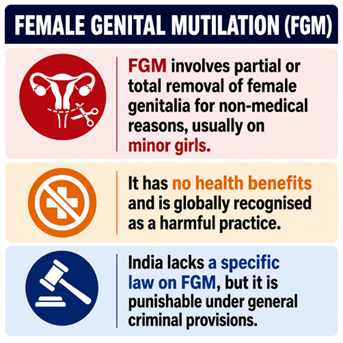
A nine-judge Constitution Bench of the Supreme Court of India is examining the constitutional validity of Female Genital Mutilation (FGM), practised among sections of the Dawoodi Bohra community. The case raises a key question on whether such practices are protected under religious freedom or violate fundamental rights such as dignity and bodily integrity.
Key Takeaways:
Explanation:
- The practice is justified within communities on socio-cultural grounds:
- Belief in controlling female sexuality and preserving chastity
- Seen as a rite of passage and marker of community identity
- Considered necessary for social acceptance and marriage
- Claimed by some as a religious obligation, though not clearly mandated in scriptures
- Constitutional conflict arises between:
- Article 25: Freedom of religion
- Article 21: Right to life, dignity, and bodily autonomy
- The Court must determine whether FGM qualifies as an essential religious practice. Judicial doctrine holds that:
- Religious freedom is not absolute and is subject to health, morality, and public order
- Practices violating dignity and bodily integrity can be restricted
- Legal provisions applicable:
- Indian Penal Code Sections 320–326 on grievous hurt
- Protection of Children from Sexual Offences Act for protection of minors
- Case history:
- 2017: PIL filed challenging FGM; Union Government opposed the practice
- 2018: Supreme Court referred the issue to a larger bench due to wider constitutional questions
- Present: Nine-judge bench examining scope of religious freedom
- International obligation:
- Convention on the Elimination of All Forms of Discrimination Against Women requires states to eliminate harmful practices against women
- It treats FGM as gender-based violence and obligates India to prevent such practices
Conclusion:
The case tests the limits of religious freedom within India’s constitutional framework. A judgment prioritising dignity, bodily integrity, and international commitments is likely to reaffirm that harmful practices such as FGM cannot be protected under religion, thereby strengthening gender justice and constitutional morality.
Source: (The Indian Express)
La Excellence IAS Academy, the best IAS coaching in Hyderabad, known for delivering quality content and conceptual clarity for UPSC 2026 preparation.
FOLLOW US ON:
◉ YouTube : https://www.youtube.com/@CivilsPrepTeam
◉ Facebook: https://www.facebook.com/LaExcellenceIAS
◉ Instagram: https://www.instagram.com/laexcellenceiasacademy/
GET IN TOUCH:
Contact us at info@laex.in, https://laex.in/contact-us/
or Call us @ +91 9052 29 2929, +91 9052 99 2929, +91 9154 24 2140
OUR BRANCHES:
Head Office: H No: 1-10-225A, Beside AEVA Fertility Center, Ashok Nagar Extension, VV Giri Nagar, Ashok Nagar, Hyderabad, 500020
Madhapur: Flat no: 301, survey no 58-60, Guttala begumpet Madhapur metro pillar: 1524, Rangareddy Hyderabad, Telangana 500081
Bangalore: Plot No: 99, 2nd floor, 80 Feet Road, Beside Poorvika Mobiles, Chandra Layout, Attiguppe, Near Vijaya Nagara, Bengaluru, 560040