
Paper: GS – II, Subject: International Relations, Topic: Global Issues, Issue: Strait of Hormuz: The Strategic Chokepoint of Global Energy Security.
Context:
The Strait of Hormuz has recently emerged as a focal point of geopolitical tensions involving Iran, the United States, and regional Gulf countries. These developments have raised serious concerns regarding the disruption of global oil supply chains and energy security.
Key Takeaways:
LOCATION AND GEOGRAPHICAL SIGNIFICANCE:
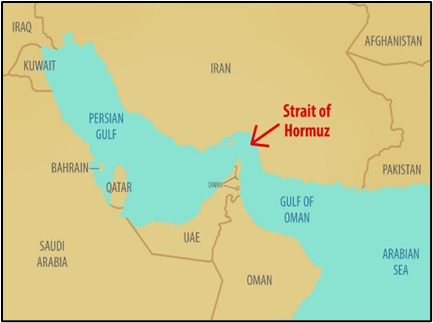
The Strait of Hormuz is a narrow but strategically vital maritime passage.
- It connects: Persian Gulf to Gulf of Oman and further to the Arabian Sea
- It is located between:
- Iran in the north
- Oman in the south
- The strait is approximately: 21 nautical miles wide at its narrowest point
- The effective shipping lanes are: Only about 2 miles wide in each direction
This extreme narrowness, combined with heavy traffic, makes it a classic example of a maritime chokepoint.
BACKGROUND: MARITIME CHOKEPOINTS IN GLOBAL TRADE
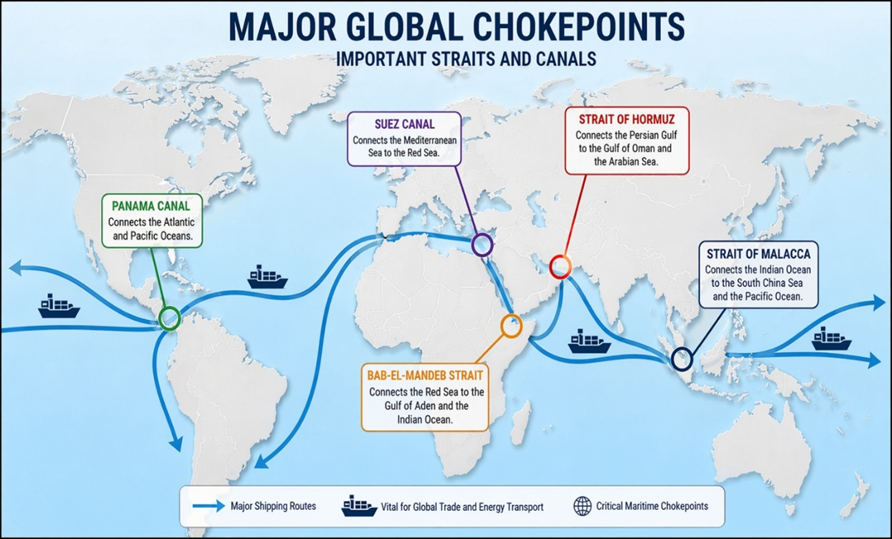
A maritime chokepoint refers to a narrow sea route through which a significant portion of global trade passes.
| Key characteristics: Limited alternative routes High strategic and economic importance Vulnerable to disruption due to conflicts or blockades | Major global chokepoints include: Strait of Hormuz Strait of Malacca Bab-el-Mandeb Strait Suez Canal Panama Canal |
These chokepoints function as critical bottlenecks in the global trade and energy network.
ENERGY SIGNIFICANCE:
- The Strait of Hormuz is the most important oil transit route in the world, carrying about 20–21 million barrels of oil per day, which is nearly one-fifth of global consumption.
- It is also a key route for liquefied natural gas exports, especially from Qatar. Nearly 80 percent of this energy flow is directed towards Asian countries such as India, China, Japan, and South Korea, making the region highly dependent on this route.
GEOPOLITICAL IMPORTANCE:
- The Strait of Hormuz lies in a politically sensitive region marked by tensions between Iran and the United States, as well as between Iran and Gulf countries such as Saudi Arabia and the UAE.
- Iran has the ability to threaten disruption of the strait, while the United States maintains a strong naval presence to ensure free navigation.
- This makes the strait a critical pressure point in global geopolitics.
LEGAL FRAMEWORK:
- The movement of ships through the strait is governed by the United Nations Convention on the Law of the Sea, which guarantees the right of transit passage.
- This allows ships of all nations to pass continuously and without obstruction, although coastal states like Iran and Oman can regulate navigation for safety and environmental purposes but cannot block passage.
ECONOMIC IMPACT:
- Any disruption in the Strait of Hormuz leads to immediate increases in global oil prices, which in turn raises transport costs and inflation.
- It also disrupts supply chains and industrial production, thereby affecting overall economic growth.
- Even minor incidents in the region can trigger significant volatility in global energy markets.
IMPACT ON INDIA:
- India depends heavily on oil imports, with nearly 85 percent of its crude oil coming from abroad, a large portion of which passes through the Strait of Hormuz.
- Therefore, any disruption increases India’s import bill, fuels inflation, and widens the current account deficit, directly affecting economic stability.
ALTERNATIVES AND SECURITY:
- Although some alternative pipelines exist, they have limited capacity and cannot fully replace maritime transport through the strait.
- At the same time, the region is heavily militarised, with risks such as tanker attacks and sea mining, leading to increased multinational naval cooperation to secure the route.
CONCLUSION: The Strait of Hormuz is a narrow but indispensable global energy corridor where geography, geopolitics, international law, and economic stability intersect, making it one of the most critical chokepoints in the world.
Source: (The Hindu)
La Excellence IAS Academy, the best IAS coaching in Hyderabad, known for delivering quality content and conceptual clarity for UPSC 2026 preparation.
FOLLOW US ON:
◉ YouTube : https://www.youtube.com/@CivilsPrepTeam
◉ Facebook: https://www.facebook.com/LaExcellenceIAS
◉ Instagram: https://www.instagram.com/laexcellenceiasacademy/
GET IN TOUCH:
Contact us at info@laex.in, https://laex.in/contact-us/
or Call us @ +91 9052 29 2929, +91 9052 99 2929, +91 9154 24 2140
OUR BRANCHES:
Head Office: H No: 1-10-225A, Beside AEVA Fertility Center, Ashok Nagar Extension, VV Giri Nagar, Ashok Nagar, Hyderabad, 500020
Madhapur: Flat no: 301, survey no 58-60, Guttala begumpet Madhapur metro pillar: 1524, Rangareddy Hyderabad, Telangana 500081
Bangalore: Plot No: 99, 2nd floor, 80 Feet Road, Beside Poorvika Mobiles, Chandra Layout, Attiguppe, Near Vijaya Nagara, Bengaluru, 560040