
Paper: GS – I, Subject: Society, Topic: Urbanization – Problems and remedies, Issue: Groundwater Crisis Bengaluru: A Failure of Urban Planning.
Context:
Bengaluru is facing a recurring water crisis due to excessive groundwater extraction and poor urban planning. Despite Karnataka improving overall water security, Bengaluru remains highly vulnerable.
Key Takeaways:
Key Facts:
- Karnataka extracted about 66% of its sustainable groundwater limit in 2025.
- Bengaluru East Taluk extracted 378%, indicating severe overuse.
- This does not mean total depletion but signals an acute and ongoing crisis.
Urbanisation and Demand Pressures:
- High population density and rising per capita consumption increase demand.
- Tech parks and apartment complexes are major water consumers.
- Expansion of built-up areas reduces natural recharge zones.
Impact of Infrastructure:
- Concrete surfaces prevent rainwater from percolating into the ground.
- Urban “grey infrastructure” (roads, buildings) suppresses groundwater recharge.
- Lack of integrated planning worsens water stress.
Dependence on External Sources:
- A growing population depends on Cauvery River water, which is expensive to supply.
- Tankers have become a major fallback option due to unreliable supply systems.
Recent Developments:
- Weak monsoon in 2024 dried nearly half of Bengaluru’s 14,000 borewells.
- A project to supply 775 million litres/day to villages is only partially complete.
- Crisis has spread to areas like Koramangala and Hebbal.
- Authorities are using treated sewage water to recharge lakes.
Core Problem Identified:
- Bengaluru treats water supply as “infinitely expandable,” which is incorrect.
- Demand continues to rise while natural supply remains limited.
- Mismanagement leads to ecological and economic costs being borne by citizens.
Policy and Governance Issues:
- Lack of integrated management of pipeline supply, groundwater, and wastewater.
- Poor regulation allows over-extraction of groundwater.
- Distribution losses and inefficiencies persist.
Suggested Solutions:
- Reduce leakages and improve water distribution efficiency.
- Penalise excessive groundwater extraction.
- Mandate 100% decentralized wastewater recycling for non-drinking uses.
Long-Term Solution: Sponge City Concept
- A “sponge city” absorbs and stores rainwater like a sponge.
- Requires restoration of lakes, wetlands, and traditional water systems.
- Improve connections between lakes and wells for better recharge.
- Align land-use planning with groundwater recharge capacity.
- Reduce surface sealing and increase permeable surfaces.
Conclusion:
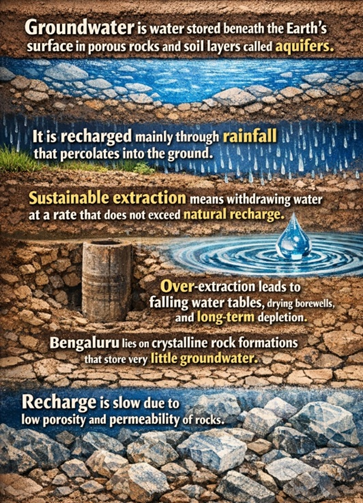
Bengaluru’s crisis is both natural (geology) and man-made (urbanisation). Sustainable water management requires balancing demand with ecological limits. Long-term resilience depends on restoring natural hydrological systems and better governance.
Source: (The Hindu)
La Excellence IAS Academy, the best IAS coaching in Hyderabad, known for delivering quality content and conceptual clarity for UPSC 2026 preparation.
FOLLOW US ON:
◉ YouTube : https://www.youtube.com/@CivilsPrepTeam
◉ Facebook: https://www.facebook.com/LaExcellenceIAS
◉ Instagram: https://www.instagram.com/laexcellenceiasacademy/
GET IN TOUCH:
Contact us at info@laex.in, https://laex.in/contact-us/
or Call us @ +91 9052 29 2929, +91 9052 99 2929, +91 9154 24 2140
OUR BRANCHES:
Head Office: H No: 1-10-225A, Beside AEVA Fertility Center, Ashok Nagar Extension, VV Giri Nagar, Ashok Nagar, Hyderabad, 500020
Madhapur: Flat no: 301, survey no 58-60, Guttala begumpet Madhapur metro pillar: 1524, Rangareddy Hyderabad, Telangana 500081
Bangalore: Plot No: 99, 2nd floor, 80 Feet Road, Beside Poorvika Mobiles, Chandra Layout, Attiguppe, Near Vijaya Nagara, Bengaluru, 560040