
Paper: GS – III, Subject: Science and Technology, Topic: Fourth Industrial Revolution Technologies, Issue: AI in Cybersecurity: From Defence to Offensive Capability.
Context:
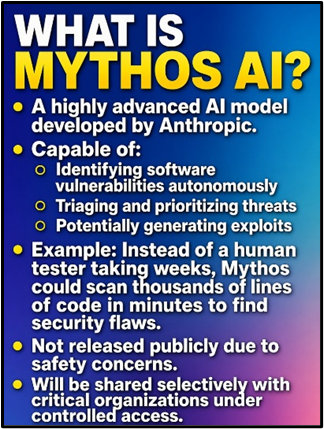
Anthropic announced its advanced AI model “Mythos,” capable of autonomously identifying cybersecurity vulnerabilities. Due to its powerful capabilities, the model will not be released publicly, raising concerns about its impact on cybersecurity.
Key Takeaways:
BACKGROUND:
- Cybersecurity refers to protecting computers, networks, and data from digital attacks and unauthorized access.
- Vulnerabilities are weaknesses in software that hackers can exploit to gain access or disrupt systems. Example: A bug in a banking app that allows unauthorized login is a vulnerability.
- Zero-day vulnerabilities are unknown flaws that even developers are unaware of, making them highly dangerous. Example: The WannaCry ransomware attack (2017) exploited a zero-day vulnerability in Windows systems.
- Bug bounty programs reward ethical hackers for reporting vulnerabilities.
- Example: Companies like Google and Facebook pay millions of dollars annually to ethical hackers.
- AI in cybersecurity is used for detecting threats, automating analysis, and predicting attacks.
- Anthropic is a US-based AI company focused on building safe and responsible artificial intelligence systems.
WHY ARE CYBERSECURITY CONCERNS RISING?
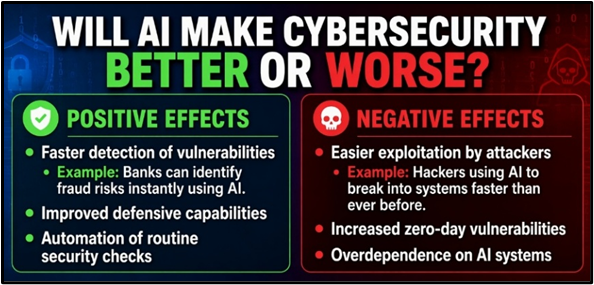
- AI can find vulnerabilities much faster than humans.
- Example: An AI system could scan an entire banking system overnight, while humans may take months.
- It may empower:
- Ethical hackers (to improve security)
- Malicious actors (to exploit systems faster)
- Example: Hackers could use AI to automatically find and attack weak points in government databases.
- Increases risks of:
- Zero-day exploit trading in underground markets
- State-sponsored cyberattacks
KEY INSIGHTS FROM EXPERTS:
1. Increased Discovery of Vulnerabilities:
- AI will identify a large number of bugs quickly. Example: A single AI tool could find thousands of vulnerabilities across multiple companies in one day.
- The real challenge is Prioritisation, Validation & Fixing them efficiently
2. Bottleneck in Cybersecurity:
- Companies already struggle to fix known vulnerabilities.
- Example: Many systems still run outdated software like old Windows versions, making them easy targets.
- AI may worsen this by increasing the number of detected issues.
3. Changing Role of Cybersecurity Professionals:
- Shift from manual work → AI-assisted analysis.
- Example: Instead of manually searching for bugs, professionals will focus on deciding which threats are most dangerous.
- More focus on strategic and high-level decision-making.
4. Impact on Bug Bounty Ecosystem:
- Faster detection and reporting of vulnerabilities.
- Example: Ethical hackers may use AI tools to find more bugs and earn higher rewards initially.
- Over time, automation may reduce dependence on human effort.
IMPACT ON CYBER WARFARE AND GLOBAL SECURITY:
- Governments may use AI for cyber espionage and digital warfare. Example: Spyware like Pegasus has already been used for surveillance.
- AI may reduce cost of cyberattacks & increase speed and scale of attacks Example: A state actor could launch large-scale cyberattacks on power grids or banking systems using AI.
LONG-TERM TRENDS:
- The “zero-day economy” may shrink as vulnerabilities are discovered and fixed faster.
- Example: If AI detects bugs instantly, companies can patch them before hackers exploit them.
- However, attackers may:
- Combine multiple vulnerabilities
- Exploit system misconfigurations
- Example: Instead of one big flaw, hackers may use several small weaknesses together.
WAY FORWARD:
- Strengthen systems to fix vulnerabilities quickly.
- Example: Automatic security updates for all users.
- Improve coordination between governments and companies.
- Ensure responsible use of AI with strict regulations.
- Invest in human expertise alongside AI tools.
CONCLUSION:
The Mythos AI model represents a turning point where artificial intelligence can both strengthen and weaken cybersecurity, making governance, regulation, and efficient vulnerability management crucial for future digital security.
Source: (The Hindu)
La Excellence IAS Academy, the best IAS coaching in Hyderabad, known for delivering quality content and conceptual clarity for UPSC 2026 preparation.
FOLLOW US ON:
◉ YouTube : https://www.youtube.com/@CivilsPrepTeam
◉ Facebook: https://www.facebook.com/LaExcellenceIAS
◉ Instagram: https://www.instagram.com/laexcellenceiasacademy/
GET IN TOUCH:
Contact us at info@laex.in, https://laex.in/contact-us/
or Call us @ +91 9052 29 2929, +91 9052 99 2929, +91 9154 24 2140
OUR BRANCHES:
Head Office: H No: 1-10-225A, Beside AEVA Fertility Center, Ashok Nagar Extension, VV Giri Nagar, Ashok Nagar, Hyderabad, 500020
Madhapur: Flat no: 301, survey no 58-60, Guttala begumpet Madhapur metro pillar: 1524, Rangareddy Hyderabad, Telangana 500081
Bangalore: Plot No: 99, 2nd floor, 80 Feet Road, Beside Poorvika Mobiles, Chandra Layout, Attiguppe, Near Vijaya Nagara, Bengaluru, 560040