
Paper: GS – II, Subject: Governance, Topic: Government Policies, Issue: India’s NRLM Model.
Context:
India’s National Rural Livelihood Mission has evolved from a domestic poverty alleviation programme into a model influencing global development practice, especially in the Global South, thereby shaping India’s development diplomacy.
Key Takeaways:
NRLM Impact and Reach:
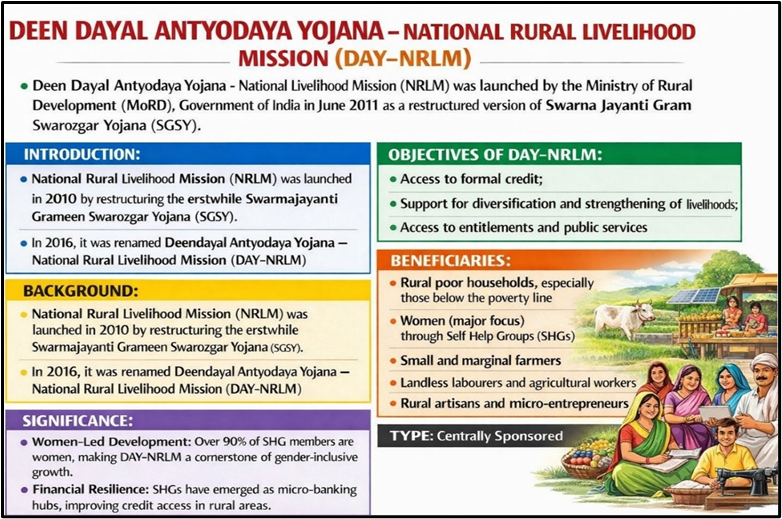
- The NRLM was designed to address multidimensional poverty by enabling rural households to access sustainable livelihoods through skills, credit, and entrepreneurship.
- Over 15 years, it has expanded significantly, with more than 20 million women earning over ₹1,000 monthly and widespread institutional penetration across local governance structures.
- More than 50 million women have accessed credit, strengthening financial inclusion and increasing female labour force participation.
- The mission has built a strong institutional ecosystem through federated SHGs, community cadres, and decentralised governance at village, cluster, and block levels.
- It has mobilised over 100 million households, formed millions of SHGs, and facilitated large-scale capitalisation and bank linkages.
- Budgetary support has increased substantially, reinforcing its role as a flagship poverty alleviation programme.
- The NRLM’s success lies in combining social mobilisation, institutional architecture, and access to credit and skills.
- Its model has gained international attention, particularly in African countries such as Ethiopia, Tanzania, Malawi, Kenya, and Rwanda.
- Delegations from these countries have studied both outcomes and operational mechanisms, including SHG scaling, credit linkages, and community mobilisation.
- The model promotes women’s empowerment through collective action, peer learning, and trust-based financial systems.
- Its cost-effective design relies on community-driven processes rather than heavy capital investment, making it scalable in resource-constrained settings.
- It aligns with the needs of informal economies by promoting microenterprises and livelihood diversification.
- The model strengthens local governance, accountability, and long-term community capacity.
- India is increasingly exporting institutional solutions rather than just financial aid, marking a shift in development diplomacy.
- Initiatives such as knowledge exchange platforms, training programmes, and pilot projects enable adaptation of the model in different contexts.
- NRLM demonstrates how domestic innovations can shape global development paradigms through South-South cooperation.
CONCLUSION:
India’s rural development model exemplifies how inclusive, community-driven approaches can drive both domestic transformation and international influence, redefining development diplomacy through knowledge sharing and institutional capacity building.
Source: (The Hindu)
La Excellence IAS Academy, the best IAS coaching in Hyderabad, known for delivering quality content and conceptual clarity for UPSC 2026 preparation.
FOLLOW US ON:
◉ YouTube : https://www.youtube.com/@CivilsPrepTeam
◉ Facebook: https://www.facebook.com/LaExcellenceIAS
◉ Instagram: https://www.instagram.com/laexcellenceiasacademy/
GET IN TOUCH:
Contact us at info@laex.in, https://laex.in/contact-us/
or Call us @ +91 9052 29 2929, +91 9052 99 2929, +91 9154 24 2140
OUR BRANCHES:
Head Office: H No: 1-10-225A, Beside AEVA Fertility Center, Ashok Nagar Extension, VV Giri Nagar, Ashok Nagar, Hyderabad, 500020
Madhapur: Flat no: 301, survey no 58-60, Guttala begumpet Madhapur metro pillar: 1524, Rangareddy Hyderabad, Telangana 500081
Bangalore: Plot No: 99, 2nd floor, 80 Feet Road, Beside Poorvika Mobiles, Chandra Layout, Attiguppe, Near Vijaya Nagara, Bengaluru, 560040