
Paper: GS – II, Subject: Governance, Topic: Government Policies and Interventions, Issue: Understanding Welfare vs Development.
Context:
In contemporary democratic politics, development has become a dominant electoral narrative. However, political discourse often blurs the distinction between welfare (short-term relief) and development (long-term transformation), leading to policy confusion and suboptimal outcomes.
Key Takeaways:
Conceptual Distinction:
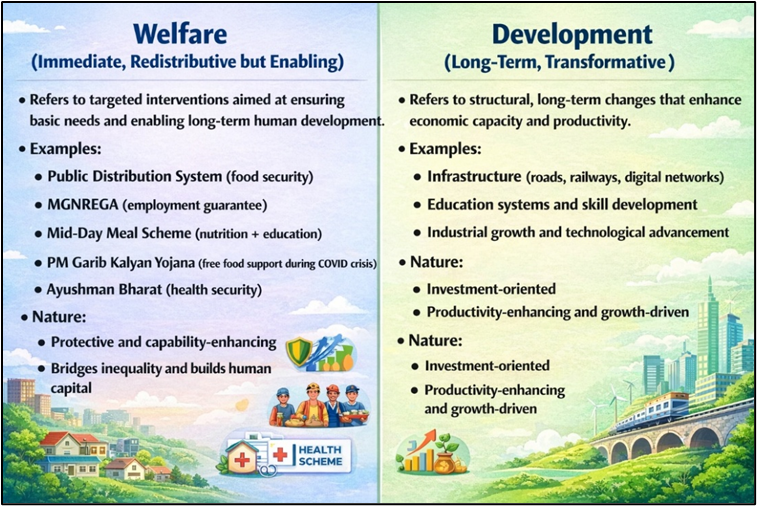
Complementarity vs Conflation:
• Ideally:
o Welfare → Provides safety net
o Development → Expands opportunities
• In practice:
o Welfare is often projected as development
o Short-term gains overshadow long-term outcomes
o Welfare initiatives become freebies.
• Result:
o Policy distortion and weak structural transformation
Freebies vs Welfare (Critical Distinction):
• Welfare Policies:
o Targeted, need-based, and linked to human capability enhancement
o Aim to reduce vulnerability and improve productivity
o Example: food security, health insurance, employment schemes
• Freebies (Populist Measures):
o Often announced close to elections to gain immediate voter support
o Universal or poorly targeted, with limited long-term value
o Examples: free electricity without targeting, cash doles, consumer goods distribution
o Nature:
Consumption-driven
Politically motivated rather than development-oriented
Key Difference:
• Welfare enables people to become productive
• Freebies prioritise immediate consumption without capacity building
Key Tensions:
- Fiscal Trade-off:
o Excessive spending on freebies:
Reduces fiscal space for infrastructure and growth
Crowds out capital expenditure - Incentive Distortion:
o Poorly designed transfers:
May discourage work participation
Create dependency rather than empowerment - Political Economy Bias:
o Governments tend to prioritise:
Visible, short-term electoral gains over
Long-term structural reforms
Development as a Long-Term Process:
• Development is:
o Incremental and cumulative
o Dependent on institutional capacity and continuity
• It unfolds through:
o Investment in infrastructure, education, and health
o Gradual expansion of economic opportunities
Dangers of Freebie-Driven Populism:
• Fiscal stress and debt burden
• Crowding out of productive investment
• Illusion of rapid development
• Weakening of governance and institutional priorities
Way Forward:
• Clearly distinguish welfare (productive) from freebies (consumptive)
• Ensure targeted and conditional welfare delivery
• Maintain fiscal discipline with focus on capital expenditure
• Align welfare with human capability enhancement (health, education, skills)
• Promote transparency in electoral promises and public spending
Conclusion:
Welfare and development are complementary but not interchangeable. Welfare provides immediate support and builds human capabilities, while development ensures long-term transformation. The real challenge lies in preventing welfare from degenerating into election-driven freebies, and instead aligning it with a sustainable, productivity-oriented development strategy.
Source: (The Hindu)
La Excellence IAS Academy, the best IAS coaching in Hyderabad, known for delivering quality content and conceptual clarity for UPSC 2026 preparation.
FOLLOW US ON:
◉ YouTube : https://www.youtube.com/@CivilsPrepTeam
◉ Facebook: https://www.facebook.com/LaExcellenceIAS
◉ Instagram: https://www.instagram.com/laexcellenceiasacademy/
GET IN TOUCH:
Contact us at info@laex.in, https://laex.in/contact-us/
or Call us @ +91 9052 29 2929, +91 9052 99 2929, +91 9154 24 2140
OUR BRANCHES:
Head Office: H No: 1-10-225A, Beside AEVA Fertility Center, Ashok Nagar Extension, VV Giri Nagar, Ashok Nagar, Hyderabad, 500020
Madhapur: Flat no: 301, survey no 58-60, Guttala begumpet Madhapur metro pillar: 1524, Rangareddy Hyderabad, Telangana 500081
Bangalore: Plot No: 99, 2nd floor, 80 Feet Road, Beside Poorvika Mobiles, Chandra Layout, Attiguppe, Near Vijaya Nagara, Bengaluru, 560040