
Paper: GS – II, Subject: Society and Social Justice, Topic: Social Sector – Health, Issue: Snakebite Crisis Needs Urgent Attention.
Context:
India accounts for a disproportionately high burden of snakebite cases and deaths, making snakebite envenoming a major public health concern. Recent incidents, especially during extreme heat conditions, highlight gaps in diagnosis, treatment, and healthcare infrastructure despite the availability of antivenom.
Key Takeaways:
BACKGROUND:
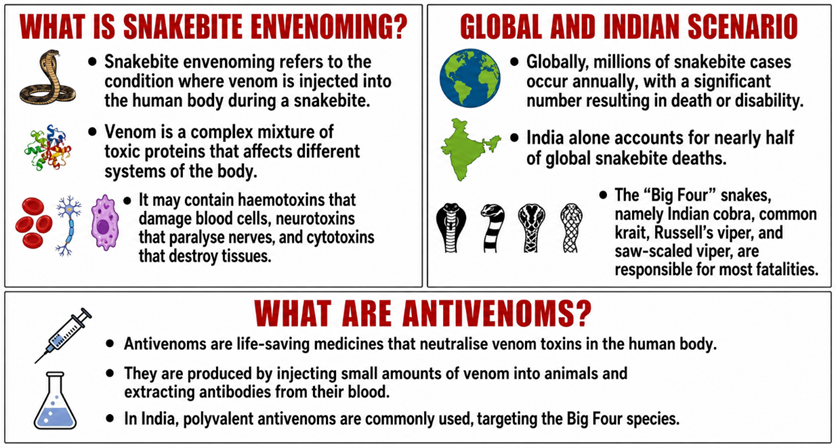
EXPLANATION:
Link Between Heat and Increased Snakebite Incidents:
- Snakes are ectothermic animals and depend on external temperature for regulating body functions.
- During extreme heat, snakes seek cooler and shaded areas such as human dwellings, increasing human-snake interactions.
- The pre-monsoon period is also a breeding season, leading to increased snake movement and defensive behaviour.
Nature of Snakebite Cases:
- A significant proportion of snakebite cases involve non-venomous snakes.
- Even among venomous bites, many are “dry bites” where no venom is injected.
- This creates challenges in deciding whether antivenom should be administered.
Challenges in Diagnosis and Treatment:
Absence of Rapid Diagnostic Tools:
- India lacks widely available diagnostic kits to detect venom in the bloodstream.
- Doctors rely on a syndromic approach based on symptoms rather than confirmed diagnosis.
- This leads to delays in treatment and sometimes irreversible damage before intervention.
Risks Associated with Antivenom Use:
- Antivenom administration can cause severe allergic reactions such as anaphylaxis.
- Therefore, indiscriminate use of antivenom is not advisable.
- This creates a dilemma for doctors in emergency situations.
Healthcare Infrastructure Gaps:
- Many rural and semi-urban areas lack access to intensive care units, ventilators, and trained medical personnel.
- Limited laboratory support further restricts monitoring and management of patients.
- These gaps reduce the effectiveness of available treatments.
Socio-economic and Environmental Factors:
- Agricultural workers and rural populations are most vulnerable due to occupational exposure.
- Poor housing conditions, presence of rodents, and vegetation near homes increase snake presence.
- Cultural beliefs and delayed healthcare-seeking behaviour worsen outcomes.
Policy Measures and Initiatives:
- Snakebite has been declared a notifiable disease in some regions to improve reporting and response.
- Programmes such as awareness campaigns and rescue initiatives aim to reduce risk and improve preparedness.
- The National Action Plan for Prevention and Control of Snakebite Envenoming aim to reduce deaths and disabilities significantly.
Way Forward:
- Development of rapid venom detection kits is essential for accurate and timely treatment.
- Strengthening healthcare infrastructure, especially in rural areas, is critical.
- Training healthcare workers in emergency management and anaphylaxis treatment is necessary.
- Public awareness regarding prevention and early medical intervention must be enhanced.
CONCLUSION:
Snakebite envenoming remains a neglected but serious public health issue in India, exacerbated by environmental factors such as rising temperatures and systemic healthcare gaps. Addressing this challenge requires a combination of technological innovation, improved medical infrastructure, and community-level awareness.
Source: (The Hindu)
La Excellence IAS Academy, the best IAS coaching in Hyderabad, known for delivering quality content and conceptual clarity for UPSC 2026 preparation.
FOLLOW US ON:
◉ YouTube : https://www.youtube.com/@CivilsPrepTeam
◉ Facebook: https://www.facebook.com/LaExcellenceIAS
◉ Instagram: https://www.instagram.com/laexcellenceiasacademy/
GET IN TOUCH:
Contact us at info@laex.in, https://laex.in/contact-us/
or Call us @ +91 9052 29 2929, +91 9052 99 2929, +91 9154 24 2140
OUR BRANCHES:
Head Office: H No: 1-10-225A, Beside AEVA Fertility Center, Ashok Nagar Extension, VV Giri Nagar, Ashok Nagar, Hyderabad, 500020
Madhapur: Flat no: 301, survey no 58-60, Guttala begumpet Madhapur metro pillar: 1524, Rangareddy Hyderabad, Telangana 500081
Bangalore: Plot No: 99, 2nd floor, 80 Feet Road, Beside Poorvika Mobiles, Chandra Layout, Attiguppe, Near Vijaya Nagara, Bengaluru, 560040