
Paper: GS – III, Subject: Environment and Ecology, Topic: Pollution and Sustainable Development, Issue: Corporate Average Fuel Efficiency-III Norms (CAFE III Norms).
Context:
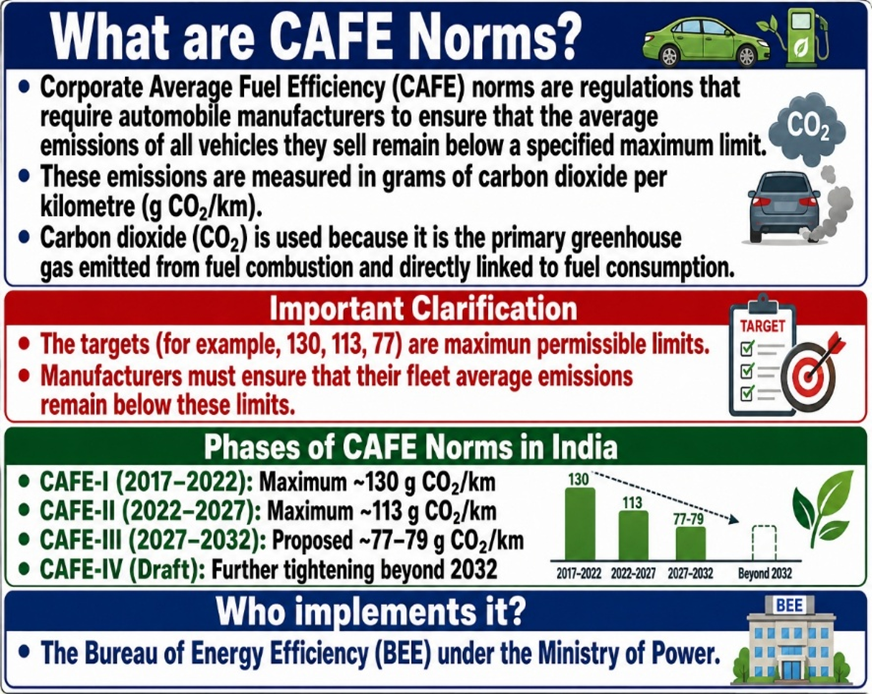
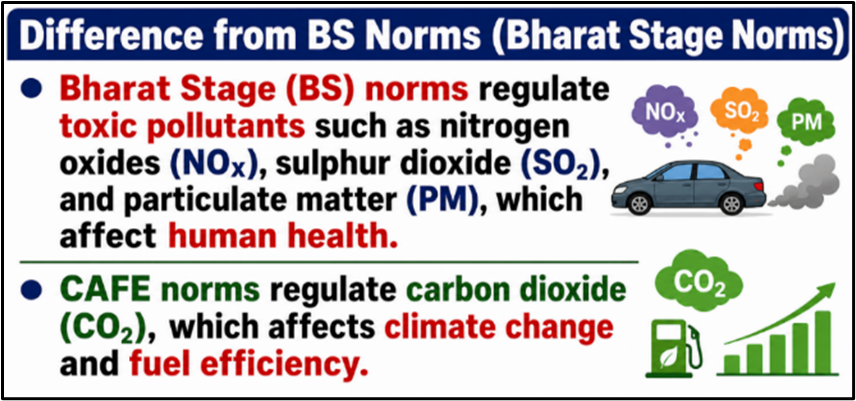
India is preparing to implement CAFE-III norms (2027–2032) to reduce emissions from passenger vehicles. While the proposed targets appear stricter, concerns have emerged that the design of the policy may weaken its effectiveness in driving a real transition to cleaner technologies like electric vehicles.
Key Takeaways:
Background:
Explanation:
1. Apparent Stringency vs Real Impact:
The reduction from about 113 g/km to around 77 g/km appears ambitious.
However, the policy allows several ways to meet the target without fundamentally changing vehicle technology. This allows manufacturers to choose from multiple ways to comply, rather than mandating a clear shift to cleaner technologies.
Example: A company can meet targets by:
Slightly improving engine efficiency
Adding start-stop systems (engine shuts off at signals)
Improving air-conditioning efficiency
Therefore, the numerical strictness may not translate into real emission reduction. The company meets rules on paper, but real emissions reduction remains limited.
2. Incremental Improvements vs Structural Transformation:
Incremental measures include:
Improving mileage
Blending ethanol with petrol (for example, increasing ethanol percentage in fuel)
These reduce emissions only marginally.
Structural change means: Transition to electric vehicles (EVs) or zero-emission mobility.
Issue: Policy allows incremental steps instead of forcing structural change.
3. “Super-Credit System”:
The policy gives extra weight (multipliers) to cleaner vehicles when calculating averages.
Example: If a company sells 1 electric vehicle, it may be counted as 3 vehicles for compliance purposes
This artificially reduces the company’s average emissions.
Problem: A company can sell a small number of EVs and still offset emissions from many petrol/diesel vehicles. This leads to mathematical compliance without proportional real-world impact.
4. Credit Trading and Banking:
Companies that perform better than required can:
Save extra compliance (banking)
Sell it to other companies (trading)
Example: Company A exceeds target → earns extra credits; Company B fails target → buys credits from Company A instead of improving vehicles.
Issue: Some firms may avoid technological upgrades and rely on buying credits.
5. Multi-Year Compliance (Why It Weakens Pressure):
Instead of checking compliance every year, it is checked over 3-year blocks.
Example: A company can: Perform poorly in Year 1 & compensate later in Year 2 or 3
Effect: Reduces urgency for immediate action & delays adoption of cleaner technology
6. Core Concern:
The policy risks becoming a system of “paper compliance”, rather than real decarbonisation
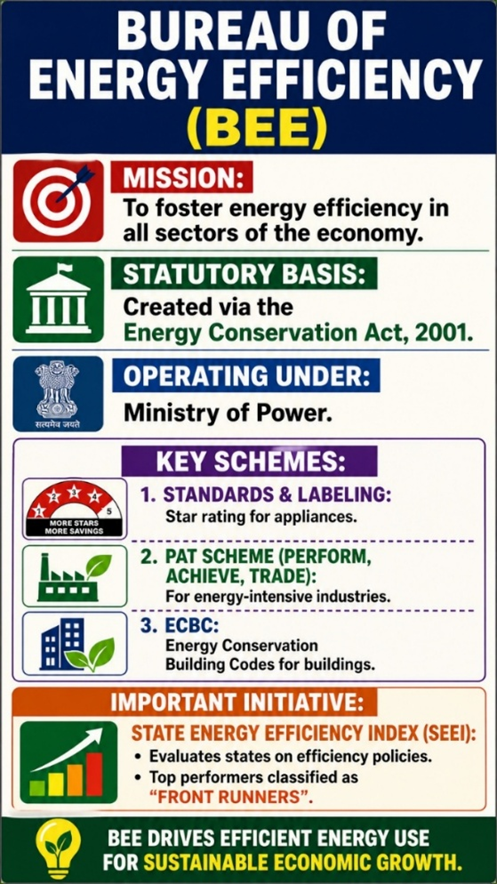
At a time when transport is a major source of emissions & India faces climate and energy security challenges; stronger push toward electric mobility is needed.
Conclusion:
CAFE-III norms represent progress in tightening emission standards, but their flexible design may limit real-world impact. For effective climate action, India must ensure that regulations drive a decisive shift toward low- and zero-emission technologies rather than relying on incremental improvements.
Source: (The Hindu)
La Excellence IAS Academy, the best IAS coaching in Hyderabad, known for delivering quality content and conceptual clarity for UPSC 2026 preparation.
FOLLOW US ON:
◉ YouTube : https://www.youtube.com/@CivilsPrepTeam
◉ Facebook: https://www.facebook.com/LaExcellenceIAS
◉ Instagram: https://www.instagram.com/laexcellenceiasacademy/
GET IN TOUCH:
Contact us at info@laex.in, https://laex.in/contact-us/
or Call us @ +91 9052 29 2929, +91 9052 99 2929, +91 9154 24 2140
OUR BRANCHES:
Head Office: H No: 1-10-225A, Beside AEVA Fertility Center, Ashok Nagar Extension, VV Giri Nagar, Ashok Nagar, Hyderabad, 500020
Madhapur: Flat no: 301, survey no 58-60, Guttala begumpet Madhapur metro pillar: 1524, Rangareddy Hyderabad, Telangana 500081
Bangalore: Plot No: 99, 2nd floor, 80 Feet Road, Beside Poorvika Mobiles, Chandra Layout, Attiguppe, Near Vijaya Nagara, Bengaluru, 560040