
Paper: GS – II, Subject: Polity, Topic: Elections, Issue: Electoral Roll Purges and Constitutional Concerns.
Context:
Recent reports highlight large-scale deletions of voters from electoral rolls in several states under the category of “logical discrepancy” during the Special Intensive Revision (SIR) conducted by the Election Commission of India (ECI). This has raised constitutional and procedural concerns regarding citizenship verification, voter rights, and institutional accountability.
Key Takeaways:
Background:
- Article 326 of the Constitution provides for universal adult suffrage based on citizenship, age, and non-disqualification.
- Under Article 324 of the Constitution of India (overall control of elections) read with the Representation of the People Act, 1950, the Election Commission of India is responsible for preparation and revision of electoral rolls.
- Electoral roll revision can be summary revision (routine) or intensive revision (detailed verification).
Explanation:
1. Nature of the Issue:
- Large numbers of voters were removed under vague categories such as “logical discrepancy.”
- Many commonly used documents (Aadhaar, ration card, voter ID) were reportedly not accepted.
- Rural and poor populations faced difficulty in producing required documents.
- Example: Around 91 lakh voters removed in West Bengal & Around 64 lakh removed in Bihar.
- This suggests possible exclusion of genuine voters, not just correction of rolls.
2. Citizenship vs Voter Registration:
- Citizenship is the fundamental basis for voting rights under Article 326.
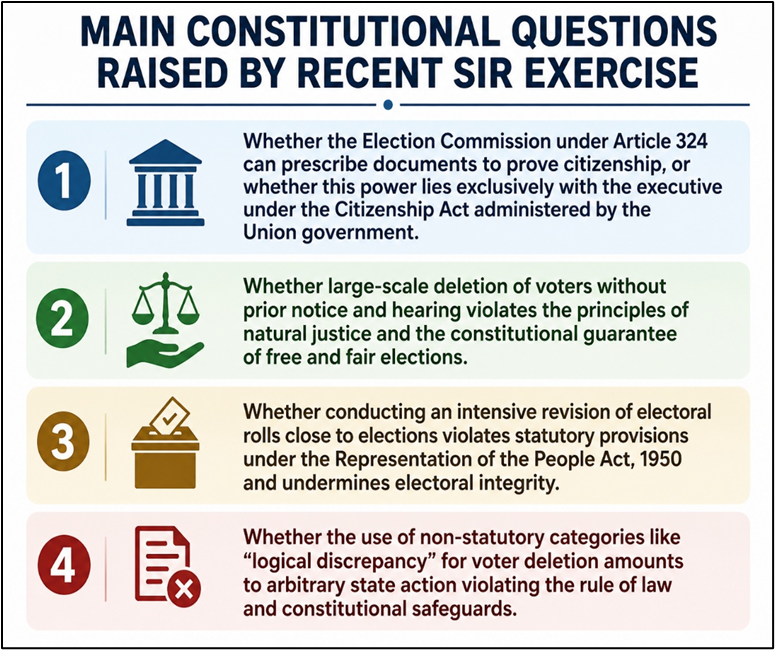
- The ECI can verify entries in electoral rolls but does not have the authority to determine citizenship conclusively.
- Citizenship determination is legally under the jurisdiction of the Union Ministry of Home Affairs (As it administers the Citizenship Act 1955).
- Hence ECI actions creating a jurisdictional overlap issue.
3. Legal and Procedural Concerns:
- The Special Intensive Revision appears to have been conducted hastily, sometimes close to elections.
- Laws permit intensive revision, but such processes require time and careful verification.
- The removal of voters without adequate opportunity to respond violates principles of natural justice.
4. Administrative Challenges:
- Many citizens, especially in rural areas, lack access to proper documentation.
- Some reports suggest that ECI did not accept routine documents such as Addhar
- Demanding multiple documents increases exclusion risks.
- Booth Level Officers (BLOs) may rely on local information, which can be inconsistent.
5. Democratic Implications:
- Exclusion from electoral rolls effectively denies the right to vote.
- It undermines electoral integrity and public trust in democratic institutions.
- Mass deletions can distort electoral outcomes and representation.
Conclusion:
The issue of electoral roll purges highlights the need to balance electoral integrity with inclusiveness. Ensuring due process, clear legal boundaries, and citizen-friendly verification mechanisms is essential to uphold democratic rights and constitutional values.
Source: (The Hindu)
La Excellence IAS Academy, the best IAS coaching in Hyderabad, known for delivering quality content and conceptual clarity for UPSC 2026 preparation.
FOLLOW US ON:
◉ YouTube : https://www.youtube.com/@CivilsPrepTeam
◉ Facebook: https://www.facebook.com/LaExcellenceIAS
◉ Instagram: https://www.instagram.com/laexcellenceiasacademy/
GET IN TOUCH:
Contact us at info@laex.in, https://laex.in/contact-us/
or Call us @ +91 9052 29 2929, +91 9052 99 2929, +91 9154 24 2140
OUR BRANCHES:
Head Office: H No: 1-10-225A, Beside AEVA Fertility Center, Ashok Nagar Extension, VV Giri Nagar, Ashok Nagar, Hyderabad, 500020
Madhapur: Flat no: 301, survey no 58-60, Guttala begumpet Madhapur metro pillar: 1524, Rangareddy Hyderabad, Telangana 500081
Bangalore: Plot No: 99, 2nd floor, 80 Feet Road, Beside Poorvika Mobiles, Chandra Layout, Attiguppe, Near Vijaya Nagara, Bengaluru, 560040