
Paper: GS – I/II, Subject: Society and Social Justice, Topic: Social Sector – Health, Issue: Reliability of Brain Death Protocols in India.
Context:
Recent allegations of premature or incorrect declaration of brain death, particularly in the context of organ transplantation, have triggered a national debate. The Supreme Court is now reviewing the reliability of the apnoea test and overall certification process, seeking expert inputs from AIIMS on improving safeguards and objectivity.
Key Takeaways:
Background:
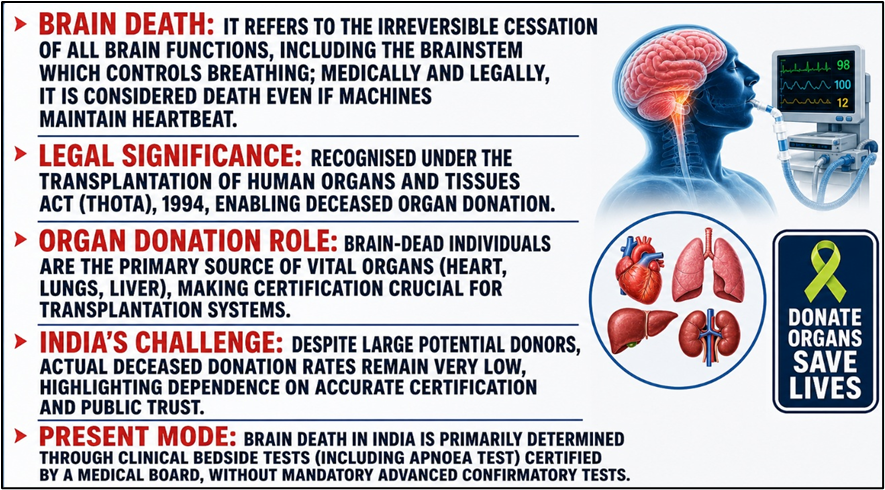
Explanation:
- Core Issue and Concerns:
o Allegations that some patients may be incorrectly declared brain dead to facilitate organ donation.
o Concerns that the apnoea test is subjective and not fully conclusive if used alone.
o Ethical issues regarding patient rights, informed consent, and transparency.
o Reports of non-adherence to safeguards such as mandatory documentation and videography. - Existing Protocol in India:
o Certification by a 4-member medical board (including neurologist/neurosurgeon).
o Brain death must be confirmed twice with a time gap (minimum 12 hours).
o Doctors must rule out reversible conditions (e.g., drugs, hypothermia).
o Advanced tests like EEG or angiography are not mandatory. - Apnoea Test (Central but Controversial):
o Involves removal/reduction of ventilator support to check spontaneous breathing.
o No breathing despite rising CO₂ → indicates brainstem failure.
o Criticism:
May reduce oxygen supply, potentially worsening condition.
Considered operator-dependent and subjective. - Objective Tests: EEG and Angiography:
o EEG (Electroencephalogram):
Records electrical activity of the brain
Brain death → no detectable signals
o Cerebral Angiography:
Assesses blood flow to the brain
Brain death → absence of cerebral circulation
o These provide objective, visual, and confirmatory evidence, reducing ambiguity. - International Practices:
o Many countries follow multi-step protocols, combining clinical examination with confirmatory tests.
o Guidelines (e.g., WHO-aligned practices) recommend that the apnoea test be used as a confirmatory tool, not the sole basis.
o Emphasis on standardisation, documentation, and accountability. - Practical and Systemic Challenges:
o Limited availability of EEG/angiography in smaller hospitals.
o High costs and infrastructure constraints.
o Mandatory use may reduce certification and organ donation rates.
o Lack of training and awareness among doctors; absence of standardised curriculum. - Supreme Court’s Observations and Directions:
o Recognised prima facie merit (“ring of truth”) in concerns raised.
o Highlighted need for scientifically rigorous and legally robust procedures.
o Directed AIIMS to:
Form an expert committee
Evaluate role of apnoea test
Recommend inclusion of additional confirmatory tests
o Timeline: Report within 2 months. - Broader Implications:
o Possible shift towards multi-test, standardised certification protocols.
o Strengthening of ethical safeguards and transparency in organ donation.
o Impact on availability of organs vs accuracy of diagnosis.
o Critical for maintaining public trust in the healthcare system.
Conclusion:
The issue highlights the delicate balance between medical certainty, ethical responsibility, and public trust. The Supreme Court’s review is likely to push India towards a more objective, transparent, and standardised brain death certification framework, ensuring both patient rights and integrity of organ donation systems.
Source: (The Hindu)
La Excellence IAS Academy, the best IAS coaching in Hyderabad, known for delivering quality content and conceptual clarity for UPSC 2026 preparation.
FOLLOW US ON:
◉ YouTube : https://www.youtube.com/@CivilsPrepTeam
◉ Facebook: https://www.facebook.com/LaExcellenceIAS
◉ Instagram: https://www.instagram.com/laexcellenceiasacademy/
GET IN TOUCH:
Contact us at info@laex.in, https://laex.in/contact-us/
or Call us @ +91 9052 29 2929, +91 9052 99 2929, +91 9154 24 2140
OUR BRANCHES:
Head Office: H No: 1-10-225A, Beside AEVA Fertility Center, Ashok Nagar Extension, VV Giri Nagar, Ashok Nagar, Hyderabad, 500020
Madhapur: Flat no: 301, survey no 58-60, Guttala begumpet Madhapur metro pillar: 1524, Rangareddy Hyderabad, Telangana 500081
Bangalore: Plot No: 99, 2nd floor, 80 Feet Road, Beside Poorvika Mobiles, Chandra Layout, Attiguppe, Near Vijaya Nagara, Bengaluru, 560040