
Paper: GS-III,Subject: Science and Technology,Topic: Indigenization and Development of Technologies, Issue: Naval Expansion vs Maritime Preparedness in the Indian Ocean
Context:
India is expanding its advanced naval capabilities through the construction of modern stealth frigates under Project 17A. While these warships strengthen maritime presence and deterrence, concerns remain regarding delays, technological dependence, sensor gaps, and whether naval expansion is fully aligned with India’s evolving security challenges in the Indian Ocean Region.
Background
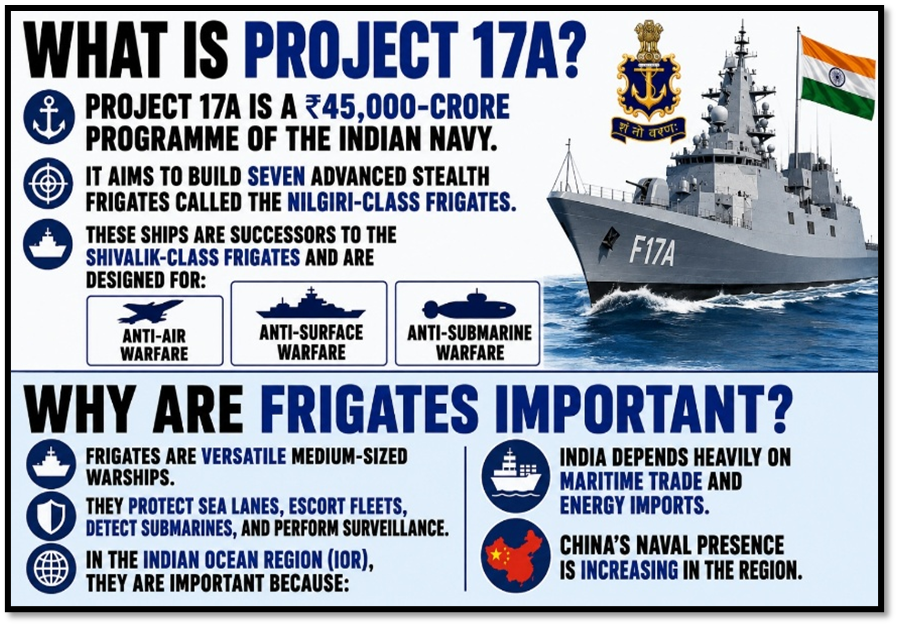
Explanation
Problems and Concerns
- Repeated delays in warship construction have affected operational readiness and fleet modernisation timelines.
- Many vessels face shortages of critical systems such as radars, sonars, engines, and advanced sensors despite formal delivery.
- India still depends heavily on imported high-end defence electronics and propulsion systems, limiting true strategic self-reliance.
- Expansion of naval platforms has not always been matched by adequate surveillance networks, underwater sensors, and maritime domain awareness systems.
- Existing sensor coverage in the Indian Ocean remains incomplete, reducing effective detection of submarines and maritime threats.
- Expensive high-end frigates may not always be the most efficient response to non-traditional threats such as piracy, smuggling, and drone attacks.
- Increasing Chinese submarine presence in the Indian Ocean demands stronger anti-submarine warfare capabilities, premium sensors, and integrated detection architecture.
Way Forward
- India should prioritize timely integration of combat systems and improve project management in naval shipbuilding.
- Greater investment is needed in indigenous development of radars, sonars, propulsion systems, and defence electronics.
- Maritime security strategy should focus equally on surveillance infrastructure, coastal security, satellites, and underwater sensor networks.
- The Indian Navy and Coast Guard should adopt a balanced force structure combining high-end warships with cost-effective surveillance and patrol assets.
- Indigenous defence manufacturing should be guided by strategic threat assessment and technological capability rather than only production targets.
- Stronger coordination between shipyards, defence research institutions, and private industry can improve technological reliability and reduce import dependence.
Conclusion:
India’s naval modernisation is essential for securing sea lanes, protecting trade, and responding to growing strategic competition in the Indian Ocean. However, long-term maritime strength will depend not only on increasing the number of warships, but also on improving technological self-reliance, surveillance capability, combat readiness, and integrated maritime security architecture.
Source: (The Hindu)
La Excellence IAS Academy, the best IAS coaching in Hyderabad, known for delivering quality content and conceptual clarity for UPSC 2026 preparation.
FOLLOW US ON:
◉ YouTube : https://www.youtube.com/@CivilsPrepTeam
◉ Facebook: https://www.facebook.com/LaExcellenceIAS
◉ Instagram: https://www.instagram.com/laexcellenceiasacademy/
GET IN TOUCH:
Contact us at info@laex.in, https://laex.in/contact-us/
or Call us @ +91 9052 29 2929, +91 9052 99 2929, +91 9154 24 2140
OUR BRANCHES:
Head Office: H No: 1-10-225A, Beside AEVA Fertility Center, Ashok Nagar Extension, VV Giri Nagar, Ashok Nagar, Hyderabad, 500020
Madhapur: Flat no: 301, survey no 58-60, Guttala begumpet Madhapur metro pillar: 1524, Rangareddy Hyderabad, Telangana 500081
Bangalore: Plot No: 99, 2nd floor, 80 Feet Road, Beside Poorvika Mobiles, Chandra Layout, Attiguppe, Near Vijaya Nagara, Bengaluru, 560040