
Paper: GS – III, Subject: Environment and Ecology, Topic: Pollution, Issue: Electric Mobility Transition: Delhi’s new proposed EV policy.
Context:
The Delhi Government has proposed the EV Policy 2.0 to accelerate the transition towards electric mobility and reduce vehicular pollution in the National Capital Region (NCR). Under the proposed policy, only electric two-wheelers may be permitted for new registrations from April 2028. The policy is intended to improve urban air quality, reduce dependence on fossil fuels, and support India’s broader climate and clean-energy objectives.
Key Takeaways:
Background:
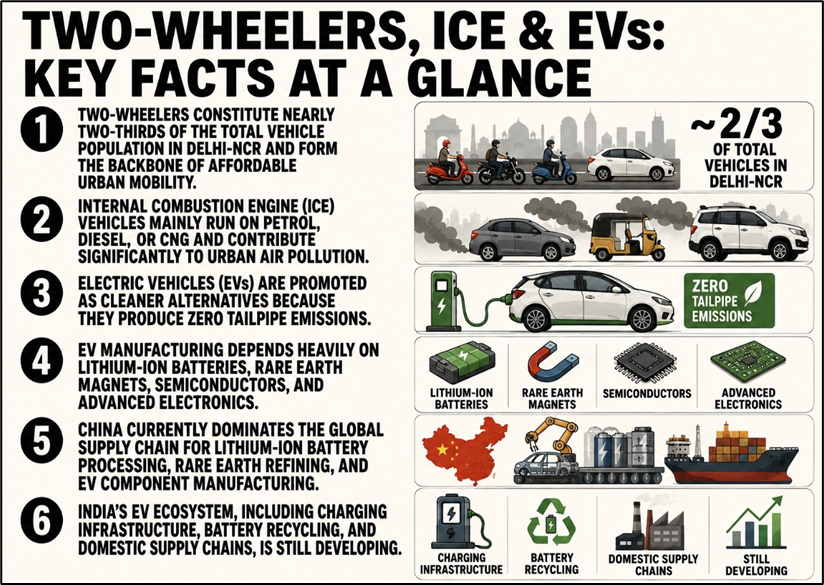
Explanation:
Major Concerns and Challenges:
Dependence on China for Critical Minerals and Components:
- EV batteries require critical minerals such as lithium, cobalt, nickel, graphite, and rare earth elements.
- China controls a major share of global battery processing, rare earth refining, and EV component manufacturing capacities.
- India currently imports a large share of battery cells, magnets, and advanced EV components from China.
- Excessive import dependence may create supply-chain vulnerabilities and strategic risks.
Inadequate Charging Infrastructure:
- Public charging stations remain insufficient for large-scale EV adoption.
- Many urban areas still lack reliable fast-charging networks.
- Long charging duration and limited charging access create range anxiety among consumers.
Livelihood and Employment Risks:
- Thousands of mechanics, repair shops, and informal-sector workers depend on servicing conventional vehicles.
- EVs require fewer moving parts and different maintenance systems, reducing demand for traditional automobile repair services.
- Small workshops and low-skilled workers may struggle to adapt quickly to new technologies.
High Initial Cost of Electric Vehicles:
- EV purchase prices remain relatively high despite lower operating costs.
- Battery costs continue to form a major portion of vehicle prices.
- Lower- and middle-income consumers may face affordability challenges during the transition.
Technological and Safety Concerns:
- Battery performance in extreme temperatures remains a concern in Indian climatic conditions.
- Fire hazards, battery degradation, and recycling challenges continue to raise safety and environmental concerns.
- Domestic expertise in advanced battery technologies remains limited.
Environmental Concerns Beyond Tailpipe Emissions:
- EVs reduce direct vehicular emissions but electricity generation in India still relies heavily on coal-based thermal power.
- If electricity comes mainly from fossil fuels, overall carbon reduction benefits may remain limited.
- Battery disposal and e-waste management also pose emerging environmental challenges.
Industrial and Manufacturing Challenges:
- Automobile manufacturers and ancillary industries require time to restructure production systems and investments.
- Rapid policy shifts may disrupt existing supply chains, manufacturing units, and dealer networks.
- Domestic EV manufacturing ecosystems are still evolving and may not yet support large-scale demand.
Way Forward:
- Adopt a gradual and predictable EV transition with realistic timelines for industries and consumers.
- Expand renewable energy generation to ensure cleaner electricity for EV charging.
- Strengthen domestic production of batteries, semiconductors, and critical EV components under initiatives such as Make in India and PLI schemes.
- Develop large-scale skill-development and reskilling programmes for mechanics, technicians, and small enterprises involved in the automobile sector.
Conclusion:
Electric mobility is essential for improving urban air quality and supporting climate goals, but the transition must remain technologically feasible, economically practical, and socially inclusive. A balanced approach that combines environmental sustainability, domestic manufacturing capacity, energy security, and livelihood protection is necessary for achieving a successful long-term EV transition.
Source: (The Indian Express)
La Excellence IAS Academy, the best IAS coaching in Hyderabad, known for delivering quality content and conceptual clarity for UPSC 2026 preparation.
FOLLOW US ON:
◉ YouTube : https://www.youtube.com/@CivilsPrepTeam
◉ Facebook: https://www.facebook.com/LaExcellenceIAS
◉ Instagram: https://www.instagram.com/laexcellenceiasacademy/
GET IN TOUCH:
Contact us at info@laex.in, https://laex.in/contact-us/
or Call us @ +91 9052 29 2929, +91 9052 99 2929, +91 9154 24 2140
OUR BRANCHES:
Head Office: H No: 1-10-225A, Beside AEVA Fertility Center, Ashok Nagar Extension, VV Giri Nagar, Ashok Nagar, Hyderabad, 500020
Madhapur: Flat no: 301, survey no 58-60, Guttala begumpet Madhapur metro pillar: 1524, Rangareddy Hyderabad, Telangana 500081
Bangalore: Plot No: 99, 2nd floor, 80 Feet Road, Beside Poorvika Mobiles, Chandra Layout, Attiguppe, Near Vijaya Nagara, Bengaluru, 560040