
Paper: GS – III, Subject: Economy, Topic: Trade and External sector, Issue: Forex Reserve Management and India’s Development Path.
Context:
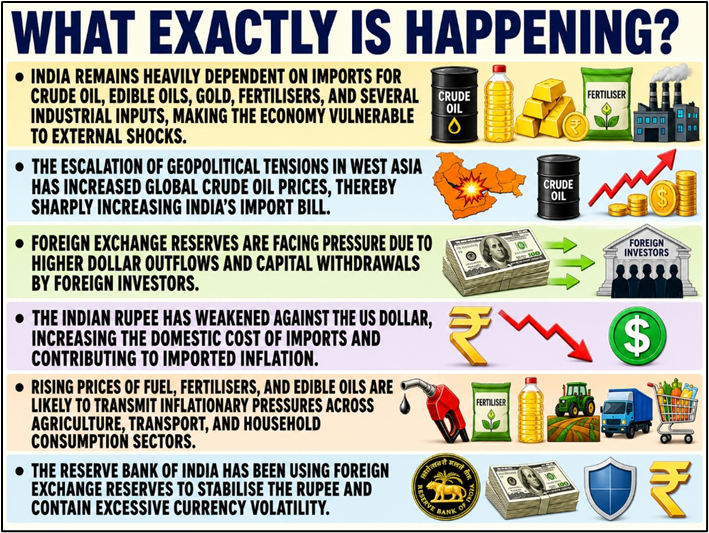
India is facing pressure on its foreign exchange reserves, the rupee, and import bill because of the West Asia crisis, rising oil prices, gold imports, and capital outflows. The government is therefore asking citizens to reduce activities that require large amounts of foreign currency.
Key Takeaways:
Government Appeal and Its Critical Analysis:
Government’s Economic Appeal:
1. Reducing Fuel Consumption:
- Citizens have been encouraged to reduce fuel consumption through greater use of public transport, electric vehicles, and work-from-home arrangements wherever feasible.
- The objective is to reduce crude oil imports and thereby lower foreign exchange outflows arising from petroleum purchases.
2. Curtailing Non-Essential Foreign Exchange Expenditure:
- People have been advised to avoid unnecessary foreign travel and reduce expenditure involving foreign currency.
- Such measures aim to conserve foreign exchange reserves during a period of external economic uncertainty.
3. Discouraging Gold Imports:
- Citizens have been encouraged to postpone or reduce gold purchases because India imports most of its gold requirements.
- Large-scale gold imports increase dollar demand and widen the Current Account Deficit, thereby exerting pressure on the rupee.
4. Promoting Domestic Consumption:
- Greater use of domestically produced goods has been emphasised as a means of reducing import dependence and supporting local industries.
- The broader objective is to improve economic self-reliance and reduce vulnerability to global supply disruptions.
5. Reducing Excessive Chemical Fertiliser Usage:
- Farmers have been encouraged to reduce excessive dependence on imported chemical fertilisers and gradually adopt balanced agricultural practices.
- This is linked to rising fertiliser import costs and disruptions in global supply chains.
Critical Analysis of the Appeal:
1. Risk of Slower Economic Growth:
- Excessive emphasis on reducing consumption may weaken aggregate demand and adversely affect sectors dependent on consumer spending.
- Lower consumption of travel, fuel, and discretionary goods can reduce business activity and slow economic growth.
2. Structural Dependence on Imports:
- India cannot rapidly eliminate dependence on imports because several critical sectors such as energy, fertilisers, and edible oils lack sufficient domestic production capacity.
- Abrupt reductions in imports may disrupt industrial production and agricultural productivity.
3. Concerns Regarding Agricultural Output:
- Sharp reductions in chemical fertiliser usage without adequate alternatives may reduce crop productivity and worsen food inflation.
- This concern becomes more significant during periods of climatic uncertainty and supply-side stress.
4. Limited Immediate Alternatives:
- Domestic substitutes for imported edible oils, energy products, and industrial inputs cannot be scaled up quickly enough to fully replace imports.
- Regional consumption preferences and supply constraints further limit rapid substitution.
5. Pressure on Inflation and Household Welfare:
- Rising import costs and rupee depreciation can increase inflation across fuel, transport, food, and essential commodities.
- Lower-income households are likely to face a disproportionate burden due to higher living costs.
Need for Long-Term Structural Solutions:
- Sustainable external sector stability requires higher exports, improved manufacturing competitiveness, stronger productivity growth, and greater investment inflows.
- Merely suppressing consumption may provide temporary relief but cannot substitute long-term economic strengthening.
Conclusion:
The current external economic pressures highlight India’s vulnerability to global commodity shocks and geopolitical disruptions. While temporary conservation measures may help reduce foreign exchange stress in the short term, long-term resilience will depend on expanding domestic production capacity, strengthening exports, improving productivity, and reducing structural import dependence through sustained economic reforms.
Source: (The Indian Express)
La Excellence IAS Academy, the best IAS coaching in Hyderabad, known for delivering quality content and conceptual clarity for UPSC 2026 preparation.
FOLLOW US ON:
◉ YouTube : https://www.youtube.com/@CivilsPrepTeam
◉ Facebook: https://www.facebook.com/LaExcellenceIAS
◉ Instagram: https://www.instagram.com/laexcellenceiasacademy/
GET IN TOUCH:
Contact us at info@laex.in, https://laex.in/contact-us/
or Call us @ +91 9052 29 2929, +91 9052 99 2929, +91 9154 24 2140
OUR BRANCHES:
Head Office: H No: 1-10-225A, Beside AEVA Fertility Center, Ashok Nagar Extension, VV Giri Nagar, Ashok Nagar, Hyderabad, 500020
Madhapur: Flat no: 301, survey no 58-60, Guttala begumpet Madhapur metro pillar: 1524, Rangareddy Hyderabad, Telangana 500081
Bangalore: Plot No: 99, 2nd floor, 80 Feet Road, Beside Poorvika Mobiles, Chandra Layout, Attiguppe, Near Vijaya Nagara, Bengaluru, 560040