
Paper: GS – II, Subject: Governance, Topic: Government Policies, interventions, Issue: Water Governance in India.
Context:
India’s water crisis is not merely a problem of water scarcity but also a challenge of water governance and management. Despite receiving substantial annual rainfall, inefficient storage, unequal distribution, groundwater overuse, and institutional fragmentation have created severe water stress across many regions of the country.
Key Takeaways:
Background:
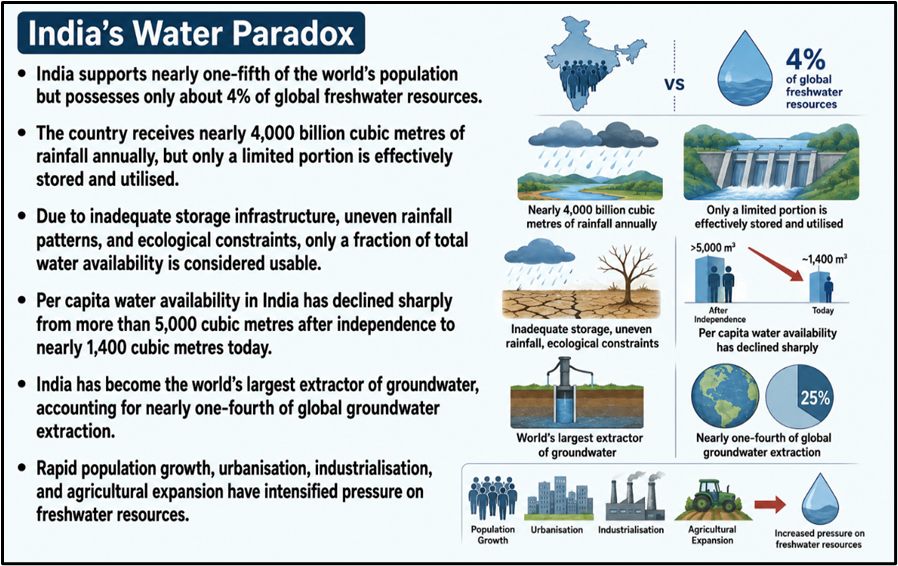
Explanation:
Nature of India’s Water Crisis:
- India’s water crisis is both hydrological and institutional in nature.
- Many regions experience declining groundwater tables due to excessive extraction for irrigation and domestic use.
- Water stress is aggravated by climate variability, erratic monsoons, floods, droughts, pollution, and inefficient irrigation practices.
- Agriculture consumes the majority of India’s freshwater resources, making irrigation efficiency extremely important.
- Urban areas face rising demand for drinking water, sewage treatment, and wastewater management.
Institutional Structure of Water Governance:
- Water governance in India follows a multi-level federal structure involving the Union government, States, and local bodies.
- The Ministry of Jal Shakti acts as the nodal ministry for water resources, drinking water, and sanitation.
- The Central Water Commission focuses on surface water planning, river basin development, and flood management.
- The Central Ground Water Board studies groundwater resources and promotes sustainable aquifer management.
- Since water is largely a State subject under the Constitution, State governments play the primary role in irrigation, groundwater regulation, and local water supply.
- Local governments and urban bodies are responsible for implementation and maintenance of water services.
Major Government Initiatives:
- The Jal Jeevan Mission aims to provide functional tap water connections to rural households.
- The Atal Bhujal Yojana promotes participatory groundwater management and community-based water budgeting in water-stressed regions.
- The Pradhan Mantri Krishi Sinchayee Yojana encourages micro-irrigation and efficient water use in agriculture.
- AMRUT (Atal Mission for Rejuvenation and Urban Transformation) focuses on urban water supply, sewage systems, and wastewater reuse.
- The Namami Gange Programme combines pollution control, sewage treatment, and ecological restoration of the Ganga basin.
- NITI Aayog’s Composite Water Management Index promotes competitive and evidence-based water governance among States.
Towards a Circular Water Economy:
- Modern water governance increasingly emphasises wastewater recycling, reuse, efficient irrigation, and technological innovation.
- Treated wastewater can reduce pressure on freshwater resources in urban areas.
- Scientific water governance requires coordination between governments, communities, and technology-driven monitoring systems.
- Sustainable water management is essential for achieving food security, economic growth, public health, and climate resilience.
Conclusion:
India’s future water security will depend not only on the quantity of rainfall received but also on the quality of governance, regulation, and institutional coordination. A shift toward sustainable, participatory, and technology-driven water management is necessary to transform India’s water economy from a cycle of scarcity to a framework of long-term sustainability
Source: (The Hindu)
La Excellence IAS Academy, the best IAS coaching in Hyderabad, known for delivering quality content and conceptual clarity for UPSC 2026 preparation.
FOLLOW US ON:
◉ YouTube : https://www.youtube.com/@CivilsPrepTeam
◉ Facebook: https://www.facebook.com/LaExcellenceIAS
◉ Instagram: https://www.instagram.com/laexcellenceiasacademy/
GET IN TOUCH:
Contact us at info@laex.in, https://laex.in/contact-us/
or Call us @ +91 9052 29 2929, +91 9052 99 2929, +91 9154 24 2140
OUR BRANCHES:
Head Office: H No: 1-10-225A, Beside AEVA Fertility Center, Ashok Nagar Extension, VV Giri Nagar, Ashok Nagar, Hyderabad, 500020
Madhapur: Flat no: 301, survey no 58-60, Guttala begumpet Madhapur metro pillar: 1524, Rangareddy Hyderabad, Telangana 500081
Bangalore: Plot No: 99, 2nd floor, 80 Feet Road, Beside Poorvika Mobiles, Chandra Layout, Attiguppe, Near Vijaya Nagara, Bengaluru, 560040