
Paper: GS – II, Subject: International Relations, Topic: Agreements involving India and/or affecting India’s interests, Issue: U.S.–China Relations.
Context:
A summit between Xi Jinping and Donald Trump is taking place in Beijing currently amid intensifying geopolitical instability marked by the Iran crisis, trade tensions, AI and semiconductor rivalry, and growing strategic competition in the Indo-Pacific. The meeting reflects the reality that U.S.–China Relations now shape not only bilateral ties but also the broader global economic and security order.
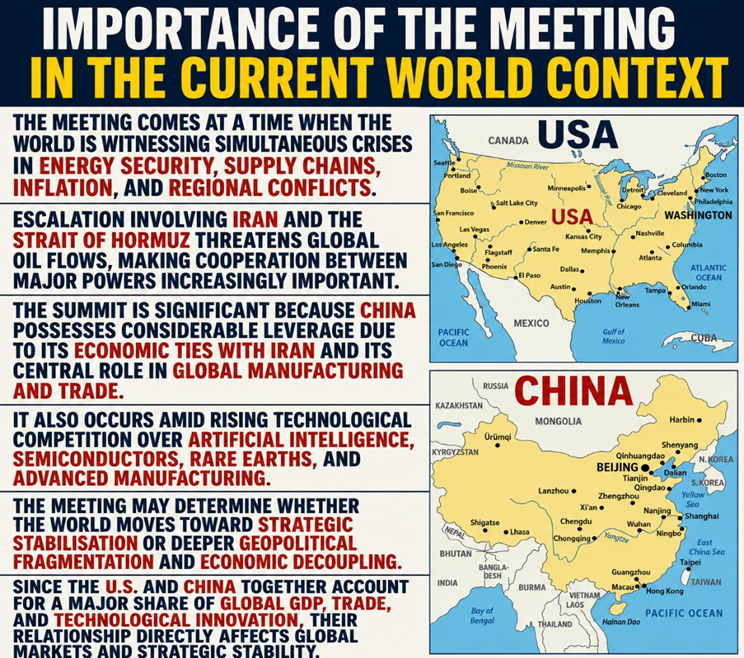
Key Takeaways:
Various Dimensions of U.S.–China Relations and Possible Outcomes of the Meeting:
Trade and Economic Relations:
- Trade tensions remain central, especially regarding tariffs, market access, and supply-chain dependence.
- Limited trade accommodation or tariff easing may emerge to reduce global economic uncertainty.
- However, strategic distrust and efforts toward supply-chain diversification are likely to continue.
Technology and AI Competition:
- AI, semiconductors, and export controls have become core areas of rivalry.
- The U.S. seeks to restrict China’s access to advanced chips, while China aims for technological self-reliance.
- Continued technological decoupling may fragment global technology ecosystems.
Iran and West Asia:
- China may play a mediatory or stabilising role due to its strong ties with Iran.
- The U.S. may seek Chinese cooperation to prevent wider regional escalation and disruption of oil supplies.
- Stability in West Asia is crucial for global energy markets and inflation control.
Taiwan and Indo-Pacific Security:
- Taiwan remains a major flashpoint, with increasing military and diplomatic tensions.
- Any improvement in communication mechanisms may reduce risks of military confrontation in the Indo-Pacific.
Impact on India:
- India may benefit from supply-chain diversification and investments shifting away from China.
- Stable U.S.–China relations could support global economic recovery and energy price moderation, benefiting India’s import-dependent economy.
- However, intensified rivalry may increase strategic pressure on India regarding Indo-Pacific alignments, technology partnerships, and balancing relations with both powers.
Conclusion:
The Xi–Trump summit represents more than a bilateral diplomatic engagement; it reflects the evolving structure of global power politics in an era shaped by economic interdependence and strategic rivalry. The outcomes of the meeting will significantly influence global trade, technological competition, regional security, and the strategic environment within which India must pursue its national interests.
Source: (The Indian Express, The Hindu)
La Excellence IAS Academy, the best IAS coaching in Hyderabad, known for delivering quality content and conceptual clarity for UPSC 2026 preparation.
FOLLOW US ON:
◉ YouTube : https://www.youtube.com/@CivilsPrepTeam
◉ Facebook: https://www.facebook.com/LaExcellenceIAS
◉ Instagram: https://www.instagram.com/laexcellenceiasacademy/
GET IN TOUCH:
Contact us at info@laex.in, https://laex.in/contact-us/
or Call us @ +91 9052 29 2929, +91 9052 99 2929, +91 9154 24 2140
OUR BRANCHES:
Head Office: H No: 1-10-225A, Beside AEVA Fertility Center, Ashok Nagar Extension, VV Giri Nagar, Ashok Nagar, Hyderabad, 500020
Madhapur: Flat no: 301, survey no 58-60, Guttala begumpet Madhapur metro pillar: 1524, Rangareddy Hyderabad, Telangana 500081
Bangalore: Plot No: 99, 2nd floor, 80 Feet Road, Beside Poorvika Mobiles, Chandra Layout, Attiguppe, Near Vijaya Nagara, Bengaluru, 560040