
Paper: GS – III, Subject: Economy, Topic: Economic reforms, Issue: India’s Fertiliser Subsidy Burden and the Need for Economic Reforms.
Context:
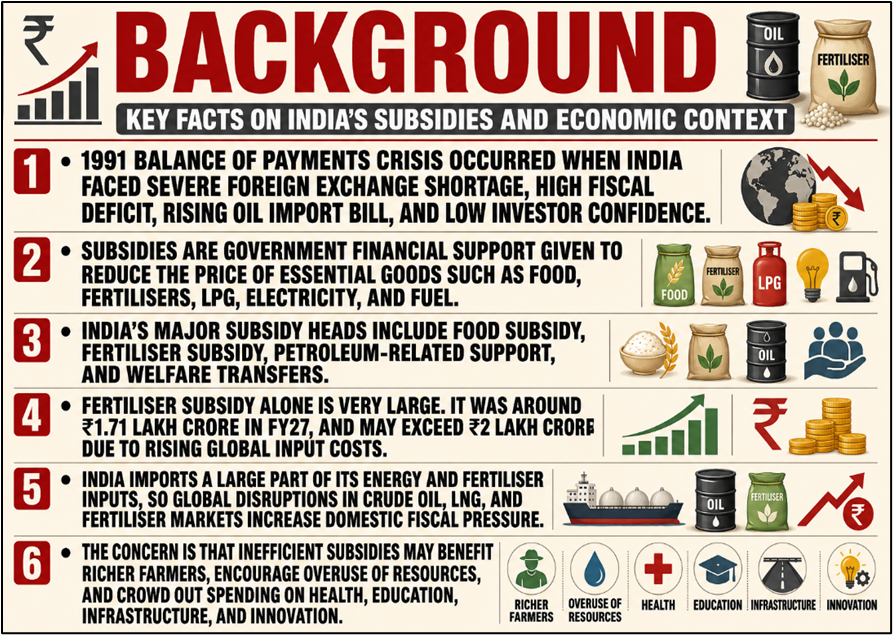
India is facing renewed concerns over macroeconomic stability due to pressure on the rupee, global oil price volatility, and a large subsidy burden. The issue is being compared to a “1991-type moment” because external shocks and domestic fiscal stress may force India to rethink subsidies, especially in fertilisers, food, and energy.
Key Takeaways:
Explanation:
Why India Faces a Reform Moment:
- India’s economy is vulnerable when global oil prices rise because crude oil is a major import item.
- A weaker rupee makes imports costlier, especially crude oil, LNG, fertilisers, and other essential commodities.
- If inflation rises due to fuel and fertiliser prices, the government often increases subsidies to protect consumers and farmers.
- This creates a fiscal burden because the government must spend more while still maintaining growth and welfare commitments.
Fertiliser Subsidy: Core Problem:
- Fertiliser subsidies are meant to keep farm inputs affordable and protect food security.
- However, the system often supports products rather than directly supporting farmers.
- Urea is heavily subsidised, which makes it cheaper than other nutrients like phosphorus and potassium.
- This causes excessive use of urea and leads to imbalanced fertiliser consumption, soil degradation, and lower nutrient efficiency.
- The subsidy also creates risks of leakage, diversion, and inefficient targeting.
Food and Energy Subsidies:
- Food subsidy helps provide cheap foodgrains through the Public Distribution System and protects vulnerable households.
- However, free or highly subsidised foodgrains can become fiscally costly if coverage is not rationalised.
- Energy subsidies, including fuel and LPG support, can also distort consumption and increase import dependence.
Direct Benefit Transfer as a Solution:
- A better reform path is to shift from price-based subsidies to direct income support.
- Direct Benefit Transfer can reduce leakages and ensure that the benefit reaches the intended beneficiary.
- Linking fertiliser support with land records, Aadhaar, Jan Dhan accounts, and PM-Kisan can improve targeting.
- However, implementation must protect small and marginal farmers from sudden price shocks.
Wider Reform Need:
- India needs subsidy rationalisation, better targeting, nutrient-balanced fertiliser policy, and stronger fiscal discipline.
- Reforms should not mean withdrawal of welfare, but redesigning welfare so that public money reaches the poor more efficiently.
Conclusion:
India’s subsidy system needs reform because poorly targeted subsidies create fiscal stress and economic distortions. The way forward is not to remove support suddenly, but to shift towards targeted, transparent, and direct benefit-based welfare while protecting farmers, the poor, and food security.
Source: (The Indian Express)
La Excellence IAS Academy, the best IAS coaching in Hyderabad, known for delivering quality content and conceptual clarity for UPSC 2026 preparation.
FOLLOW US ON:
◉ YouTube : https://www.youtube.com/@CivilsPrepTeam
◉ Facebook: https://www.facebook.com/LaExcellenceIAS
◉ Instagram: https://www.instagram.com/laexcellenceiasacademy/
GET IN TOUCH:
Contact us at info@laex.in, https://laex.in/contact-us/
or Call us @ +91 9052 29 2929, +91 9052 99 2929, +91 9154 24 2140
OUR BRANCHES:
Head Office: H No: 1-10-225A, Beside AEVA Fertility Center, Ashok Nagar Extension, VV Giri Nagar, Ashok Nagar, Hyderabad, 500020
Madhapur: Flat no: 301, survey no 58-60, Guttala begumpet Madhapur metro pillar: 1524, Rangareddy Hyderabad, Telangana 500081
Bangalore: Plot No: 99, 2nd floor, 80 Feet Road, Beside Poorvika Mobiles, Chandra Layout, Attiguppe, Near Vijaya Nagara, Bengaluru, 560040