
Paper: GS – II, Subject: Polity, Topic: Associations, Issue: Rise of Digital Outrage Politics.
Context:
A new form of youth-centred political mobilisation is emerging through social media platforms, memes, slogans, and online communities. It reflects growing frustration with established politics, but also raises questions about whether digital anger can become a serious democratic force.
Key Takeaways:
Explanation:
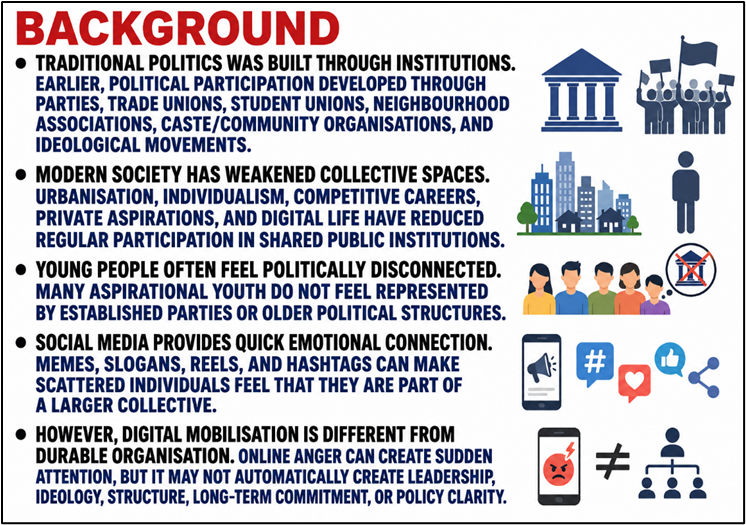
- The rise of meme-based and youth-led political formations shows a deeper crisis in public life. People are angry, expressive, and digitally connected, but they may remain disconnected from stable political institutions.
- This is also a crisis of collective social life. Citizens still desire belonging, justice, dignity, and political participation, but older institutions that organised public life have weakened.
- Digital platforms create emotional synchronisation. Thousands of individuals may react together to a common issue, symbol, slogan, or perceived enemy. This creates the feeling of a movement.
- But synchronisation is not the same as organisation. A crowd can gather around outrage, but a serious political force requires continuity, discipline, internal debate, leadership, ideology, and a future programme.
- Online mobilisation is often reactive. It is easier to unite people against something than to unite them around a constructive long-term agenda.
- Cross-country comparisons require caution. Youth protests in some countries may become major political movements when they connect with deeper social, economic, and institutional conditions. The same pattern cannot be applied mechanically everywhere.
- Digital politics also contains a contradiction. Social media appears decentralised because anyone can post, mobilise, or participate. However, the platforms themselves are controlled by highly centralised technological, financial, and algorithmic systems.
- Therefore, digital politics may challenge old power but may also create new forms of power. Algorithms, influencers, platform owners, and data systems can shape public opinion without sufficient democratic accountability.
- The real test is transformation. Digital anger becomes politically meaningful only when it turns into trust, organisation, responsibility, policy imagination, and long-term democratic commitment.
Conclusion:
Contemporary politics is shifting from institution-based mobilisation to emotion-based digital mobilisation. Such politics can reveal alienation and public anger, but unless it builds organisation, ideology, and democratic responsibility, it may remain reactive rather than transformative.
Source: (The Hindu)
La Excellence IAS Academy, the best IAS coaching in Hyderabad, known for delivering quality content and conceptual clarity for UPSC 2026 preparation.
FOLLOW US ON:
◉ YouTube : https://www.youtube.com/@CivilsPrepTeam
◉ Facebook: https://www.facebook.com/LaExcellenceIAS
◉ Instagram: https://www.instagram.com/laexcellenceiasacademy/
GET IN TOUCH:
Contact us at info@laex.in, https://laex.in/contact-us/
or Call us @ +91 9052 29 2929, +91 9052 99 2929, +91 9154 24 2140
OUR BRANCHES:
Head Office: H No: 1-10-225A, Beside AEVA Fertility Center, Ashok Nagar Extension, VV Giri Nagar, Ashok Nagar, Hyderabad, 500020
Madhapur: Flat no: 301, survey no 58-60, Guttala begumpet Madhapur metro pillar: 1524, Rangareddy Hyderabad, Telangana 500081
Bangalore: Plot No: 99, 2nd floor, 80 Feet Road, Beside Poorvika Mobiles, Chandra Layout, Attiguppe, Near Vijaya Nagara, Bengaluru, 560040