
Paper: GS – I, Subject: Geography, Topic: Geo-physical Phenomenon, Issue: Rising Night-Time Heat: India’s Emerging Public Health Crisis.
Context:
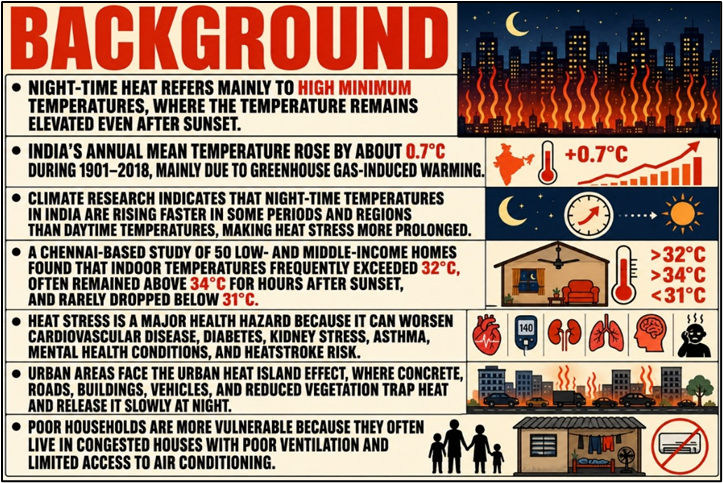
India’s heat-risk debate usually focuses on peak daytime temperatures, but warmer nights are now emerging as a serious public health concern. When nights do not cool sufficiently, the human body loses its recovery period, making heat exposure continuous, especially for people living in low-income and poorly ventilated urban houses.
Key Takeaways:
Explanation:
Why Night-time Heat is Dangerous?
- Night-time heat is dangerous because it converts heat exposure from a daytime problem into a 24-hour health burden.
- When nights remain hot, the body does not get enough time to cool down, leading to prolonged stress on the heart, kidneys, respiratory system, and nervous system.
- The article points out that hotter nights are linked with higher mortality, especially among elderly people, children, outdoor workers, pregnant women, and people with existing illnesses.
Evidence from the Article:
- The article mentions that India’s average temperature has increased over the last century, but the rise in night-time temperature is becoming a growing concern.
- A study cited in the article notes that even small increases in night-time temperature can significantly increase discomfort and health risks.
- An example from Ahmedabad shows that when night-time temperatures cross certain thresholds, all-cause mortality rises sharply.
Urban Heat Island Effect:
- Cities remain hotter at night because concrete, asphalt, bricks, and glass absorb heat during the day and release it slowly after sunset.
- Lack of trees, water bodies, open spaces, and natural ventilation further reduces night-time cooling.
- Dense high-rise buildings and narrow lanes restrict air movement, making low-income settlements especially vulnerable.
Need for Relief Measures:
- Relief measures must go beyond heatwave warnings and drinking water points.
- Passive cooling methods such as whitewashed roofs, reflective coatings, improved ventilation, shaded streets, urban greenery, and better housing design can reduce heat exposure.
- Heat action plans should include night-time temperature indicators, ward-level vulnerability mapping, public cooling shelters, and targeted support for poor households.
Conclusion:
Rising night-time heat is not merely a climate issue; it is a public health, urban planning, and social justice challenge. India’s heat action plans must shift from only managing extreme daytime heat to addressing sustained 24-hour heat exposure through climate-resilient housing, urban cooling, and protection of vulnerable populations.
Source: (The Indian Express)
La Excellence IAS Academy, the best IAS coaching in Hyderabad, known for delivering quality content and conceptual clarity for UPSC 2026 preparation.
FOLLOW US ON:
◉ YouTube : https://www.youtube.com/@CivilsPrepTeam
◉ Facebook: https://www.facebook.com/LaExcellenceIAS
◉ Instagram: https://www.instagram.com/laexcellenceiasacademy/
GET IN TOUCH:
Contact us at info@laex.in, https://laex.in/contact-us/
or Call us @ +91 9052 29 2929, +91 9052 99 2929, +91 9154 24 2140
OUR BRANCHES:
Head Office: H No: 1-10-225A, Beside AEVA Fertility Center, Ashok Nagar Extension, VV Giri Nagar, Ashok Nagar, Hyderabad, 500020
Madhapur: Flat no: 301, survey no 58-60, Guttala begumpet Madhapur metro pillar: 1524, Rangareddy Hyderabad, Telangana 500081
Bangalore: Plot No: 99, 2nd floor, 80 Feet Road, Beside Poorvika Mobiles, Chandra Layout, Attiguppe, Near Vijaya Nagara, Bengaluru, 560040