
Paper: GS – II, Subject: Polity, Topic: Local Government, Issue: Empowering Local Bodies: Strengthening India’s Third Tier of Governance.
Context:
India’s federal debates usually focus on Centre–State relations, but the third tier of government local bodies remains neglected. The article argues that India’s cities cannot deliver good governance unless municipalities are given real powers, finances, staff, and accountability.
Key Takeaways:
Background:
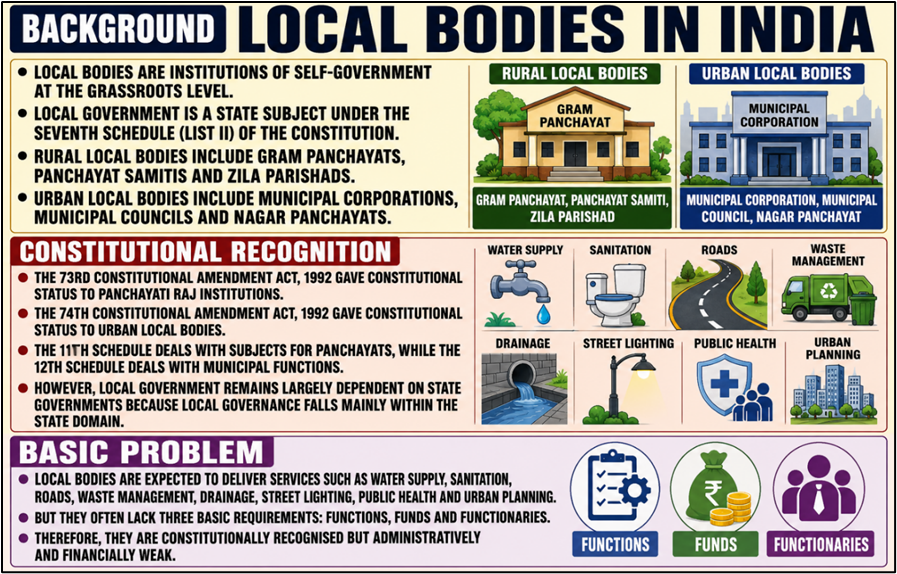
Explanation:
1. Weak Position of the Third Tier:
- The article highlights that India’s third tier of government is much weaker than local governments in countries such as the United States and China.
- In China and the U.S., local governments handle a very large share of public expenditure, while in India, local bodies account for only a small part of government spending.
- In India, just over 10% of government employment is in local governments, while in the U.S. and China, nearly two-thirds of government employees work at the local level.
2. Poor Financial Autonomy:
- Indian local bodies have very limited own-source revenue.
- The article shows that local bodies’ own tax resources are only around 0.3% of GDP, while the Centre and States collect much more.
- This means municipalities depend heavily on grants from State and Central governments.
- Such dependence reduces their ability to plan independently and weakens accountability to citizens.
3. Failure to Use Urban Land Effectively:
- The article compares India with China in land-based revenue generation.
- China used land revenue and land monetisation to finance urban infrastructure and growth.
- India has not been able to do this effectively because of weak land records, fragmented ownership, legal disputes, poor planning and rigid laws.
- As a result, Indian cities struggle to fund infrastructure.
4. State Control and Fragmented Governance:
- Urban local bodies are often controlled by State governments and parastatal agencies.
- Development authorities, water boards, transport bodies and housing boards often perform municipal functions without being directly accountable to elected city governments.
- This creates confusion, duplication and weak service delivery.
5. Need for Genuine Empowerment:
- Empowering local bodies means giving them real authority over planning, taxation, staff and service delivery.
- Strong municipalities can improve urban infrastructure, reduce congestion, manage waste better, and make governance more citizen-centric.
Conclusion:
India’s urban future cannot be managed only through Centre–State federalism. As cities become centres of growth, employment and innovation, local bodies must be treated as genuine governments. Strengthening the third tier is essential for better democracy, better services and better urban development.
Source: (The Indian Express)
La Excellence IAS Academy, the best IAS coaching in Hyderabad, known for delivering quality content and conceptual clarity for UPSC 2026 preparation.
FOLLOW US ON:
◉ YouTube : https://www.youtube.com/@CivilsPrepTeam
◉ Facebook: https://www.facebook.com/LaExcellenceIAS
◉ Instagram: https://www.instagram.com/laexcellenceiasacademy/
GET IN TOUCH:
Contact us at info@laex.in, https://laex.in/contact-us/
or Call us @ +91 9052 29 2929, +91 9052 99 2929, +91 9154 24 2140
OUR BRANCHES:
Head Office: H No: 1-10-225A, Beside AEVA Fertility Center, Ashok Nagar Extension, VV Giri Nagar, Ashok Nagar, Hyderabad, 500020
Madhapur: Flat no: 301, survey no 58-60, Guttala begumpet Madhapur metro pillar: 1524, Rangareddy Hyderabad, Telangana 500081
Bangalore: Plot No: 99, 2nd floor, 80 Feet Road, Beside Poorvika Mobiles, Chandra Layout, Attiguppe, Near Vijaya Nagara, Bengaluru, 560040