
Paper: GS – II, Subject: Polity, Topic: Federalism, Issue: Federalism Challenges.
Context:
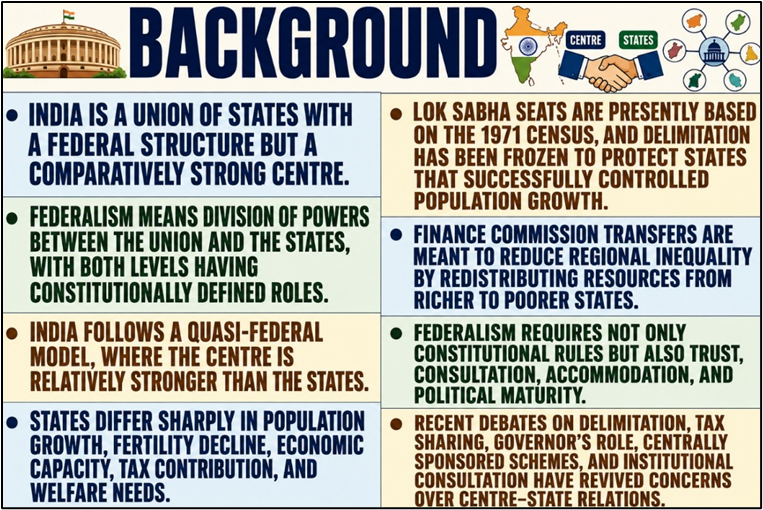
India’s federal system is facing new tensions due to changing population patterns, unequal representation, fiscal redistribution, and declining Centre–State trust. The core challenge is to balance democratic representation with fiscal fairness and cooperative governance.
Key Takeaways:
Explanation:
Proximate Challenges:
1. Representation Imbalance:
- India’s population growth has been uneven across regions.
- States that controlled fertility, especially many southern States, may become under-represented if Lok Sabha seats are redistributed only on the basis of current population.
- More populous northern and central States may gain seats, while smaller-population States may lose relative political influence.
- This creates a democratic dilemma: one person, one vote must be respected, but States should not be punished for better demographic performance.
- Any future delimitation must therefore balance population, federal fairness, and national unity.
2. Fiscal Transfer Concerns:
- In a federal system, richer regions usually contribute more revenue, while poorer regions receive more support for balanced development.
- However, excessive perception of unequal returns can create resentment among better-performing States.
- States contributing more may feel that their development, tax effort, and governance efficiency are not adequately recognised.
- At the same time, redistribution remains essential for reducing regional inequality and maintaining national cohesion.
- Therefore, fiscal transfers must combine equity, efficiency, transparency, and performance incentives.
3. Centre–State Trust Deficit:
- Federalism weakens when major decisions are taken without meaningful consultation with States.
- Issues such as taxation, language, resource-sharing, law and order, education, and administrative control often become politically sensitive.
- A powerful Centre must avoid treating States as subordinate units.
- Cooperative institutions such as the GST Council, Inter-State Council, Finance Commission, and NITI Aayog should be strengthened.
- Federalism works best when disagreements are resolved through dialogue rather than unilateralism.
4. Need for Cooperative Federalism:
- India’s diversity requires negotiation, not domination.
- Consensus-building helps prevent regional alienation and strengthens national integration.
- Accommodation and compromise are essential because States differ in demography, economy, culture, language, and political priorities.
Conclusion:
India’s federal challenges are not merely technical issues of seats or funds; they are questions of trust, fairness, and national unity. A stronger Centre must practise consultation and restraint, while States must participate constructively in nation-building through cooperative federalism.
Source: (The Indian Express)
La Excellence IAS Academy, the best IAS coaching in Hyderabad, known for delivering quality content and conceptual clarity for UPSC 2026 preparation.
FOLLOW US ON:
◉ YouTube : https://www.youtube.com/@CivilsPrepTeam
◉ Facebook: https://www.facebook.com/LaExcellenceIAS
◉ Instagram: https://www.instagram.com/laexcellenceiasacademy/
GET IN TOUCH:
Contact us at info@laex.in, https://laex.in/contact-us/
or Call us @ +91 9052 29 2929, +91 9052 99 2929, +91 9154 24 2140
OUR BRANCHES:
Head Office: H No: 1-10-225A, Beside AEVA Fertility Center, Ashok Nagar Extension, VV Giri Nagar, Ashok Nagar, Hyderabad, 500020
Madhapur: Flat no: 301, survey no 58-60, Guttala begumpet Madhapur metro pillar: 1524, Rangareddy Hyderabad, Telangana 500081
Bangalore: Plot No: 99, 2nd floor, 80 Feet Road, Beside Poorvika Mobiles, Chandra Layout, Attiguppe, Near Vijaya Nagara, Bengaluru, 560040