
Paper: GS – I, Subject: Geography, Topic: Geo-physical Phenomenon, Issue: Heat Waves, Climate Change and the Need for Local Data Monitoring.
Context:
India and parts of Europe are facing unusually intense and early heatwaves, showing that extreme heat is becoming a major climate, public health and governance challenge. The issue highlights the need for localised heat-risk mapping, reliable temperature monitoring and city-specific mitigation strategies.
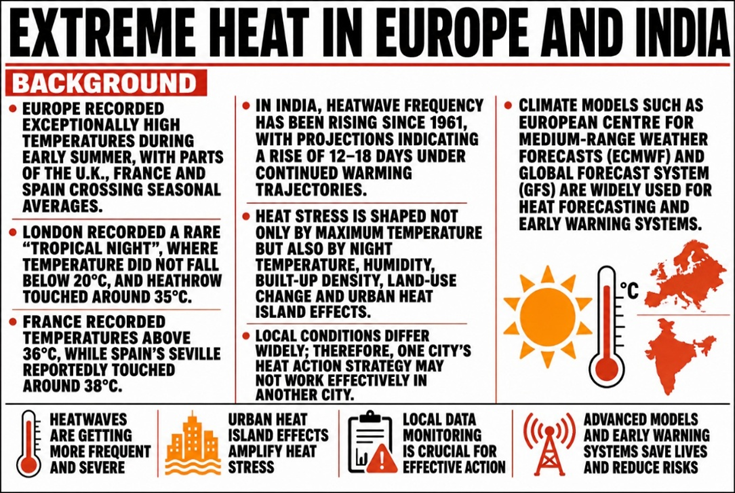
Key Takeaways:
Explanation:
Climate and Heatwave Dimension:
- Rising baseline temperatures are making heatwaves more frequent, intense and early.
- Reduced pre-monsoon rainfall, persistent dry air circulation, high solar radiation and slow soil-moisture formation intensify summer heat.
- Long-term anthropogenic warming is steadily increasing land-surface and air temperatures.
Urban and Local Geography Dimension:
- Cities experience stronger heat due to dense infrastructure, vehicles, air-conditioning exhaust, industries, concrete surfaces and lack of vegetation.
- Local heat stress varies according to terrain, surface materials, wind flow, water bodies and green cover.
- This makes local data monitoring more useful than broad national-level temperature averages.
Public Health Dimension:
- It can worsen dehydration, cardiovascular stress, respiratory illness, kidney problems and heat stroke.
- Night-time heat is especially dangerous because it prevents the body from recovering.
Impact on Society and Economy:
- Heat waves reduce labour productivity, especially among construction workers, street vendors and agricultural labourers.
- Vulnerable groups such as the elderly, children and low-income populations face higher health risks.
- Rising temperatures increase cases of dehydration, heatstroke and cardiovascular illnesses.
- Heat stress also affects agriculture, livestock, water availability and urban infrastructure.
Governance and Mitigation Dimension:
- Heat action plans must use local thermal maps, ward-level data and real-time monitoring.
- Interventions should include cool roofs, shaded public spaces, drinking water access, early warnings, work-hour changes and urban greening.
- Heat strategies must integrate climate planning, public health, labour welfare and urban design.
Conclusion:
Extreme heat is no longer a seasonal inconvenience but a structural climate-risk challenge. India needs decentralised, data-based and city-specific heat governance to protect lives, livelihoods and urban resilience.
Source: (The Indian Express)
La Excellence IAS Academy, the best IAS coaching in Hyderabad, known for delivering quality content and conceptual clarity for UPSC 2026 preparation.
FOLLOW US ON:
◉ YouTube : https://www.youtube.com/@CivilsPrepTeam
◉ Facebook: https://www.facebook.com/LaExcellenceIAS
◉ Instagram: https://www.instagram.com/laexcellenceiasacademy/
GET IN TOUCH:
Contact us at info@laex.in, https://laex.in/contact-us/
or Call us @ +91 9052 29 2929, +91 9052 99 2929, +91 9154 24 2140
OUR BRANCHES:
Head Office: H No: 1-10-225A, Beside AEVA Fertility Center, Ashok Nagar Extension, VV Giri Nagar, Ashok Nagar, Hyderabad, 500020
Madhapur: Flat no: 301, survey no 58-60, Guttala begumpet Madhapur metro pillar: 1524, Rangareddy Hyderabad, Telangana 500081
Bangalore: Plot No: 99, 2nd floor, 80 Feet Road, Beside Poorvika Mobiles, Chandra Layout, Attiguppe, Near Vijaya Nagara, Bengaluru, 560040