
Paper: GS – II, Subject: Polity, Topic: Legislature, Issue: Rajya Sabha Defections and the Anti-Defection Law Debate.
Context:
Recent political developments have raised important constitutional questions about defections in the Rajya Sabha, especially when a large group of MPs claims to “merge” with another political party. The issue is significant because it tests the balance between legislative freedom, political party discipline, and the constitutional purpose of the Anti-Defection Law.
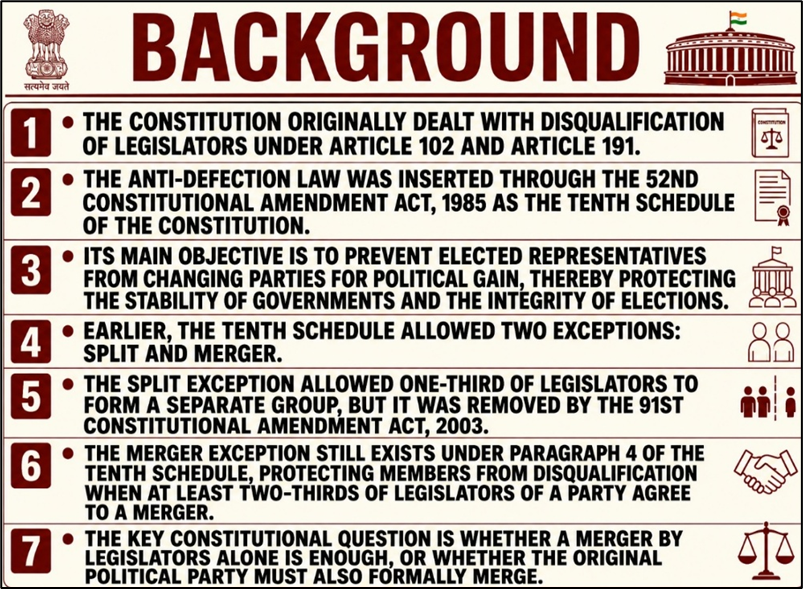
Key Takeaways:
Explanation:
Anti-Defection Law and Its Purpose:
- The anti-defection law seeks to maintain political morality, party discipline, and electoral accountability.
- A voter elects a candidate not merely as an individual, but often as a representative of a political party, its ideology, manifesto, and leadership.
- Therefore, when elected representatives shift allegiance after elections, it can weaken the democratic mandate.
Meaning of Merger Under the Tenth Schedule:
- Under Paragraph 4, disqualification does not apply if a member’s original political party merges with another political party.
- A member is protected if he or she accepts such merger, or if at least two-thirds of the members of the legislature party agree to it.
- However, this provision creates a legal debate: whether two-thirds of MPs or MLAs can themselves create a merger, or whether they can only act after the original political party has decided to merge.
Legislature Party vs Political Party:
- A legislature party consists of elected members inside Parliament or a State Legislature.
- A political party is the larger organisation outside the legislature, with its constitution, leadership, ideology, workers, and voters.
- The Constitution gives importance to the political party because legislators are elected under its symbol and platform.
- If legislators alone are allowed to merge without the political party’s approval, it may weaken party identity and allow indirect defections.
Impact of Removing the Split Exception:
- Earlier, one-third legislators could claim a split and avoid disqualification.
- This was removed to prevent frequent group defections and political instability.
- If two-thirds legislators are now allowed to merge without the political party’s decision, it may indirectly revive the old split logic in another form.
Need for Judicial Clarity:
- The issue requires authoritative judicial interpretation because it affects parliamentary democracy, opposition stability, and the sanctity of electoral mandates.
- Courts must clarify whether legislative majority can override the organisational identity of a political party.
Conclusion:
The controversy highlights the continuing tension between individual legislative choice and party-based democracy. A clear constitutional interpretation is necessary to ensure that the merger exception does not become a loophole for mass defections, while still respecting genuine political realignments.
Source: (The Hindu)
La Excellence IAS Academy, the best IAS coaching in Hyderabad, known for delivering quality content and conceptual clarity for UPSC 2026 preparation.
FOLLOW US ON:
◉ YouTube : https://www.youtube.com/@CivilsPrepTeam
◉ Facebook: https://www.facebook.com/LaExcellenceIAS
◉ Instagram: https://www.instagram.com/laexcellenceiasacademy/
GET IN TOUCH:
Contact us at info@laex.in, https://laex.in/contact-us/
or Call us @ +91 9052 29 2929, +91 9052 99 2929, +91 9154 24 2140
OUR BRANCHES:
Head Office: H No: 1-10-225A, Beside AEVA Fertility Center, Ashok Nagar Extension, VV Giri Nagar, Ashok Nagar, Hyderabad, 500020
Madhapur: Flat no: 301, survey no 58-60, Guttala begumpet Madhapur metro pillar: 1524, Rangareddy Hyderabad, Telangana 500081
Bangalore: Plot No: 99, 2nd floor, 80 Feet Road, Beside Poorvika Mobiles, Chandra Layout, Attiguppe, Near Vijaya Nagara, Bengaluru, 560040