
Paper: GS – II, Subject: Society and Social Justice, Topic: Welfare schemes, mechanisms and institutions related to STs, Issue: Adivasi Identity, Religion and the Politics of Assimilation.
Context:
The debate over the religious identity of Adivasis has again gained prominence due to two simultaneous developments: the demand for recognising Sarna or traditional tribal faith in the ongoing Census, and the demand for delisting converted Adivasis from the Scheduled Tribe category. The issue is not merely religious; it involves constitutional interpretation, tribal identity, reservation benefits, cultural autonomy and political mobilisation.
Key Takeaways:
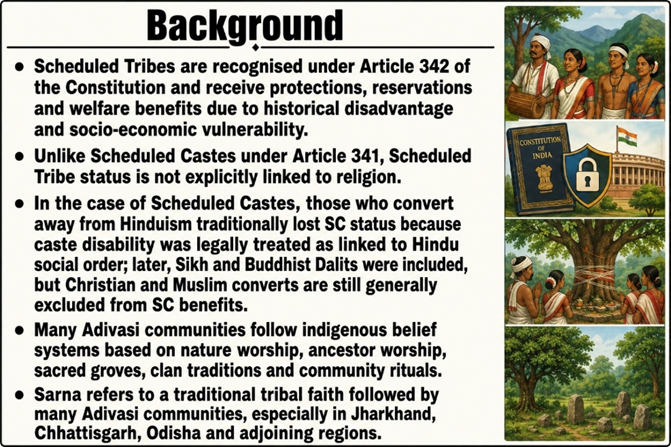
Explanation:
1. Meaning of the Delisting Demand:
- Delisting means removing converted Adivasis from the Scheduled Tribe list.
- Supporters argue that Adivasis who convert to Christianity or Islam no longer follow traditional tribal faith and should not receive ST benefits.
- Critics argue that tribal identity is based on birth, ethnicity, community, customs, language, ancestry and shared historical experience.
- Therefore, conversion may change religious belief, but it does not automatically erase tribal identity.
2. Constitutional Distinction between SCs and STs:
- The debate often wrongly applies the Scheduled Caste logic to Scheduled Tribes.
- SC status has historically been tied to caste oppression within the Hindu social structure, though Sikh and Buddhist Dalits were later included.
- ST status is different because tribal identity is not based on caste hierarchy but on community, culture, geography, ethnicity and historical marginalisation.
- Therefore, the legal basis for denying SC benefits after certain conversions cannot automatically be extended to STs.
3. Judicial Understanding of Tribal Identity:
- Courts have recognised that tribal identity is primarily ethnic and community-based, not merely religious.
- The Kartik Oraon case is important because the Patna High Court held that an Oraon remains an Oraon even after conversion.
- The Court noted that converted Adivasis may continue to follow clan practices, festivals, customs and collective community concerns.
- This supports the view that Adivasi identity can survive religious conversion.
4. Sarna and Separate Religious Recognition:
- Many Adivasi groups argue that they should not be forced into categories such as Hindu, Christian, Muslim or “others” in the Census.
- The demand for a separate Sarna code reflects the desire to recognise Adivasi faith as a distinct indigenous tradition.
- It is linked to cultural dignity, statistical visibility and protection of tribal belief systems.
5. “Adivasi” versus “Vanvasi”:
- The term Adivasi means original inhabitant and carries a historical and political identity linked to land and indigeneity.
- The term Vanvasi, meaning forest dweller, is criticised because it reduces tribal identity to geography.
- This debate matters because language shapes how society and the state understand tribal communities.
6. Political Mobilisation around Tribal Religion:
- The delisting issue has become a site of political mobilisation by different organisations.
- Some groups claim that Adivasis are part of a broader Hindu civilisational framework.
- Sarna and Christian Adivasi groups argue that such claims weaken the distinctiveness of tribal identity.
- Hence, the debate is not only about reservation benefits but also about who defines Adivasi culture and faith.
7. Real Issues Facing Adivasis:
- Excessive focus on conversion may divert attention from real & urgent tribal concerns.
- These include land alienation, mining displacement, weakening of gram sabhas and poor implementation of the Forest Rights Act.
- Other issues include unemployment, poor health facilities, delayed scholarships, weak education and inadequate student hostels.
Conclusion:
The delisting debate reflects a larger contest over Adivasi identity. Since ST identity is rooted in community, ethnicity, culture and historical disadvantage, conversion alone should not automatically erase it. A democratic approach must protect Adivasi faith traditions, land rights, forest rights and cultural autonomy.
Source: (The Indian Express, The Hindu)
La Excellence IAS Academy, the best IAS coaching in Hyderabad, known for delivering quality content and conceptual clarity for UPSC 2026 preparation.
FOLLOW US ON:
◉ YouTube : https://www.youtube.com/@CivilsPrepTeam
◉ Facebook: https://www.facebook.com/LaExcellenceIAS
◉ Instagram: https://www.instagram.com/laexcellenceiasacademy/
GET IN TOUCH:
Contact us at info@laex.in, https://laex.in/contact-us/
or Call us @ +91 9052 29 2929, +91 9052 99 2929, +91 9154 24 2140
OUR BRANCHES:
Head Office: H No: 1-10-225A, Beside AEVA Fertility Center, Ashok Nagar Extension, VV Giri Nagar, Ashok Nagar, Hyderabad, 500020
Madhapur: Flat no: 301, survey no 58-60, Guttala begumpet Madhapur metro pillar: 1524, Rangareddy Hyderabad, Telangana 500081
Bangalore: Plot No: 99, 2nd floor, 80 Feet Road, Beside Poorvika Mobiles, Chandra Layout, Attiguppe, Near Vijaya Nagara, Bengaluru, 560040