
Paper: GS – III, Subject: Economy, Topic: Monetary policies and instruments, Issue: RBI Maintains Policy Stability Amid Growth Concerns.
Context:
The RBI’s Monetary Policy Committee has kept the repo rate unchanged at 5.25% and maintained a neutral policy stance. At the same time, it has lowered India’s real GDP growth forecast for FY27 to 6.6% and raised CPI inflation projection to 5.1%, reflecting concerns over global conflict, energy prices, weak monsoon risks and El Niño conditions.
Key Takeaways:
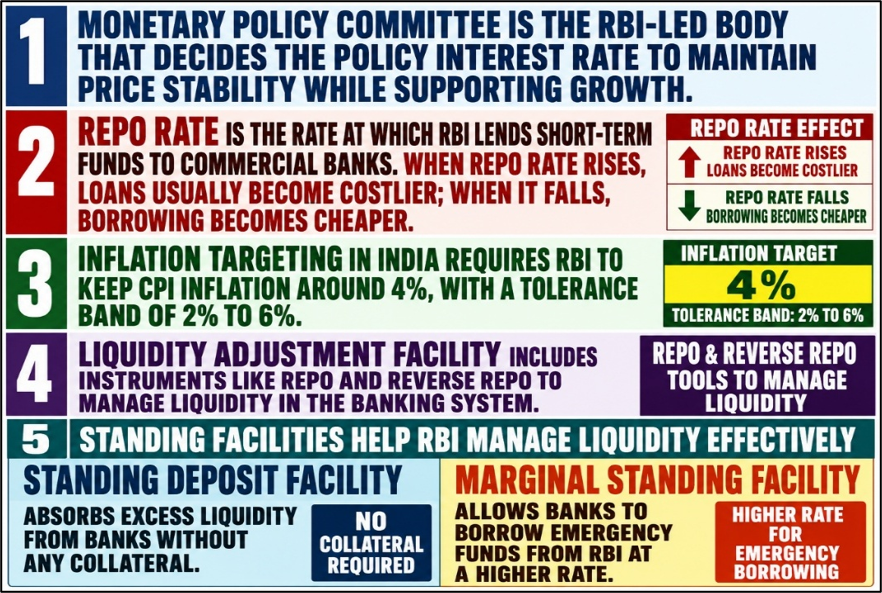
What is Monetary Policy?
- Monetary policy refers to the use of interest rates, liquidity tools and credit conditions by the RBI to control inflation and support growth.
- In India, monetary policy is decided by the Monetary Policy Committee, which aims to keep inflation around the legally mandated target of 4% with a tolerance band of ±2%.
Growth-Inflation Trade-off:
- If inflation is high, RBI avoids cutting rates because cheaper loans may increase demand and prices.
- If growth is slowing, RBI may cut rates to encourage borrowing, investment and consumption.
- The present policy shows that RBI is balancing both concerns: inflation risk and growth slowdown.
Explanation:
Main Decision of the MPC:
- The MPC unanimously decided to keep the repo rate unchanged at 5.25%.
- The SDF rate remains at 5%, and the MSF rate and Bank Rate remain at 5.50%.
- The MPC also continued with a neutral stance, meaning it has kept the option open for either a future rate cut or a future rate hike depending on data.
- This shows that the RBI is not in a hurry to reduce interest rates despite growth concerns.
Why the Repo Rate Was Not Reduced:
- A rate cut could have supported growth by making loans cheaper for businesses and consumers.
- However, RBI avoided a rate cut because inflation risks have increased.
- Elevated energy prices due to the West Asia conflict may increase fuel and transport costs.
- Supply chain disruptions may increase the cost of imported goods and raw materials.
- Food inflation may rise because of uncertainty related to the southwest monsoon and El Niño conditions.
- Therefore, RBI preferred caution because cutting rates too early may worsen inflation expectations.
Growth Forecast Lowered:
- RBI lowered India’s real GDP growth forecast for FY27 from 6.9% to 6.6%.
- The quarterly forecast is 6.6% in Q1, 6.3% in Q2, 6.5% in Q3 and 6.8% in Q4.
- This suggests that growth may remain weak in the first half of the year and recover slowly in the second half.
- The article also notes that ICRA expects growth to fall below 6% in the first half before recovering later.
- Domestic demand, manufacturing and services remain resilient, but external shocks may reduce growth momentum.
Inflation Forecast Raised:
- RBI increased the CPI inflation forecast for FY27 from 4.6% to 5.1%.
- This upward revision reflects higher expected food, fuel and supply-side inflation.
- Core inflation has also been revised upward, showing that price pressures are not limited only to food and fuel.
- Inflation is expected to become firmer in the third quarter and soften later in the fourth quarter.
- Since inflation directly affects household purchasing power, the RBI cannot ignore inflation even when growth is slowing.
Role of Global Conflict and Crude Oil:
- India imports a large share of its crude oil requirement, so higher global crude prices can increase India’s import bill.
- Higher oil prices can raise petrol, diesel, transport, fertiliser and production costs.
- These costs may pass through to consumers in the form of higher prices.
- The West Asia conflict also creates uncertainty in trade routes, shipping costs and energy security.
- Thus, international geopolitics has become a major factor in India’s domestic monetary policy.
Monsoon, Agriculture and Rural Demand:
- The article highlights risks from a possible sub-normal southwest monsoon and El Niño.
- A weak monsoon can reduce agricultural output and increase food prices.
- It can also weaken rural income, rural demand and consumption.
- Since food has a large weight in India’s CPI basket, monsoon uncertainty becomes important for inflation forecasting.
- Therefore, the RBI has to consider climate and agriculture-related risks while framing monetary policy.
Measures to Attract Foreign Capital:
- RBI announced measures to attract foreign capital, especially into government securities.
- The universe of government securities under the Fully Accessible Route has been expanded to include specified 15-year, 30-year and 40-year government securities.
- Limits related to short-term investments, concentration and individual securities for FPIs under the General Route are being removed.
- These measures can increase foreign investor participation in Indian government bonds.
- Greater foreign inflows can support government borrowing and reduce pressure on bond yields.
Rupee Stability and Balance of Payments:
- The RBI’s measures are also aimed at supporting the rupee and improving capital inflows.
- Foreign portfolio investment can bring dollars into the Indian economy.
- This helps reduce pressure on the rupee when imports become costlier due to high crude prices.
- RBI also restored incentives for export proceeds and provided concessional forex swap facilities related to FCNR(B) deposits.
- These steps may help improve India’s balance of payments position and foreign exchange stability.
Government and RBI: Policy Coordination:
- The article’s phrase “between government and RBI, getting back the investor” suggests that investor confidence requires both fiscal and monetary coordination.
- The government must manage spending, borrowing and fiscal deficit carefully.
- The RBI must maintain inflation control, financial stability and currency confidence.
- If both institutions act responsibly, investors are more likely to invest in Indian assets.
- Therefore, macroeconomic stability depends on coordination between fiscal policy and monetary policy.
Conclusion:
The RBI’s decision reflects a cautious policy approach in a difficult economic environment. Growth is slowing, but inflation risks from crude oil, food prices, monsoon uncertainty and global conflict remain significant. For UPSC aspirants, this issue is important because it links monetary policy, inflation targeting, growth forecasting, foreign capital flows, rupee stability and macroeconomic governance.
Source: (The Indian Express, The Hindu)
La Excellence IAS Academy, the best IAS coaching in Hyderabad, known for delivering quality content and conceptual clarity for UPSC 2026 preparation.
FOLLOW US ON:
◉ YouTube : https://www.youtube.com/@CivilsPrepTeam
◉ Facebook: https://www.facebook.com/LaExcellenceIAS
◉ Instagram: https://www.instagram.com/laexcellenceiasacademy/
GET IN TOUCH:
Contact us at info@laex.in, https://laex.in/contact-us/
or Call us @ +91 9052 29 2929, +91 9052 99 2929, +91 9154 24 2140
OUR BRANCHES:
Head Office: H No: 1-10-225A, Beside AEVA Fertility Center, Ashok Nagar Extension, VV Giri Nagar, Ashok Nagar, Hyderabad, 500020
Madhapur: Flat no: 301, survey no 58-60, Guttala begumpet Madhapur metro pillar: 1524, Rangareddy Hyderabad, Telangana 500081
Bangalore: Plot No: 99, 2nd floor, 80 Feet Road, Beside Poorvika Mobiles, Chandra Layout, Attiguppe, Near Vijaya Nagara, Bengaluru, 560040