
Paper: GS – II, Subject: Polity, Topic: local self-governance, Issue: Formalisation of Elections in Nicobarese Tribal Self-Governance.
Context:
The Andaman and Nicobar Administration has proposed draft electoral rules for conducting formal elections to Nicobarese Village Councils and Tribal Councils. The proposal seeks to introduce constituency-based elections, electoral rolls and reserved seats. This has generated debate over its impact on traditional Nicobarese self-governance.
Key Takeaways:
Explanation:
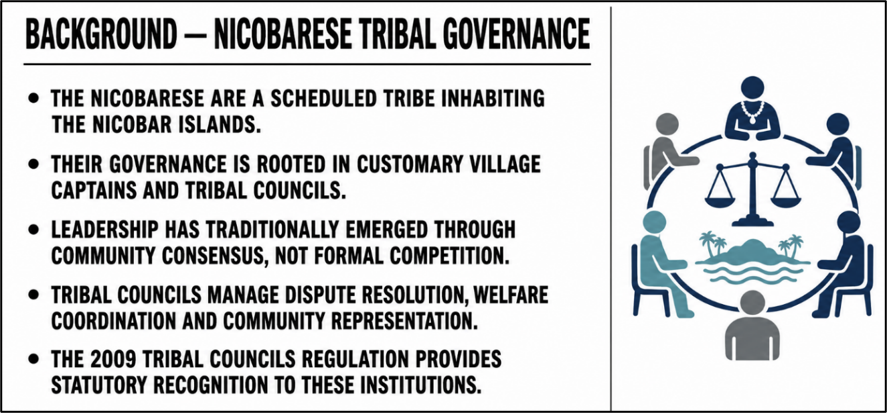
Existing Governance Structure:
- Each village is headed by a Captain, assisted by First, Second and Third Captains.
- Village representatives form Island Tribal Councils and the broader Tribal Council of Nicobar.
- Decisions are generally made through consultation, consensus and local legitimacy.
What the Draft Rules Propose:
- Formal elections for Village Councils and Tribal Councils.
- Delimitation of constituencies and preparation of electoral rolls.
- Procedures for nomination, candidature, voting and counting.
- Fixed terms, defined responsibilities and institutional structure.
- Reservation of seats and leadership positions for women.
What Changes:
- Leadership selection may shift from consensus-based choice to ballot-based election.
- Customary authority may become more bureaucratic and legally standardised.
- Local social legitimacy may be replaced by formal electoral mandate.
- Traditional community meetings may give way to competitive political processes.
- Women’s formal representation may increase through reservation provisions.
Rationale Behind the Reforms:
- Improve transparency and accountability in tribal governance.
- Standardise leadership selection procedures.
- Strengthen representation, especially for women.
- Facilitate implementation of welfare and development programmes.
Concerns Raised:
- Formal elections may weaken customary governance traditions.
- Competitive politics may create factionalism in close-knit island communities.
- Bureaucratisation may reduce community ownership over institutions.
- Tribal leaders fear erosion of indigenous autonomy and cultural practices.
Broader Significance:
- The debate reflects tension between democratic procedures and indigenous governance.
- It raises issues of tribal autonomy, cultural preservation and participatory governance.
- Reforms must balance constitutional values with customary self-rule.
Conclusion:
The proposed reforms mark a shift from consensus-based Nicobarese leadership to formal electoral governance. While transparency, women’s representation and accountability are important, reforms must be community-sensitive. Democratic modernisation should strengthen, not replace, indigenous self-governance.
Source: (The Hindu)
La Excellence IAS Academy, the best IAS coaching in Hyderabad, known for delivering quality content and conceptual clarity for UPSC 2026 preparation.
FOLLOW US ON:
◉ YouTube : https://www.youtube.com/@CivilsPrepTeam
◉ Facebook: https://www.facebook.com/LaExcellenceIAS
◉ Instagram: https://www.instagram.com/laexcellenceiasacademy/
GET IN TOUCH:
Contact us at info@laex.in, https://laex.in/contact-us/
or Call us @ +91 9052 29 2929, +91 9052 99 2929, +91 9154 24 2140
OUR BRANCHES:
Head Office: H No: 1-10-225A, Beside AEVA Fertility Center, Ashok Nagar Extension, VV Giri Nagar, Ashok Nagar, Hyderabad, 500020
Madhapur: Flat no: 301, survey no 58-60, Guttala begumpet Madhapur metro pillar: 1524, Rangareddy Hyderabad, Telangana 500081
Bangalore: Plot No: 99, 2nd floor, 80 Feet Road, Beside Poorvika Mobiles, Chandra Layout, Attiguppe, Near Vijaya Nagara, Bengaluru, 560040
Nicobarese Governance and the Electoral Transition