
Paper: GS – II, Subject: Polity, Topic: Local Government, Issue: Gram Sabhas and Grass-roots Democracy.
Context:
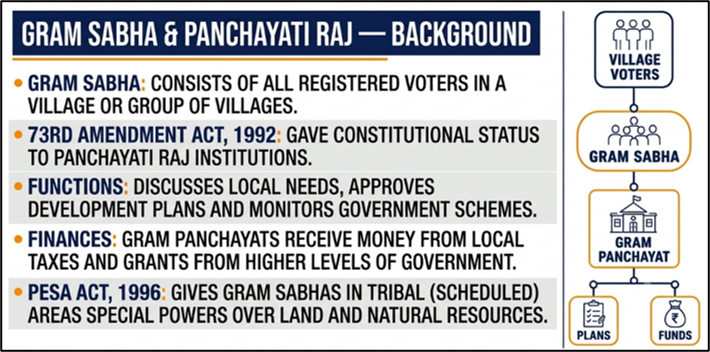
Recently, a report based on surveys of the Ministry of Rural Development highlighted declining participation in gram sabhas. It described the problem as a lack of “vibrancy”, but also showed that people often avoid meetings because decisions produce few results, attendance affects their livelihoods, and local bodies have limited real power.
Key Takeaways:
Explanation:
Why Participation Is Falling?
- Many villagers avoid meetings because previous discussions did not produce visible results.
- Poor workers may lose wages by attending, while landlords and contractors can participate more easily.
- This creates participation fatigue, where people lose interest in repeated meetings that bring little change.
- Gram sabhas may therefore become a playground for the leisured elite, dominated by people with greater time, money and influence.
Limits of Digital Solutions:
- The NIRNAY App helps schedule meetings, record decisions and upload minutes.
- Digital records can improve transparency, but excessive data entry may reduce the time available for public discussion.
- Technology cannot increase participation unless citizens have real influence over decisions.
Weak Decision-Making and Financial Powers:
- Gram sabhas are often treated as clearinghouses meaning they often merely approve, record or distribute centrally and State-designed programmes.
- True “vibrancy” means active debate, broad participation and visible implementation, not merely more meetings or uploaded records.
- Panchayats have limited taxation powers and remain dependent on grants tied to schemes such as the Jal Jeevan Mission and Swachh Bharat Mission.
- People may lose interest when locally identified needs cannot receive funds.
Rights in Scheduled Areas:
- Under Panchayats (Extension to Scheduled Areas) Act, 1996 (PESA), gram sabhas participate in decisions involving land acquisition, mining and forests.
- Governments may sometimes bypass them or use low attendance to claim approval.
- Genuine consent must include the right to say both “yes” and “no”.
Way Forward:
- Gram sabhas should receive real authority over local planning and spending.
- Participation by poor workers should be supported so that attending meetings does not cause wage loss.
- Digital tools should assist public discussion rather than increase paperwork.
- Governments must respect gram sabha decisions, including their right to reject projects.
Conclusion:
Gram sabhas cannot be strengthened only through more meetings or digital reporting. They need financial power, inclusive participation and respect for local decisions. This is essential for meaningful grass-roots democracy.
Source: (The The Hindu)
La Excellence IAS Academy, the best IAS coaching in Hyderabad, known for delivering quality content and conceptual clarity for UPSC 2026 preparation.
FOLLOW US ON:
◉ YouTube : https://www.youtube.com/@CivilsPrepTeam
◉ Facebook: https://www.facebook.com/LaExcellenceIAS
◉ Instagram: https://www.instagram.com/laexcellenceiasacademy/
GET IN TOUCH:
Contact us at info@laex.in, https://laex.in/contact-us/
or Call us @ +91 9052 29 2929, +91 9052 99 2929, +91 9154 24 2140
OUR BRANCHES:
Head Office: H No: 1-10-225A, Beside AEVA Fertility Center, Ashok Nagar Extension, VV Giri Nagar, Ashok Nagar, Hyderabad, 500020
Madhapur: Flat no: 301, survey no 58-60, Guttala begumpet Madhapur metro pillar: 1524, Rangareddy Hyderabad, Telangana 500081
Bangalore: Plot No: 99, 2nd floor, 80 Feet Road, Beside Poorvika Mobiles, Chandra Layout, Attiguppe, Near Vijaya Nagara, Bengaluru, 560040