
Paper: GS – III, Subject: Environment, Ecology and Disaster Management, Topic: Biodiversity and its conservation, Issue: India Needs a Second Home for Asiatic Lions.
Context:
Recently, India’s Asiatic lion population was estimated at 891 in the 16th Lion Population Estimation, 2025, a 32% increase since 2020. Despite this success, almost the entire wild population remains concentrated in Gujarat’s Gir landscape, leaving the species vulnerable to disease, wildfire, drought or any single large disaster.
Key Takeaways:
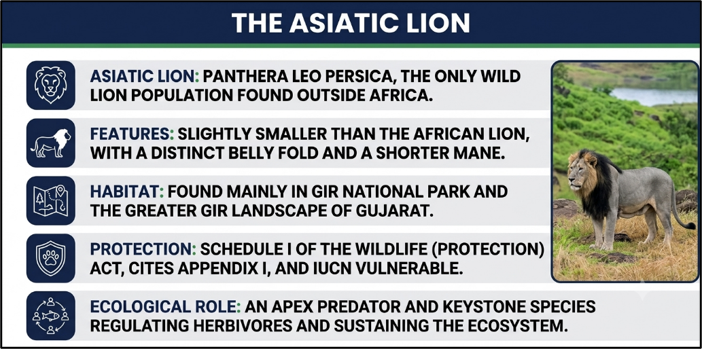
Explanation:
Why a Second Lion Population Is Needed?
- Since all lions live in one connected region, a disease outbreak, wildfire, drought or prey decline could affect many at once.
- The 2018 Canine Distemper Virus (CDV) outbreak, which killed several lions, exposed this risk.
- The population also has low genetic diversity, having grown from a very small surviving group.
Metapopulation Approach:
- A metapopulation means separate populations of one species living in different habitats.
- A distant second population would act as insurance against a major crisis in Gir.
- Managing both populations together can help preserve genetic diversity over time.
Kuno National Park:
- Studies identified Kuno National Park, Madhya Pradesh, as suitable, and it was prepared through village relocation and improved habitat and prey.
- The Supreme Court ordered translocation to Kuno in 2013, but no lions have moved yet due to Gujarat’s resistance and weak inter-State coordination.
- Kuno now also hosts the cheetah reintroduction programme, so its prey, space and management capacity need fresh review.
Barda and Project Lion:
- Project Lion (2020) focuses on landscape-level conservation, habitat restoration and disease control.
- Barda Wildlife Sanctuary in Gujarat is being developed as another site for natural dispersal of lions. However, Barda is close to Gir and may not protect the species from a region-wide disease or disaster.
Critical Concerns:
- Translocation can cause stress, injury or failure to adapt, and lions may stray outside protected areas and attack livestock.
- A small founder group risks inbreeding and unstable social structure.
- Careful quarantine, phased release, radio-collaring, compensation and long-term monitoring are needed.
Conclusion:
India has succeeded in raising lion numbers, but growth alone does not guarantee survival. A carefully planned, distant second population is essential to convert this conservation success into lasting ecological security.
Source: (The Indian Express, The Hindu)
La Excellence IAS Academy, the best IAS coaching in Hyderabad, known for delivering quality content and conceptual clarity for UPSC 2026 preparation.
FOLLOW US ON:
◉ YouTube : https://www.youtube.com/@CivilsPrepTeam
◉ Facebook: https://www.facebook.com/LaExcellenceIAS
◉ Instagram: https://www.instagram.com/laexcellenceiasacademy/
GET IN TOUCH:
Contact us at info@laex.in, https://laex.in/contact-us/
or Call us @ +91 9052 29 2929, +91 9052 99 2929, +91 9154 24 2140
OUR BRANCHES:
Head Office: H No: 1-10-225A, Beside AEVA Fertility Center, Ashok Nagar Extension, VV Giri Nagar, Ashok Nagar, Hyderabad, 500020
Madhapur: Flat no: 301, survey no 58-60, Guttala begumpet Madhapur metro pillar: 1524, Rangareddy Hyderabad, Telangana 500081
Bangalore: Plot No: 99, 2nd floor, 80 Feet Road, Beside Poorvika Mobiles, Chandra Layout, Attiguppe, Near Vijaya Nagara, Bengaluru, 560040