
Paper: GS – II, Subject: Society and Social Justice, Topic: Social sector – Health, Issue: Making Cancer a Notifiable Disease in India.
Context:
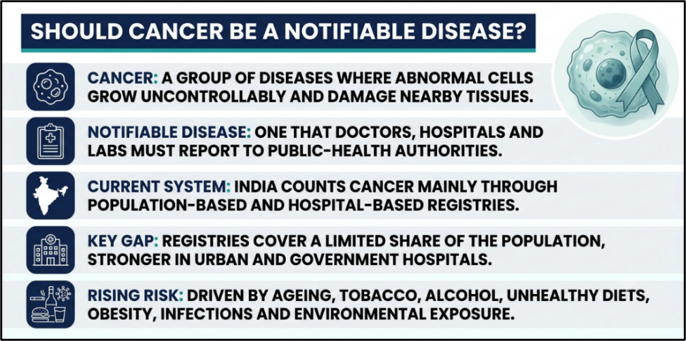
Recently, Telangana declared cancer a notifiable disease, taking the number of such States to 17. However, cancer is still not notifiable at the national level, even though India’s cancer cases are projected to rise from about 1.41 million in 2022 to 2.46 million by 2045. This has renewed the demand for complete and reliable cancer data.
Key Takeaways:
Explanation:
Need for National Notification:
- Existing cancer registries cover only about 10%–16% of India’s population and do not fully include rural areas, private hospitals and smaller clinics.
- Making cancer notifiable would require all health facilities to report diagnosed cases, giving more accurate data on the number, type and location of cancers. This information can guide screening programmes, hospitals, medicines, trained staff and research.
- An initial rise in recorded cases would mainly show better reporting, not a sudden increase in cancer.
Diagnosis and Spread:
- Cancer is diagnosed through physical examination, screening, blood tests, imaging and biopsy. A biopsy, in which tissue is examined under a microscope, is usually the most definite test.
- Cancer can spread through blood or lymph to distant organs; this process is called metastasis.
- Earlier cancer detection at early stages makes its treatment more effective, less aggressive and not very expensive most of the time.
Prevention and Vaccination:
- There is no single vaccine that can prevent all cancers.
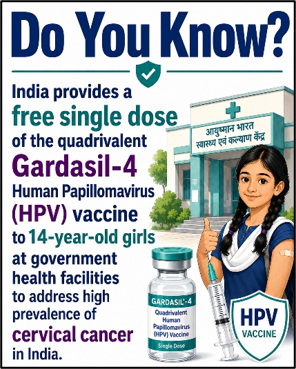
- The Human Papillomavirus (HPV) vaccine helps prevent cervical cancer and some other HPV-related cancers. The Hepatitis B vaccine helps prevent liver cancer.
- Cancer prevention also requires early screening, public awareness and reduction of risk factors such as tobacco use and unhealthy lifestyles.
Institutional Role:
- The Indian Council of Medical Research–National Institute of NCD Epidemiology (ICMR-NINE) supports cancer surveillance and disease-data systems.
- Reliable data enables vanguard action, meaning early and forward-looking public-health measures.
- Notification should be supported by common digital standards, protection of patient privacy and regular data audits.
Conclusion:
India cannot plan effective cancer prevention and treatment without complete data. National notification can strengthen screening, early diagnosis and fair distribution of health resources.
Source: (The Hindu)
La Excellence IAS Academy, the best IAS coaching in Hyderabad, known for delivering quality content and conceptual clarity for UPSC 2026 preparation.
FOLLOW US ON:
◉ YouTube : https://www.youtube.com/@CivilsPrepTeam
◉ Facebook: https://www.facebook.com/LaExcellenceIAS
◉ Instagram: https://www.instagram.com/laexcellenceiasacademy/
GET IN TOUCH:
Contact us at info@laex.in, https://laex.in/contact-us/
or Call us @ +91 9052 29 2929, +91 9052 99 2929, +91 9154 24 2140
OUR BRANCHES:
Head Office: H No: 1-10-225A, Beside AEVA Fertility Center, Ashok Nagar Extension, VV Giri Nagar, Ashok Nagar, Hyderabad, 500020
Madhapur: Flat no: 301, survey no 58-60, Guttala begumpet Madhapur metro pillar: 1524, Rangareddy Hyderabad, Telangana 500081
Bangalore: Plot No: 99, 2nd floor, 80 Feet Road, Beside Poorvika Mobiles, Chandra Layout, Attiguppe, Near Vijaya Nagara, Bengaluru, 560040
Cancer Notification Policy: Strengthening Health Surveillance