
Paper: GS – II, Subject: Governance, Topic: Transparency & Accountability, Issue: Governance of Religious Places and Endowments in India.
Context:
Recently, the Ram Janmabhoomi Temple in Ayodhya came into the news over allegations of mismanagement in handling donations. The issue has raised wider concerns about the auditing, supervision and accountability of religious institutions. It also highlights the need to balance the autonomy of religious bodies with transparent management of public donations, lands and other assets.
Key Takeaways:
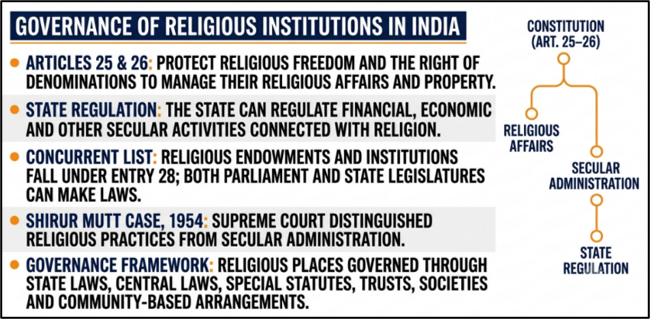
Explanation:
What the Ram Temple issue highlights:
- Major temples such as Tirupati, Vaishno Devi, Siddhivinayak and Kashi Vishwanath receive large donations and hold valuable assets.
- Donation-counting procedures may be similar, but their systems of supervision and auditing differ.
- Several major temples are governed by special state laws, while the Ram Temple is administered by an independent trust.
- The central concern is the need for independent audits, public disclosure and professional administration.
How religious places are governed?
- Hindu temples: Mostly governed through state endowment laws, special temple laws, statutory boards, trusts or hereditary management. State authorities generally supervise finances and property, not rituals.
- Mosques and waqfs: Mosques may be managed by local committees. Waqf properties are governed by a central law, amended in 2025, and administered mainly through State Waqf Boards and mutawallis.
- Churches: Usually managed by dioceses, bishops, parish councils, trusts, societies or denominational bodies. Their accounts and property are regulated through general trust, society and property laws.
- Gurudwaras and others: Major gurudwaras may have statutory committees. Jain, Buddhist and smaller religious institutions are generally managed by trusts, societies, monastic bodies or local communities.
Major Concerns:
- Different standards: Laws and auditing requirements vary across religions and states.
- Weak transparency: Accounts, donations and property transactions may not be publicly disclosed.
- Property misuse: Encroachments, illegal transfers and undervalued leases affect religious lands.
- Political interference: Appointments to governing bodies may lack independence.
- Autonomy concerns: Excessive state control can interfere with legitimate religious administration.
Way Forward:
- Introduce common minimum standards for auditing and disclosure.
- Digitise donations, accounts, land records and leases.
- Appoint professionally qualified and independent governing bodies.
- Keep government regulation limited to secular administration and make direct intervention time-bound.
Conclusion:
India needs autonomy in religious matters, accountability in financial administration and neutrality in state regulation. This balance can protect both religious freedom and public trust.
Source: (The Indian Express)
La Excellence IAS Academy, the best IAS coaching in Hyderabad, known for delivering quality content and conceptual clarity for UPSC 2026 preparation.
FOLLOW US ON:
◉ YouTube : https://www.youtube.com/@CivilsPrepTeam
◉ Facebook: https://www.facebook.com/LaExcellenceIAS
◉ Instagram: https://www.instagram.com/laexcellenceiasacademy/
GET IN TOUCH:
Contact us at info@laex.in, https://laex.in/contact-us/
or Call us @ +91 9052 29 2929, +91 9052 99 2929, +91 9154 24 2140
OUR BRANCHES:
Head Office: H No: 1-10-225A, Beside AEVA Fertility Center, Ashok Nagar Extension, VV Giri Nagar, Ashok Nagar, Hyderabad, 500020
Madhapur: Flat no: 301, survey no 58-60, Guttala begumpet Madhapur metro pillar: 1524, Rangareddy Hyderabad, Telangana 500081
Bangalore: Plot No: 99, 2nd floor, 80 Feet Road, Beside Poorvika Mobiles, Chandra Layout, Attiguppe, Near Vijaya Nagara, Bengaluru, 560040
Religious Endowments Governance: Transparency & Accountability