
Paper: GS – II, Subject: Polity, Topic: Rights Issues, Issue: Right to be Forgotten in India.
Context:
Recently, the Delhi High Court, in Laksh Vir Singh Yadav v. Union of India (2026), laid down a structured framework for recognising the Right to be Forgotten (RTBF). The Court held that informational privacy under Article 21 may justify masking names in judicial records while preserving the principle of open justice.
Key Takeaways:
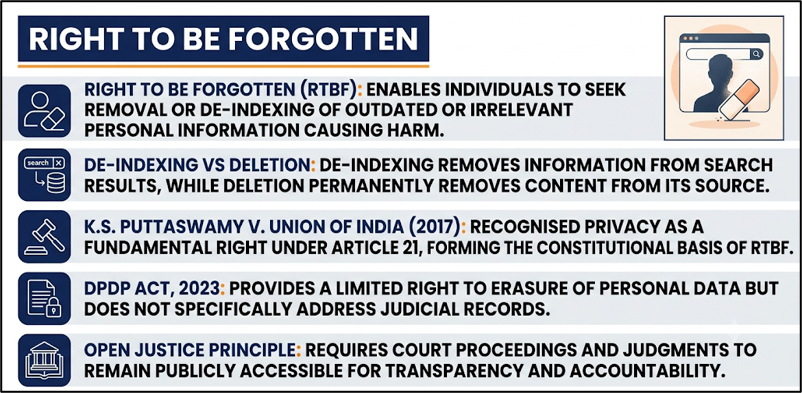
Explanation:
Delhi High Court’s Ruling:
- The Court recognised RTBF as part of informational privacy and human dignity under Article 21.
- It held that courts must balance privacy with transparency using the principle of proportionality.
- Instead of deleting judgments, the Court preferred masking names while keeping legal reasoning and case records publicly available.
- Legal databases were directed to implement masking within a specified time.
Balancing Fundamental Rights:
- RTBF is not an absolute right and must be balanced against Article 19(1)(a), which protects freedom of speech and the public’s right to information.
- Privacy claims may be rejected where disclosure serves a larger public interest, such as serious criminal matters or public accountability.
- The judgment seeks proportional visibility, ensuring that legal records remain accessible without permanently linking individuals to past disputes.
Challenges in Implementation:
- De-indexing cannot completely erase information because copies, archives and mirror websites may continue to display it.
- Search engines may continue to rank old allegations prominently, even after acquittal, creating a lasting “digital shadow.”
- The Data Protection Board under the DPDP Act is not yet fully operational, limiting institutional support for RTBF claims.
Way Forward:
- A clear national framework should be evolved through legislation or a Supreme Court ruling.
- The Data Protection Board should become operational to provide an accessible dispute-resolution mechanism.
- Greater coordination among courts, legal databases and digital platforms is necessary for effective implementation.
Conclusion:
The Delhi High Court’s ruling marks an important step in protecting digital privacy while preserving judicial transparency. However, the Right to be Forgotten will become truly effective only through robust institutions, clear legal standards and coordinated technological enforcement.
Source: (The Hindu)
La Excellence IAS Academy, the best IAS coaching in Hyderabad, known for delivering quality content and conceptual clarity for UPSC 2026 preparation.
FOLLOW US ON:
◉ YouTube : https://www.youtube.com/@CivilsPrepTeam
◉ Facebook: https://www.facebook.com/LaExcellenceIAS
◉ Instagram: https://www.instagram.com/laexcellenceiasacademy/
GET IN TOUCH:
Contact us at info@laex.in, https://laex.in/contact-us/
or Call us @ +91 9052 29 2929, +91 9052 99 2929, +91 9154 24 2140
OUR BRANCHES:
Head Office: H No: 1-10-225A, Beside AEVA Fertility Center, Ashok Nagar Extension, VV Giri Nagar, Ashok Nagar, Hyderabad, 500020
Madhapur: Flat no: 301, survey no 58-60, Guttala begumpet Madhapur metro pillar: 1524, Rangareddy Hyderabad, Telangana 500081
Bangalore: Plot No: 99, 2nd floor, 80 Feet Road, Beside Poorvika Mobiles, Chandra Layout, Attiguppe, Near Vijaya Nagara, Bengaluru, 560040