
Paper: GS – III, Subject: Economy, Topic: Economic Institutions, Issue: Cooperatives as an Alternative Business Model (Cooperative Sector Reform).
Context:
Recently, the Ministry of Cooperation completed five years, bringing renewed focus on whether cooperatives can offer a fairer alternative to profit-driven corporate models. This debate has become important as cooperatives are expanding from agriculture into services, marketing, exports and platform-based sectors.
Key Takeaways:
Explanation:
Competitive Business Model:
- Corporate firms grow rapidly by using capital, technology, data, branding and aggressive pricing.
- They can improve efficiency, customer service and innovation.
- However, profits often concentrate with investors and large platform companies.
- Small producers and gig workers may bear risks without having ownership, bargaining power or social security.
- In platform businesses like OLA & SWIGGY etc, workers may face algorithmic control and unstable earnings.
| Amul: India’s Cooperative Success StoryAmul is a successful cooperative because it converted millions of small milk producers into collective owners of a large brand. Through village-level milk collection, fair pricing, processing, marketing and professional management, it raised rural incomes and strengthened India’s White Revolution. Its success proves that cooperatives can combine democracy, scale and market competitiveness. |
| Do you know?Amul ranked No. 1 and IFFCO ranked No. 2 in the rankings based on GDP per capita performance of ICA World Cooperative Monitor 2025 prepared by the International Cooperative Alliance. These rankings show relative economic impact, and not merely absolute size. This shows the strength of India’s farmer-owned cooperative model in dairy and fertilisers. |
Cooperative Business Model:
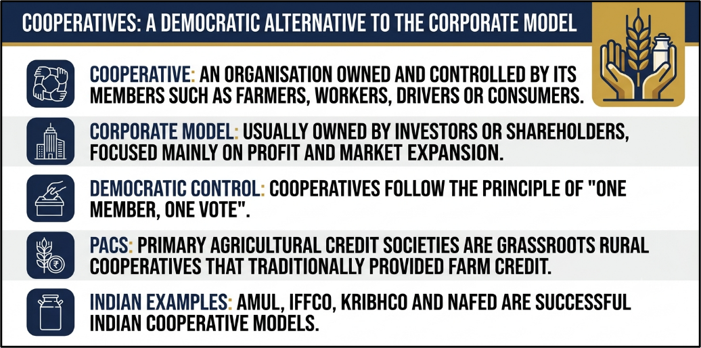
- Cooperatives try to make producers or workers both contributors and owners.
- Surplus income is expected to return to members instead of external shareholders.
- This model promotes fair income, dignity, local participation and collective bargaining.
- AMUL shows that small producers can compete when organised through village societies, district unions and State federations.
Indian Farmers Fertiliser Cooperative Limited (IFFCO), Krishak Bharati Cooperative Limited (KRIBHCO) and National Agriculture Cooperative Marketing Federation of India (NAFED) show cooperative strength in fertilisers, agricultural inputs and marketing.
Recent Expansion of Cooperatives:
- PACS are being diversified into more than 25 activities beyond farm credit.
- These include retail services, banking correspondent work, utility services and rural business activities.
- National-level multi-State cooperatives are being promoted for exports, marketing and value-chain integration.
- This aims to connect local producers with larger national and global markets.
Bharat Taxi as a Test Case:
- Bharat Taxi is a cooperative-led ride-hailing platform where drivers are projected as owners.
- It follows a zero-commission and surge-free model, aiming to increase driver earnings and reduce sudden fare hikes.
- It challenges private platforms such as Ola, Uber and Rapido.
- However, ride-hailing depends on app quality, data, customer trust and network effects, where established platforms already have an advantage.
Key Challenges:
- Cooperatives may suffer from corruption, political interference and weak management.
- A zero-commission model must prove long-term financial sustainability.
- National cooperative platforms may raise federal concerns because cooperation is a State subject.
- The main challenge is to balance scale, technology and local member control.
Conclusion:
Cooperatives can make business more worker-centric and socially fair. However, they must overcome weaknesses in governance, technology and finance. Bharat Taxi will test whether India’s cooperative model can succeed in a modern platform economy.
Source: (The Hindu)
La Excellence IAS Academy, the best IAS coaching in Hyderabad, known for delivering quality content and conceptual clarity for UPSC 2026 preparation.
FOLLOW US ON:
◉ YouTube : https://www.youtube.com/@CivilsPrepTeam
◉ Facebook: https://www.facebook.com/LaExcellenceIAS
◉ Instagram: https://www.instagram.com/laexcellenceiasacademy/
GET IN TOUCH:
Contact us at info@laex.in, https://laex.in/contact-us/
or Call us @ +91 9052 29 2929, +91 9052 99 2929, +91 9154 24 2140
OUR BRANCHES:
Head Office: H No: 1-10-225A, Beside AEVA Fertility Center, Ashok Nagar Extension, VV Giri Nagar, Ashok Nagar, Hyderabad, 500020
Madhapur: Flat no: 301, survey no 58-60, Guttala begumpet Madhapur metro pillar: 1524, Rangareddy Hyderabad, Telangana 500081
Bangalore: Plot No: 99, 2nd floor, 80 Feet Road, Beside Poorvika Mobiles, Chandra Layout, Attiguppe, Near Vijaya Nagara, Bengaluru, 560040