
Paper: GS – II, Subject: International Relations, Topic: Agreements involving India and/or affecting India’s interests, Issue: AI Governance and India’s Global South Role.
Context:
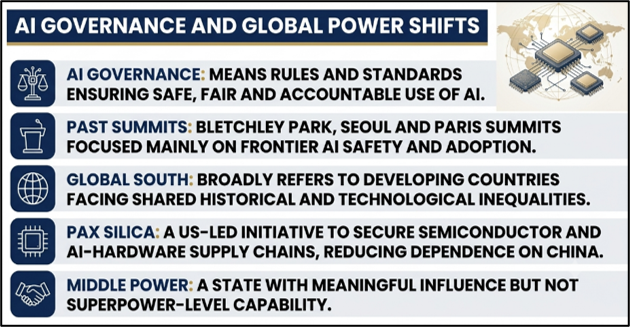
Recently, India hosted the India Artificial Intelligence (AI) Impact Summit 2026 in New Delhi with the theme “People, Planet, Progress”. The summit aimed to bring Global South concerns, such as equity, inclusion and real-world AI harms, into global AI governance debates.
Key Takeaways:
Explanation:
India’s Original Opportunity:
- India used the summit to highlight Global South concerns such as user safety, inclusion, regulatory capacity and unequal access to technology.
- The summit drew large participation and produced a declaration endorsed by many countries.
- This gave India a chance to lead a fairer AI governance agenda centred on real-world impact.
Shift Towards Middle Power Politics:
- India later began presenting itself as a “middle power” in AI diplomacy.
- This position may help attract investment and technology partnerships.
- However, it may weaken India’s image as a Global South leader.
- India’s colonial past, low per capita realities and development challenges still connect it strongly with developing countries.
Pax Silica and Strategic Autonomy:
- India joined Pax Silica during the summit period, signalling closer alignment with the United States-led technology bloc.
- This may support India’s access to semiconductor and AI supply chains.
- However, it also raises concerns that India may accept a pro-innovation regulatory approach at the cost of strategic autonomy.
Risk of AI Dependence:
- India may become mainly a market for foreign AI systems rather than a rule-maker.
- Indian data, labour, minerals, land, water and electricity may support foreign technology companies.
- Data centres have already raised concerns over land, power, water and local community impacts.
- India’s foundational AI model capacity remains limited, while semiconductor development is still focused on lower-value assembly.
Way Forward:
- India should use the United Nations (UN) Global Dialogue on AI to rebuild a Global South-centred agenda.
- It should promote cooperation on data, compute, standards, protocols and governance.
- Domestic AI ecosystems, user safety, consumer protection, skilling and regulatory capacity must be strengthened.
- AI development should serve public purpose and protect local communities from harm.
Conclusion:
India faces a choice between becoming a market for foreign AI and leading fair AI governance. Its strength lies in combining technical capacity with Global South credibility. AI policy must protect people, build domestic capability and preserve strategic autonomy.
Source: (The Hindu)
La Excellence IAS Academy, the best IAS coaching in Hyderabad, known for delivering quality content and conceptual clarity for UPSC 2026 preparation.
FOLLOW US ON:
◉ YouTube : https://www.youtube.com/@CivilsPrepTeam
◉ Facebook: https://www.facebook.com/LaExcellenceIAS
◉ Instagram: https://www.instagram.com/laexcellenceiasacademy/
GET IN TOUCH:
Contact us at info@laex.in, https://laex.in/contact-us/
or Call us @ +91 9052 29 2929, +91 9052 99 2929, +91 9154 24 2140
OUR BRANCHES:
Head Office: H No: 1-10-225A, Beside AEVA Fertility Center, Ashok Nagar Extension, VV Giri Nagar, Ashok Nagar, Hyderabad, 500020
Madhapur: Flat no: 301, survey no 58-60, Guttala begumpet Madhapur metro pillar: 1524, Rangareddy Hyderabad, Telangana 500081
Bangalore: Plot No: 99, 2nd floor, 80 Feet Road, Beside Poorvika Mobiles, Chandra Layout, Attiguppe, Near Vijaya Nagara, Bengaluru, 560040