
Paper: GS – I, Subject: Society and Social Justice, Topic: Urbanisation – Problems and remedies, Issue: Urban Flooding and the Need for Sponge Cities.
Context:
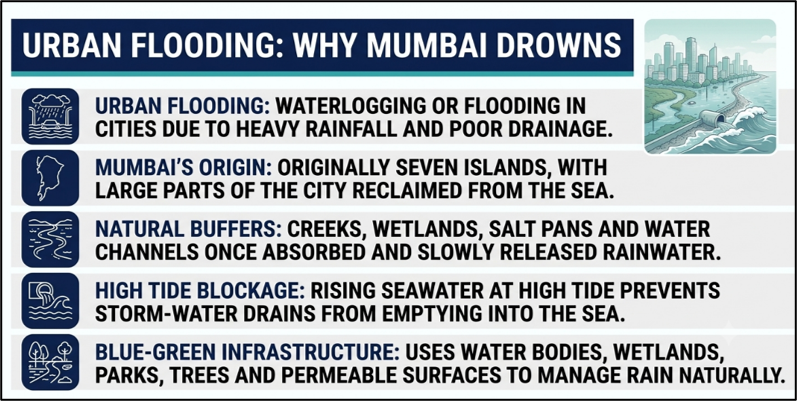
Recently, heavy rainfall in Mumbai caused flooding in roads, homes and low-lying areas, leading to deaths, transport delays and closure of educational institutions. The crisis shows that urban flooding is not only caused by heavy rain, but also by poor planning, loss of natural drainage and weak climate resilience.
Key Takeaways:
Explanation:
Why Mumbai Floods Repeatedly?
- Many parts of Mumbai lie only a few metres above sea level.
- Rapid construction has disturbed old water channels and natural drainage routes.
- During intense rainfall, water tries to flow through these old routes, causing flooding in areas such as Hindmata, Kurla, Sion and parts of the western suburbs.
- Low-lying neighbourhoods are more vulnerable because water collects there quickly.
Limits of Drainage-Based Solutions:
- After the 2005 floods, Mumbai installed pumping stations and improved weather forecasting.
- However, the drainage system is still unable to manage short and intense rainfall events.
- The storm-water drainage system depends mainly on gravity to carry water into the sea.
- When heavy rainfall occurs during high tide, seawater blocks the outfall and pushes water back into the city.
Climate Change and Extreme Rainfall:
- Cities are facing more frequent short-duration, high-intensity rainfall events.
- Traditional drainage systems alone cannot fully protect cities from such extreme weather.
- Urban planning must therefore shift from simply removing water quickly to absorbing, storing and slowly releasing it.
Lessons from Other Countries:
- China’s Sponge City policy focuses on increasing the water-retention capacity of cities.
- It promotes permeable pavements, restored wetlands, artificial lakes and rainwater storage.
- Cities in the Netherlands use water squares, which collect rainwater during heavy rainfall and serve as public spaces in dry periods.
- Green roofs are also encouraged because they absorb rainwater and reduce runoff.
Way Forward for Indian Cities:
- Wetlands, lakes, creeks and salt pans should be restored and protected.
- Roads, pavements and public spaces should use permeable materials wherever possible.
- Parks, lakes, green roofs and water squares should become part of urban design.
- Housing, transport and commercial projects must be planned without blocking natural drainage.
- City flood planning should combine drainage, forecasting, pumping stations and blue-green infrastructure.
Conclusion:
Urban flooding is not merely a natural disaster; it is also a result of how cities are built. Mumbai and other Indian cities must learn to absorb rain, not only drain it. Climate-resilient planning is essential for safer urban growth.
Source: (The Indian Express)
La Excellence IAS Academy, the best IAS coaching in Hyderabad, known for delivering quality content and conceptual clarity for UPSC 2026 preparation.
FOLLOW US ON:
◉ YouTube : https://www.youtube.com/@CivilsPrepTeam
◉ Facebook: https://www.facebook.com/LaExcellenceIAS
◉ Instagram: https://www.instagram.com/laexcellenceiasacademy/
GET IN TOUCH:
Contact us at info@laex.in, https://laex.in/contact-us/
or Call us @ +91 9052 29 2929, +91 9052 99 2929, +91 9154 24 2140
OUR BRANCHES:
Head Office: H No: 1-10-225A, Beside AEVA Fertility Center, Ashok Nagar Extension, VV Giri Nagar, Ashok Nagar, Hyderabad, 500020
Madhapur: Flat no: 301, survey no 58-60, Guttala begumpet Madhapur metro pillar: 1524, Rangareddy Hyderabad, Telangana 500081
Bangalore: Plot No: 99, 2nd floor, 80 Feet Road, Beside Poorvika Mobiles, Chandra Layout, Attiguppe, Near Vijaya Nagara, Bengaluru, 560040