
Paper: GS – III, Subject: Environment and Ecology, Topic: Renewable Energy, Issue: Brazil’s Ethanol Model and India’s Biofuel Transition (Ethanol Blending Programme).
Context:
India is rapidly increasing ethanol blending in petrol to reduce crude oil imports, improve energy security and promote cleaner transportation. Brazil’s long-term success in ethanol adoption demonstrates that a stable policy framework, strong infrastructure, consumer choice, and technological innovation are essential for building a sustainable biofuel ecosystem.
Key Takeaways:
Explanation:
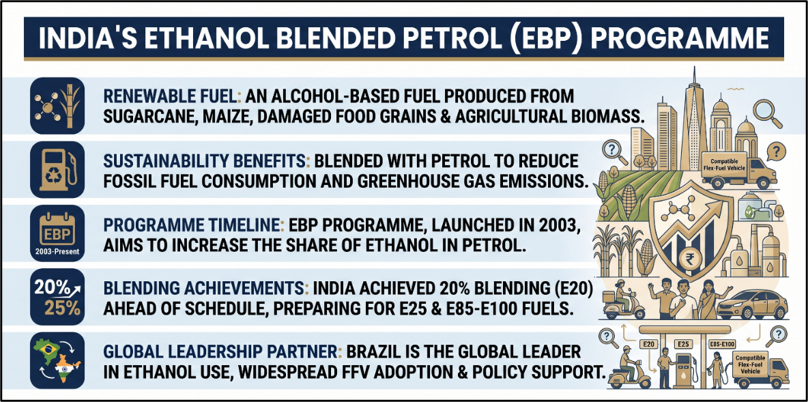
Why is Ethanol Blending Important?
- Ethanol reduces dependence on imported crude oil, strengthening India’s energy security.
- It lowers greenhouse gas emissions and supports India’s climate commitments.
- It creates an additional market for agricultural produce, increasing farmers’ incomes.
- Domestic biofuel production generates rural employment and supports the circular economy.
How Did Brazil Build a Successful Ethanol Ecosystem?
- Brazil adopted ethanol gradually through consistent policies over several decades.
- It developed dedicated infrastructure for production, storage, and nationwide fuel distribution.
- The country promoted Flex-Fuel Vehicles (FFVs) that can operate on petrol, ethanol, or any mixture of both.
- Consumers were given the freedom to choose fuels based on market prices, increasing public acceptance.
- Automobile manufacturers and fuel retailers expanded together, ensuring smooth adoption.
India’s Progress:
- The EBP Programme has significantly increased ethanol blending from low single digits to 20% nationally.
- India is promoting E20-compatible vehicles while encouraging investment in ethanol production.
- Policies such as the National Policy on Biofuels, 2018 (amended) support diversified feedstocks and advanced biofuels.
Challenges Before India
- Existing vehicles and fuel infrastructure are not fully compatible with higher ethanol blends.
- Ethanol has lower energy content than petrol, which may slightly reduce fuel efficiency.
- Large-scale ethanol production requires sustainable feedstock without affecting food security or water resources.
- Consumer awareness, vehicle availability, and fuel distribution networks need further strengthening.
The Way Forward:
- Expand ethanol infrastructure and dedicated dispensing stations across the country.
- Encourage manufacturing of affordable FFVs and higher-blend compatible vehicles.
- Promote second-generation (2G) ethanol from agricultural residues to avoid pressure on food crops.
- Ensure long-term policy stability, transparent pricing, and consumer awareness to support wider adoption.
Conclusion:
Ethanol blending is an important pillar of India’s clean energy transition, but its long-term success depends on a balanced approach that combines infrastructure development, technological innovation, sustainable feedstock management, and consumer confidence. A gradual, well-planned transition can help India achieve both energy security and environmental sustainability.
Source: (The Indian Express)
La Excellence IAS Academy, the best IAS coaching in Hyderabad, known for delivering quality content and conceptual clarity for UPSC 2026 preparation.
FOLLOW US ON:
◉ YouTube : https://www.youtube.com/@CivilsPrepTeam
◉ Facebook: https://www.facebook.com/LaExcellenceIAS
◉ Instagram: https://www.instagram.com/laexcellenceiasacademy/
GET IN TOUCH:
Contact us at info@laex.in, https://laex.in/contact-us/
or Call us @ +91 9052 29 2929, +91 9052 99 2929, +91 9154 24 2140
OUR BRANCHES:
Head Office: H No: 1-10-225A, Beside AEVA Fertility Center, Ashok Nagar Extension, VV Giri Nagar, Ashok Nagar, Hyderabad, 500020
Madhapur: Flat no: 301, survey no 58-60, Guttala begumpet Madhapur metro pillar: 1524, Rangareddy Hyderabad, Telangana 500081
Bangalore: Plot No: 99, 2nd floor, 80 Feet Road, Beside Poorvika Mobiles, Chandra Layout, Attiguppe, Near Vijaya Nagara, Bengaluru, 560040