
Paper: GS-II, Subject: International Relations, Topic: India’s relations with other nations, Issue: India–Japan Defence Partnership in a Changing Asian Order
Context
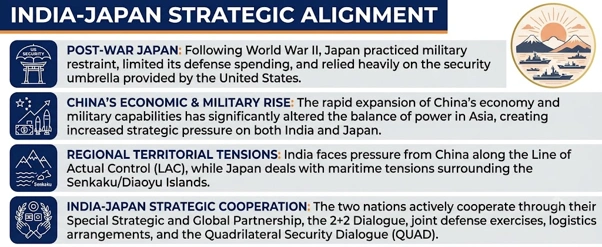
Recently, Japanese Defence Minister Shinjiro Koizumi’s visit to India highlighted the need to give greater substance to India–Japan defence ties. The visit comes amid China’s growing power, Japan’s rapid security transformation and uncertainty over the future scale of United States commitments in Asia.
Explanation
Why Japan’s Transformation Matters
- Japan is undergoing a structural security shift, not merely increasing defence spending.
- It is developing counterstrike capabilities, missile defence, cyber, unmanned systems and longer-range military capacity.
- Japan is also easing defence export restrictions and strengthening its defence industrial base, making security cooperation a normal tool of statecraft.
- This shift is driven by China’s rise and by concern that the United States may expect allies to carry a greater share of defence burdens.
Why India–Japan Cooperation Must Deepen
- India and Japan face different forms of Chinese pressure, but both seek a stable and balanced Indo-Pacific.
- India’s position in the Indian Ocean and Japan’s position in the western Pacific give their partnership strong geographical complementarity.
- Japan’s deeper defence ties with Australia show that India–Japan cooperation still remains below its potential.
Existing Cooperation and Gaps
- The two countries conduct JIMEX, Dharma Guardian, Veer Guardian and Malabar exercises.
- The Acquisition and Cross-Servicing Agreement (ACSA) improves logistical support and operational reach.
- The UNICORN naval communications antenna project marks progress towards defence co-development.
- However, joint research, co-production and technology cooperation remain limited.
Way Forward
- Cooperation should expand in anti-submarine warfare, maritime domain awareness, air defence, logistics and emerging technologies.
- Joint exercises should focus more on interoperability and operational coordination.
- Defence co-development should support India’s Atmanirbhar Bharat goals while preserving strategic autonomy.
Conclusion
India and Japan already share strategic convergence, but the relationship now needs greater operational, technological and industrial depth. India must match Japan’s growing strategic urgency so that the partnership becomes a stronger pillar of a stable, multipolar Indo-Pacific.
Source: (The Indian Express)
La Excellence IAS Academy, the best IAS coaching in Hyderabad, known for delivering quality content and conceptual clarity for UPSC 2026 preparation.
FOLLOW US ON:
◉ YouTube : https://www.youtube.com/@CivilsPrepTeam
◉ Facebook: https://www.facebook.com/LaExcellenceIAS
◉ Instagram: https://www.instagram.com/laexcellenceiasacademy/
GET IN TOUCH:
Contact us at info@laex.in, https://laex.in/contact-us/
or Call us @ +91 9052 29 2929, +91 9052 99 2929, +91 9154 24 2140
OUR BRANCHES:
Head Office: H No: 1-10-225A, Beside AEVA Fertility Center, Ashok Nagar Extension, VV Giri Nagar, Ashok Nagar, Hyderabad, 500020
Madhapur: Flat no: 301, survey no 58-60, Guttala begumpet Madhapur metro pillar: 1524, Rangareddy Hyderabad, Telangana 500081
Bangalore: Plot No: 99, 2nd floor, 80 Feet Road, Beside Poorvika Mobiles, Chandra Layout, Attiguppe, Near Vijaya Nagara, Bengaluru, 560040