
Paper: GS-II, Subject: Polity, Topic: Federalism, Issue: Mines and Minerals Bill, 2026 and State Taxation Powers
Context
Recently, Parliament passed the Mines and Minerals (Development and Regulation) Amendment Bill, 2026. Mineral-rich States have opposed its restrictions on their taxation powers, raising concerns about revenue loss and fiscal federalism.
Explanation
Key developments
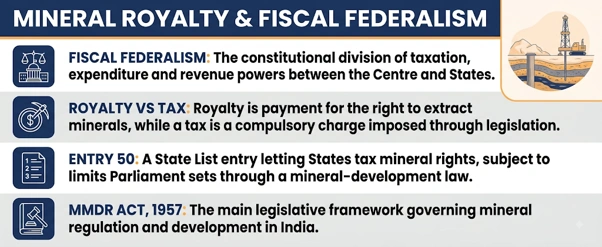
- In Mineral Area Development Authority v. Steel Authority of India, 2024, the Supreme Court held that royalty is not a tax.
- It recognised the States’ power to tax mineral rights and mineral-bearing land under Entries 50 and 49 of the State List.
- The 2026 Bill permits State taxes and cesses only under conditions or restrictions prescribed by the Central Government.
- It also invalidates unpaid or unrecovered past demands, while protecting amounts already collected by State governments.
Centre’s rationale
- Multiple and non-uniform State levies can create an unpredictable fiscal burden and discourage investment in mining.
- Higher extraction costs can make coal, iron ore and limestone expensive, raising infrastructure costs and contributing to inflation.
- A uniform framework can provide certainty, stability and predictability to mining companies and support domestic mineral production.
Concerns of States
- Mineral-rich States depend considerably on royalty, cesses and other mining revenue for development and welfare expenditure.
- They also bear local costs such as displacement, deforestation, pollution, land degradation and pressure on public infrastructure.
- Restricting taxes on mineral-bearing land may affect State powers under Entry 49, which Parliament cannot ordinarily limit through mineral regulation.
- Leaving important taxation conditions to Central rules may also raise concerns about excessive delegation and reduced State autonomy.
Way forward
- The Centre should frame transparent fiscal limits after meaningful consultation with mineral-producing States.
- A predictable taxation system must ensure fair compensation for environmental damage and mining-affected communities.
Conclusion
The Bill seeks national uniformity and investment certainty but may weaken State fiscal autonomy. A framework based on cooperative federalism, constitutional balance and equitable revenue-sharing is essential for sustainable mineral development.
Source: (The Indian Express)
La Excellence IAS Academy, the best IAS coaching in Hyderabad, known for delivering quality content and conceptual clarity for UPSC 2026 preparation.
FOLLOW US ON:
◉ YouTube : https://www.youtube.com/@CivilsPrepTeam
◉ Facebook: https://www.facebook.com/LaExcellenceIAS
◉ Instagram: https://www.instagram.com/laexcellenceiasacademy/
GET IN TOUCH:
Contact us at info@laex.in, https://laex.in/contact-us/
or Call us @ +91 9052 29 2929, +91 9052 99 2929, +91 9154 24 2140
OUR BRANCHES:
Head Office: H No: 1-10-225A, Beside AEVA Fertility Center, Ashok Nagar Extension, VV Giri Nagar, Ashok Nagar, Hyderabad, 500020
Madhapur: Flat no: 301, survey no 58-60, Guttala begumpet Madhapur metro pillar: 1524, Rangareddy Hyderabad, Telangana 500081
Bangalore: Plot No: 99, 2nd floor, 80 Feet Road, Beside Poorvika Mobiles, Chandra Layout, Attiguppe, Near Vijaya Nagara, Bengaluru, 560040