
Paper: GS-II, Subject: International Relations, Topic: Agreements involving India and/or affecting India’s Interests, Issue: India’s Role in the Changing West Asia Security Order
Context
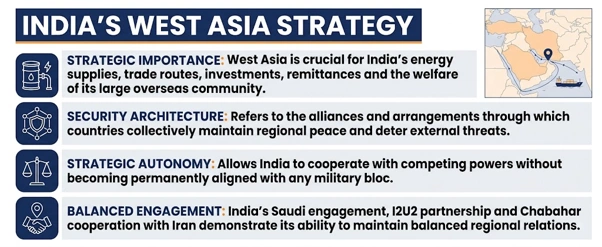
Recently, escalating regional conflicts and emerging defence partnerships involving Saudi Arabia, Türkiye and Pakistan have altered West Asia’s strategic balance. India must reassess its regional policy to protect its growing economic and security interests.
Explanation
Key Developments and Implications
- Gulf countries are questioning the traditional American security umbrella amid growing threats from both Iran and Israel.
- The United Arab Emirates favours engagement with Iran, while Saudi Arabia is considering deterrence through stronger security partnerships.
- Pakistan’s mediation between Iran and the United States has increased its diplomatic visibility and influence in the region.
- A Saudi–Türkiye–Pakistan partnership could combine Saudi finance, Pakistan’s military strength and Türkiye’s defence technology.
- Changing American politics also makes permanent United States support for Israel less certain, complicating India’s reliance on Israeli strength.
Challenges for India
- Excessive dependence on Israel and the UAE could weaken India’s relations with Iran, Saudi Arabia and other Arab countries.
- Growing UAE–Saudi differences and the UAE’s involvement in regional conflicts create additional uncertainty for Indian interests.
- Remaining passive exposes Indian sailors, energy shipments and trade passing through the Strait of Hormuz and Bab-el-Mandeb.
- India’s inability to protect nearby maritime interests could weaken its credibility as an emerging global power.
Way Forward
- India should strengthen high-level engagement with Saudi Arabia while preserving balanced relations with Israel, Iran and the UAE.
- It can promote confidence-building between Iran and Arab countries without formally presenting itself as a mediator.
- Cooperation with Egypt can help protect India-bound shipping between the Suez Canal and Bab-el-Mandeb.
- A diplomatic back-channel with Türkiye can communicate India’s concerns regarding its military relationship with Pakistan.
- A Special Envoy for West Asia can coordinate India’s diplomatic, diaspora, economic and maritime interests.
Conclusion
India has not lost West Asia, but it risks losing diplomatic initiative. Strategic autonomy must now be supported by sustained diplomacy, maritime capability and bridge-building among competing regional powers.
Source: (The Hindu)
La Excellence IAS Academy, the best IAS coaching in Hyderabad, known for delivering quality content and conceptual clarity for UPSC 2026 preparation.
FOLLOW US ON:
◉ YouTube : https://www.youtube.com/@CivilsPrepTeam
◉ Facebook: https://www.facebook.com/LaExcellenceIAS
◉ Instagram: https://www.instagram.com/laexcellenceiasacademy/
GET IN TOUCH:
Contact us at info@laex.in, https://laex.in/contact-us/
or Call us @ +91 9052 29 2929, +91 9052 99 2929, +91 9154 24 2140
OUR BRANCHES:
Head Office: H No: 1-10-225A, Beside AEVA Fertility Center, Ashok Nagar Extension, VV Giri Nagar, Ashok Nagar, Hyderabad, 500020
Madhapur: Flat no: 301, survey no 58-60, Guttala begumpet Madhapur metro pillar: 1524, Rangareddy Hyderabad, Telangana 500081
Bangalore: Plot No: 99, 2nd floor, 80 Feet Road, Beside Poorvika Mobiles, Chandra Layout, Attiguppe, Near Vijaya Nagara, Bengaluru, 560040